
捷克共和国邻里致胖性建成环境暴露方面的社会差异。
Social disparities in exposures to neighbourhood obesogenic built environments in Czechia.
作者信息
Bartoskova Polcrova Anna, Lam Thao Minh, Pikhart Hynek, Lakerveld Jeroen
机构信息
RECETOX, Faculty of Science, Masaryk University, Kotlarska 2, 611 37 Brno, Czech Republic.
Department of Epidemiology and Data Science, Amsterdam University Medical Centers Vrije Universiteit Amsterdam, Meibergdreef 9, Amsterdam 1105 AZ, The Netherlands.
出版信息
J Public Health (Oxf). 2025 Aug 29;47(3):436-445. doi: 10.1093/pubmed/fdaf065.
BACKGROUND
Exposure to the environments with limited walkability and high density of unhealthy food outlets promotes obesity development and might cluster in disadvantaged neighbourhoods. This study examines the combined obesogenicity of urban neighbourhoods in Brno, and related socio-economic disparities.
METHODS
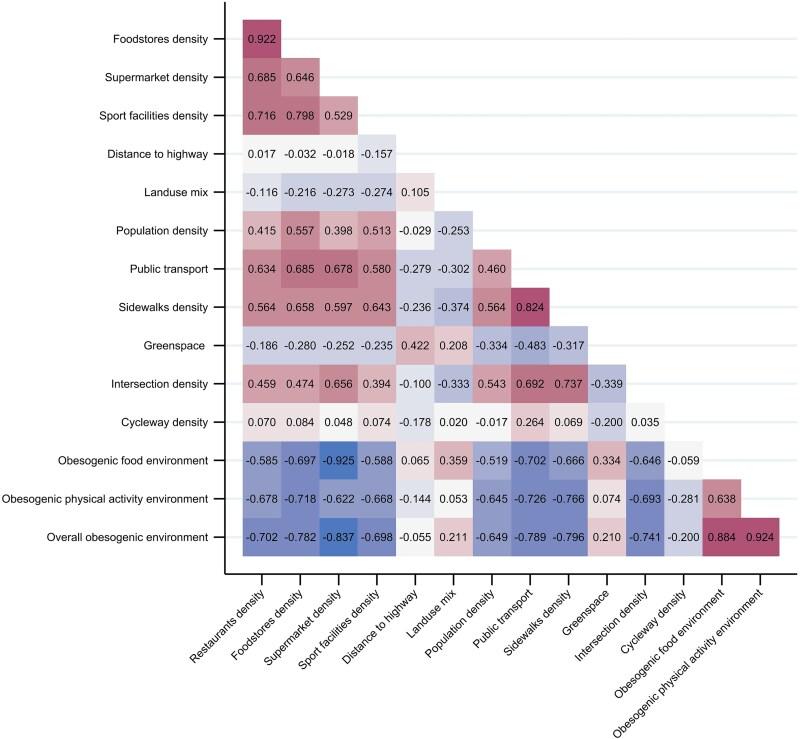
This study was conducted in Brno, the second-largest city in Czechia. The obesogenic index was calculated from 12 components of built food and physical activity environments for each of the 296 basic settlement units (BSUs) of Brno. The index ranged from 0 (low obesogenicity) to 100 (high obesogenicity). The social disparities were assessed using linear regression. Spatial clustering was assessed using the global Moran's Index.
RESULTS
The median obesogenic index score for Brno's 296 BSUs was 72.09 (IQR = 24.03), with higher scores in peripheral and industrial areas. Areas with higher proportion of people with university education had lower obesogenic scores of physical activity and overall obesogenic environment. Simultaneously, localities with higher unemployment exhibited lower obesogenic score in food and overall obesogenic environment.
CONCLUSION
Areas with lower levels of obesogenicity were primarily concentrated in central locations. No clear socio-economic gradient was observed, although proportion of university-educated inhabitants and unemployment rates were both associated with lower obesogenic environment scores.
背景
暴露于步行便利性有限且不健康食品销售点密集的环境中会促进肥胖的发展,且这种情况可能在弱势社区中集中出现。本研究考察了布尔诺市城区综合致肥胖因素以及相关的社会经济差异。
方法
本研究在捷克第二大城市布尔诺开展。从布尔诺296个基本居住单元(BSU)的建成环境中的食品和身体活动环境的12个组成部分计算致肥胖指数。该指数范围从0(低致肥胖性)到100(高致肥胖性)。使用线性回归评估社会差异。使用全局莫兰指数评估空间聚类。
结果
布尔诺296个基本居住单元的致肥胖指数得分中位数为72.09(四分位距 = 24.03),周边和工业区得分更高。大学学历人群比例较高的地区,身体活动的致肥胖得分和整体致肥胖环境得分较低。同时,失业率较高的地区,食品方面的致肥胖得分和整体致肥胖环境得分较低。
结论
致肥胖性较低的区域主要集中在市中心。尽管大学学历居民比例和失业率都与较低的致肥胖环境得分相关,但未观察到明显的社会经济梯度差异。


 Zotero 插件