
一项基于碘化丙啶的针对“昆虫盒”的筛选发现了强效抑制剂。
A propidium iodide-based screen of the "Bug Box" against reveals potent inhibitors.
作者信息
Dews Emmett A, Teixeira José E, Huston Christopher D, Meyers Marvin J, Hyson Peter R
机构信息
Department of Medicine, University of Vermont Larner College of Medicine, Burlington, Vermont, USA.
Department of Microbiology and Molecular Genetics Master's Program, University of Vermont, Burlington, Vermont, USA.
出版信息
Antimicrob Agents Chemother. 2025 Jul 2;69(7):e0003525. doi: 10.1128/aac.00035-25. Epub 2025 Jun 9.
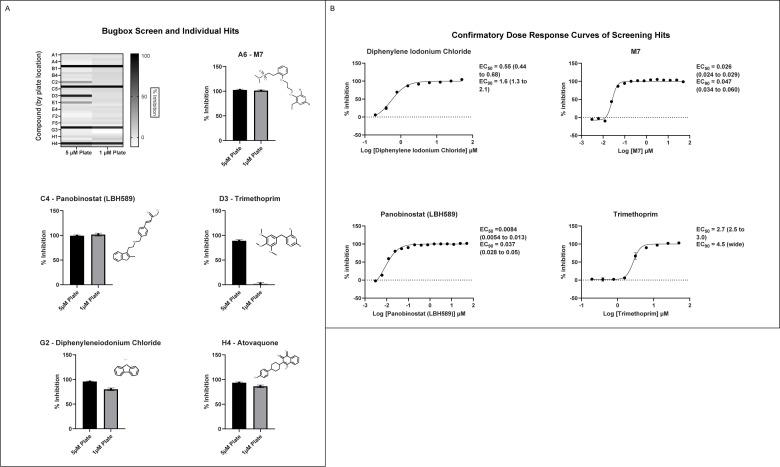
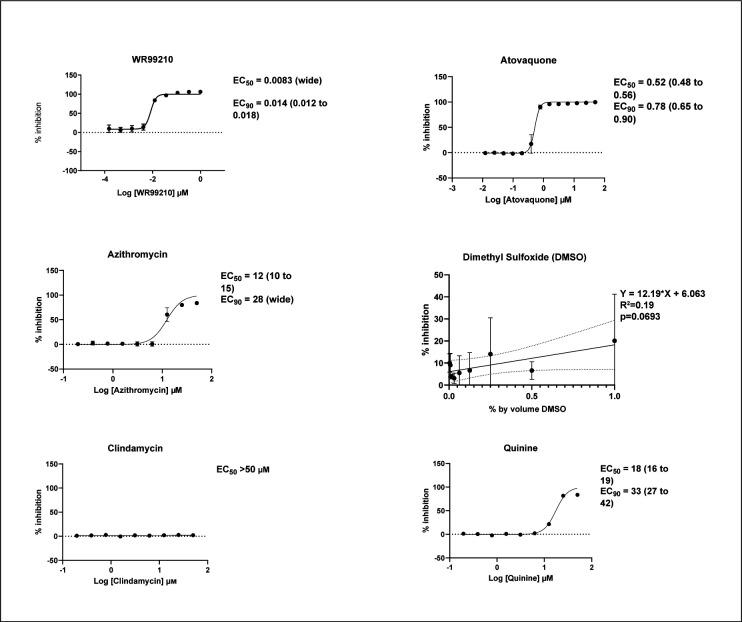
The incidence and endemic range of human babesiosis are expanding. Standard therapy for human babesiosis consists of antimicrobials developed for other indications. While these treatments are adequate in immunocompetent hosts, infections in the immunocompromised can be severe, relapsing, and drug-resistant despite the use of multi-drug regimens. Existing drugs are ineffective in the immunocompromised because they cannot achieve and maintain adequate serum concentrations to inhibit . Discovery of improved agents against spp. is of growing importance, and efficient techniques for high-throughput compound screening can assist in this effort. We developed a high-throughput drug screening assay for that is conducted in 384-well plates and makes use of the fluorescent DNA stain propidium iodide (PI) with relative fluorescence measured by a microplate reader. A Z' factor of 0.82 was calculated, which suggests an excellent ability to detect inhibitory compounds. A screen of the 41-compound library Structural Genomics Consortium Bug Box was conducted, yielding five hits: trimethoprim, atovaquone, SDDC M7, diphenyleneiodonium chloride, and panobinostat. Panobinostat, a histone deacetylase complex (HDAC) inhibitor, was selected for further evaluation given that its target had not been previously explored in . Dose-response testing of structurally related compounds revealed multiple potential leads, including nanatinostat and quisinostat, both of which were potent at the nanomolar level and showed favorable selectivity index in cytotoxicity studies. High-throughput screening using PI and 384-well plates is an advance in drug discovery for babesiosis, and HDAC inhibitors show promise as lead compounds worthy of further investigation.
人类巴贝斯虫病的发病率和流行范围正在扩大。人类巴贝斯虫病的标准治疗方法包括使用针对其他适应症开发的抗菌药物。虽然这些治疗方法对免疫功能正常的宿主足够有效,但免疫功能低下的患者感染后可能会很严重,出现复发且具有耐药性,尽管使用了多种药物联合治疗方案。现有药物对免疫功能低下的患者无效,因为它们无法达到并维持足够的血清浓度来抑制(相关病原体)。发现针对巴贝斯虫属物种的改良药物变得越来越重要,而高通量化合物筛选的有效技术可以助力这一工作。我们开发了一种针对巴贝斯虫的高通量药物筛选检测方法,该方法在384孔板中进行,并使用荧光DNA染料碘化丙啶(PI),通过微孔板读数仪测量相对荧光。计算得出的Z'因子为0.82,这表明该方法具有出色的检测抑制性化合物的能力。对41种化合物的结构基因组学联盟虫盒文库进行了筛选,产生了5个命中结果:甲氧苄啶、阿托伐醌、SDDC M7、二苯基碘鎓氯化物和帕比司他。鉴于其靶点此前未在巴贝斯虫中被探索过,选择了组蛋白去乙酰化酶复合物(HDAC)抑制剂帕比司他进行进一步评估。对结构相关化合物的剂量反应测试揭示了多个潜在的先导化合物,包括纳那司他和喹西司他,这两种化合物在纳摩尔水平上都具有活性,并且在细胞毒性研究中显示出良好的选择性指数。使用PI和384孔板进行高通量筛选是巴贝斯虫病药物发现方面的一项进展,HDAC抑制剂有望作为值得进一步研究的先导化合物。

 Zotero 插件