
有氧运动对癌症相关疲劳患者的影响:一项系统评价和荟萃分析。
The effects of aerobic exercise in patients with cancer-related fatigue: A systematic review and meta-analysis.
作者信息
Wang Tong, Deng Jiaxin, Li Weicheng, Zhang Qiubo, Yan Haoming, Liu Yongfeng
机构信息
School of Sports Training, Chengdu Sport University, Chengdu, Sichuan, China.
Primary School Attached to Chengdu Normal College, Chengdu, Sichuan, China.
出版信息
PLoS One. 2025 Jun 9;20(6):e0325100. doi: 10.1371/journal.pone.0325100. eCollection 2025.
BACKGROUND
Cancer-related fatigue (CRF) is characterized by an unusual and persistent sensation of tiredness that can occur during or after treatment, potentially impacting both physical and mental capability, and which does not ameliorate with rest. Aerobic exercise (AE) has been identified as a potent modality to mitigate the severity of CRF in such patients.
OBJECTIVE
This study aims to investigate the efficacy of AE in alleviating CRF among patients.
METHODS
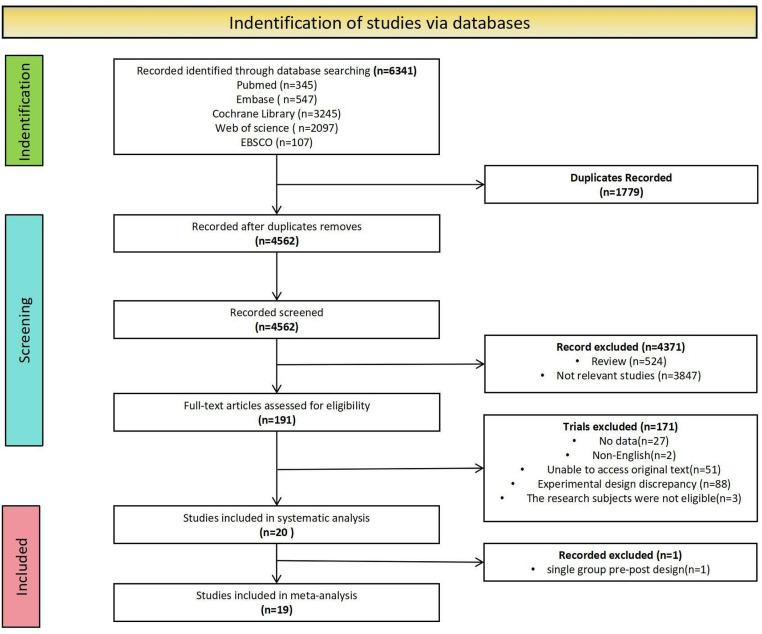
A comprehensive literature search was implemented on PubMed, Web of Science, EBSCO, Cochrane, and Embase until June 2024. Studies were selected based on the following PICOS criteria: Participants (P): cancer patients undergoing treatment or in recovery; Intervention (I): aerobic exercise, including activities such as walking, running, yoga, or tai chi; AE interventions conducted during both treatment and recovery were included. Comparison (C): usual care, no-treatment/wait-list, or attention/activity placebo controls; Outcome (O): cancer-related fatigue (CRF) measured by validated scales; Study design (S): randomized controlled trials (RCTs). The meta-analysis was performed using Review Manager 5.3.
RESULTS
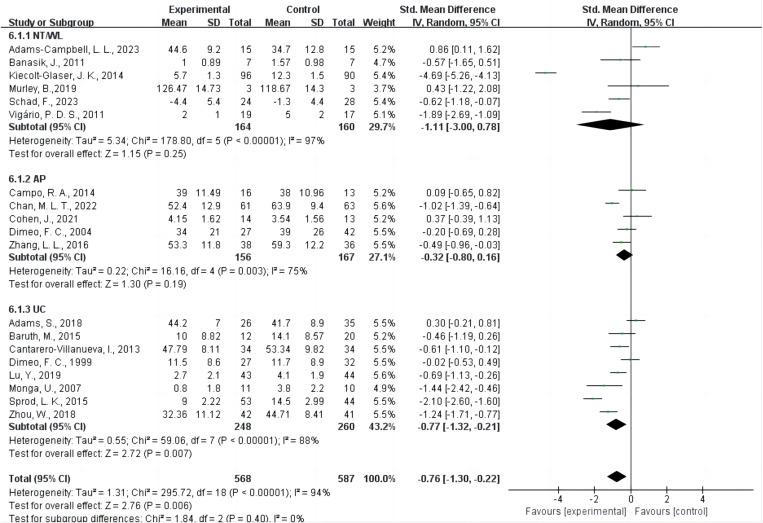
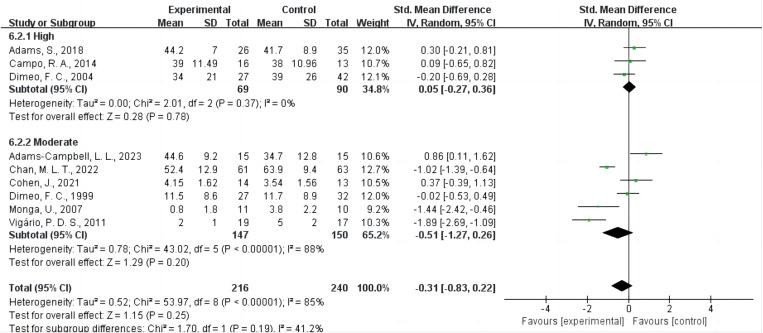
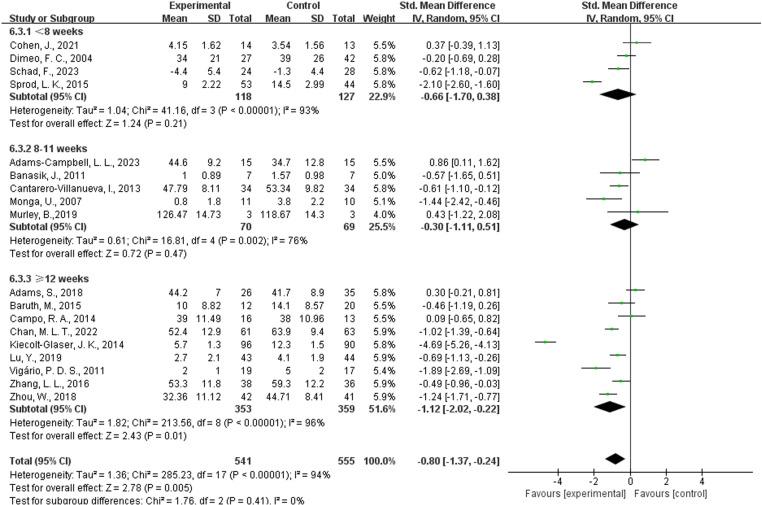
The results indicate that AE exerts a significant impact on CRF, but the heterogeneity is high (SMD = -0.76, 95% CI: -1.30 to -0.22, P < 0.05, I² = 94%). Subgroup analysis revealed that AE interventions lasting at least 12 weeks (SMD = -1.12, 95% CI = -2.02 ~ -0.22, P < 0.05, I² = 96%), 3 times or less per week (SMD = -1.00, 95% CI = -1.83 ~ -0.16, P < 0.05, I2 = 96%), with each session exceeding 60 minutes (SMD = -1.48, 95% CI = -2.32 ~ -0.64, P < 0.01, I2 = 96%), compared to the control group, significantly improve CRF in patients.
CONCLUSION
The research findings confirm the effectiveness of AE in alleviating CRF. Subgroup analysis further elucidated that AE interventions lasting at least 12 weeks, 3 times or less per week, with 60 minutes or more per session, significantly alleviated CRF among patients. However, given the limited number of included studies, caution is warranted in interpreting these subgroup analysis outcomes. The protocol for this review was duly registered on PROSPERO under the registration number CRD42024559098.
背景
癌症相关疲劳(CRF)的特征是在治疗期间或治疗后出现异常且持续的疲劳感,这可能会影响身体和心理能力,并且不会因休息而改善。有氧运动(AE)已被确定为减轻此类患者CRF严重程度的有效方式。
目的
本研究旨在探讨有氧运动在减轻患者CRF方面的疗效。
方法
截至2024年6月,在PubMed、科学网、EBSCO、考克兰图书馆和Embase上进行了全面的文献检索。根据以下PICOS标准选择研究:参与者(P):正在接受治疗或处于康复期的癌症患者;干预措施(I):有氧运动,包括散步、跑步、瑜伽或太极拳等活动;包括治疗期间和康复期间进行的有氧运动干预。对照(C):常规护理、无治疗/等待名单或注意力/活动安慰剂对照;结局(O):通过经过验证的量表测量的癌症相关疲劳(CRF);研究设计(S):随机对照试验(RCT)。使用Review Manager 5.3进行荟萃分析。
结果
结果表明,有氧运动对CRF有显著影响,但异质性较高(标准化均数差[SMD]=-0.76,95%可信区间:-1.30至-0.22,P<0.05,I²=94%)。亚组分析显示,与对照组相比,持续至少12周(SMD=-1.12,95%可信区间=-2.02至-0.22,P<0.05,I²=96%)、每周3次或更少(SMD=-1.00,95%可信区间=-1.83至-0.16,P<0.05,I²=96%)、每次运动超过60分钟(SMD=-1.48,95%可信区间=-2.32至-0.64,P<0.01,I²=96%)的有氧运动干预能显著改善患者的CRF。
结论
研究结果证实了有氧运动在减轻CRF方面的有效性。亚组分析进一步阐明,持续至少12周、每周3次或更少、每次运动60分钟或更长时间的有氧运动干预能显著减轻患者的CRF。然而,鉴于纳入研究的数量有限,在解释这些亚组分析结果时应谨慎。本综述方案已在PROSPERO上正式注册,注册号为CRD42024559098。



 Zotero 插件