
产生粒细胞集落刺激因子的皮肤鳞状细胞癌:一例报告及文献复习
Granulocyte colony-stimulating factor-producing cutaneous squamous cell carcinoma: A case report and literature review.
作者信息
Ishiguro Akihiro, Iwashita Nobuhiko, Otani Megumi, Watanabe Daisuke
机构信息
Department of Dermatology, Aichi Medical University, Nagakute, Aichi, Japan.
出版信息
Medicine (Baltimore). 2025 Jun 6;104(23):e42798. doi: 10.1097/MD.0000000000042798.
RATIONALE
Granulocyte colony-stimulating factor (G-CSF) leads to an abnormal increase in the white blood cell count and is associated with a poor prognosis due to accelerated progression of the G-CSF-producing tumors. G-CSF-producing tumors arising from skin malignancies are rare.
PATIENT CONCERNS
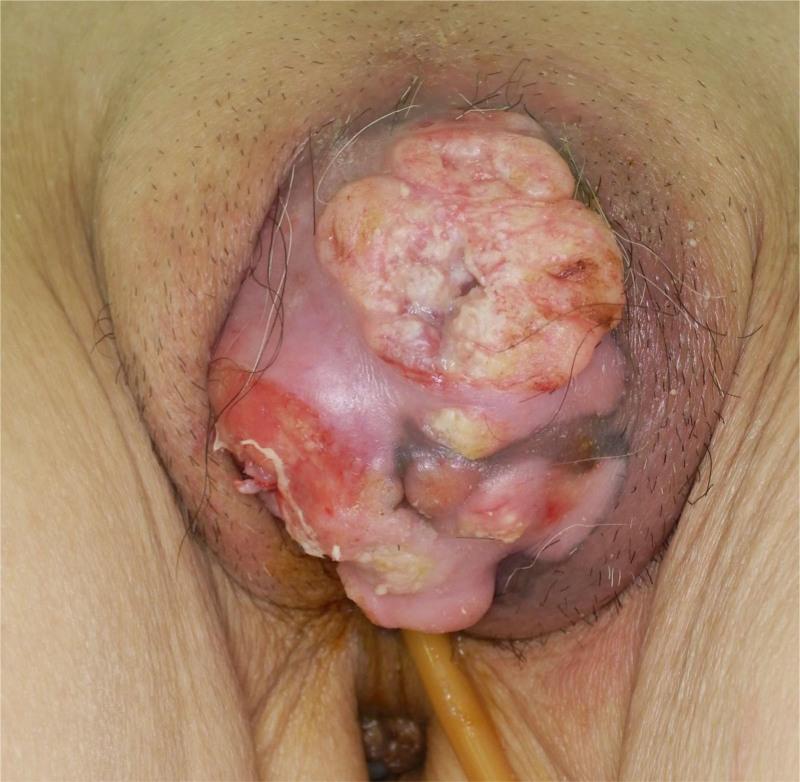
A 72-year-old female patient presented with a 6-cm skin tumor on the genital midline. Two biopsy specimens revealed condyloma acuminatum, but a total resection and bilateral inguinal lymph node dissection were performed because the tumor was suspected of being malignant.
DIAGNOSES
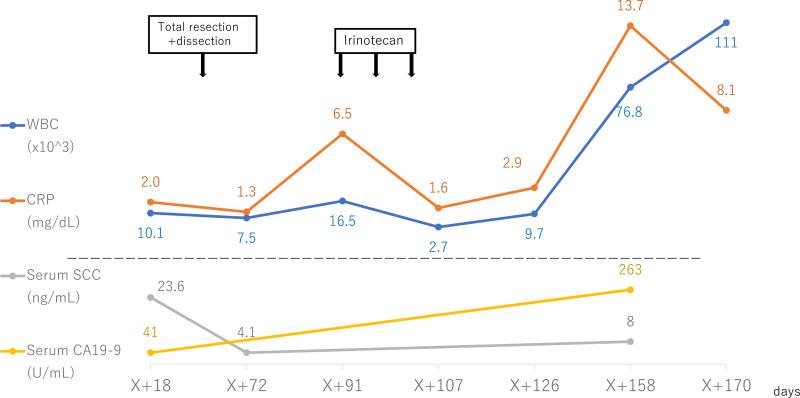
Histopathological analysis revealed poorly differentiated verrucous carcinoma with a lymph node metastasis. After the white blood cell count and G-CSF rose to 111,000/μL and 543 pg/mL, respectively, the tumor was diagnosed as a G-CSF-producing tumor. The patient died 8 months after her initial visit.
INTERVENTIONS
We summarize the previously reported cases of G-CSF-producing cutaneous squamous cell carcinoma (SCC).
OUTCOMES
The present report includes a review of 11 previous cases of G-CSF-producing cutaneous SCC, all of which occurred in Japanese patients. Compared with the typical SCC patient, the patients in the studies cited were relatively young, and the lesions tended to occur on the genitals or buttocks. The mean tumor length is 9.2 ± 4.8 cm, and many instances were much larger than typical cutaneous SCCs due to the very rapid growth of G-CSF-producing tumors. The histological type of these cases included poorly differentiated SCC and a special type of SCC with high malignancy potential. Only 2 of the 11 patients survived; the median overall survival of the deceased patients was 7.8 ± 6.4 months, which was indicative of an extremely poor prognosis.
LESSONS
The present case is the first to report a case of G-CSF-producing tumors developed from verrucous carcinoma and had an extremely poor prognosis. G-CSF-producing cutaneous SCC should be considered in the differential diagnoses of malignant lesions developing on the genitals or buttocks or having a histological type or growth rate indicating high malignancy.
理论依据
粒细胞集落刺激因子(G-CSF)会导致白细胞计数异常增加,并且由于产生G-CSF的肿瘤进展加速,其与预后不良相关。源自皮肤恶性肿瘤的产生G-CSF的肿瘤很罕见。
患者情况
一名72岁女性患者,在生殖器中线处出现一个6厘米的皮肤肿瘤。两份活检标本显示为尖锐湿疣,但由于怀疑肿瘤为恶性,故进行了全切除及双侧腹股沟淋巴结清扫术。
诊断
组织病理学分析显示为低分化疣状癌伴淋巴结转移。在白细胞计数和G-CSF分别升至111,000/μL和543 pg/mL后,该肿瘤被诊断为产生G-CSF的肿瘤。患者在初次就诊8个月后死亡。
干预措施
我们总结了先前报道的产生G-CSF的皮肤鳞状细胞癌(SCC)病例。
结果
本报告回顾了先前11例产生G-CSF的皮肤SCC病例,所有病例均发生在日本患者中。与典型的SCC患者相比,所引用研究中的患者相对年轻,病变往往发生在生殖器或臀部。平均肿瘤长度为9.2±4.8厘米,由于产生G-CSF的肿瘤生长非常迅速,许多病例比典型的皮肤SCC大得多。这些病例的组织学类型包括低分化SCC和具有高恶性潜能的特殊类型SCC。11例患者中仅2例存活;死亡患者的中位总生存期为7.8±6.4个月,这表明预后极差。
经验教训
本病例是首例报道由疣状癌发展而来的产生G-CSF的肿瘤,且预后极差。在鉴别诊断生殖器或臀部出现的恶性病变或具有提示高恶性的组织学类型或生长速度的病变时,应考虑产生G-CSF的皮肤SCC。
 Zotero 插件