
母乳喂养期间人乳中低聚糖的分泌动态及其抗菌作用:一项系统综述。
Human milk oligosaccharide secretion dynamics during breastfeeding and its antimicrobial role: A systematic review.
作者信息
Al-Beltagi Mohammed
机构信息
Department of Paediatrics, Faculty of Medicine, Tanta University, Tanta 31511, Alghrabia, Egypt.
Department of Pediatric, University Medical Center, King Abdulla Medical City, Arabian Gulf University, Manama 26671, Bahrain.
出版信息
World J Clin Pediatr. 2025 Jun 9;14(2):104797. doi: 10.5409/wjcp.v14.i2.104797.
BACKGROUND
Human milk oligosaccharides (HMOs) are bioactive components of breast milk with diverse health benefits, including shaping the gut microbiota, modulating the immune system, and protecting against infections. HMOs exhibit dynamic secretion patterns during lactation, influenced by maternal genetics and environmental factors. Their direct and indirect antimicrobial properties have garnered significant research interest. However, a comprehensive understanding of the secretion dynamics of HMOs and their correlation with antimicrobial efficacy remains underexplored.
AIM
To synthesize current evidence on the secretion dynamics of HMOs during lactation and evaluate their antimicrobial roles against bacterial, viral, and protozoal pathogens.
METHODS
A systematic search of PubMed, Scopus, Web of Science, and Cochrane Library focused on studies investigating natural and synthetic HMOs, their secretion dynamics, and antimicrobial properties. Studies involving human, animal, and models were included. Data on HMO composition, temporal secretion patterns, and mechanisms of antimicrobial action were extracted. Quality assessment was performed using validated tools appropriate for study design.
RESULTS
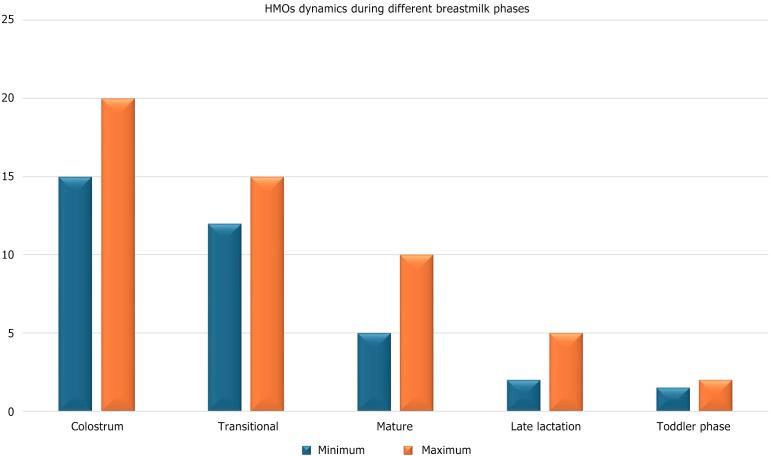
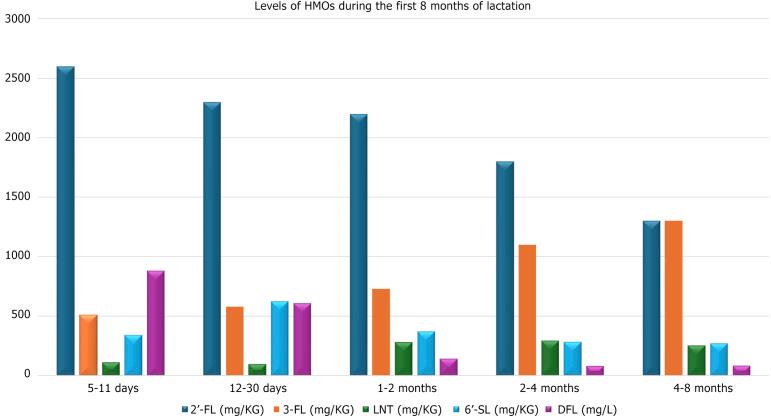
A total of 44 studies were included, encompassing human, animal, and research. HMOs exhibited dynamic secretion patterns, with 2'-fucosyllactose (2'-FL) and lacto-N-tetraose peaking in early lactation and declining over time, while 3-fucosyllactose (3-FL) increased during later stages. HMOs demonstrated significant antimicrobial properties through pathogen adhesion inhibition, biofilm disruption, and enzymatic activity impairment. Synthetic HMOs, including bioengineered 2'-FL and 3-FL, were structurally and functionally comparable to natural HMOs, effectively inhibiting pathogens such as , , and . Additionally, HMOs exhibited synergistic effects with antibiotics, enhancing their efficacy against resistant pathogens.
CONCLUSION
HMOs are vital in antimicrobial defense, supporting infant health by targeting various pathogens. Both natural and synthetic HMOs hold significant potential for therapeutic applications, particularly in infant nutrition and as adjuncts to antibiotics. Further research, including clinical trials, is essential to address gaps in knowledge, validate findings, and explore the broader applicability of HMOs in improving maternal and neonatal health.
背景
人乳寡糖(HMOs)是母乳中的生物活性成分,具有多种健康益处,包括塑造肠道微生物群、调节免疫系统和预防感染。HMOs在哺乳期表现出动态分泌模式,受母亲遗传和环境因素影响。它们的直接和间接抗菌特性引起了大量研究兴趣。然而,对HMOs分泌动态及其与抗菌功效的相关性仍缺乏全面了解。
目的
综合目前关于哺乳期HMOs分泌动态的证据,并评估它们对细菌、病毒和原生动物病原体的抗菌作用。
方法
对PubMed、Scopus、Web of Science和Cochrane图书馆进行系统检索,重点关注研究天然和合成HMOs、其分泌动态和抗菌特性的研究。纳入涉及人类、动物和模型的研究。提取有关HMO组成、时间分泌模式和抗菌作用机制的数据。使用适合研究设计的经过验证的工具进行质量评估。
结果
共纳入44项研究,涵盖人类、动物和研究。HMOs表现出动态分泌模式,2'-岩藻糖基乳糖(2'-FL)和乳糖-N-四糖在哺乳期早期达到峰值并随时间下降,而3-岩藻糖基乳糖(3-FL)在后期增加。HMOs通过抑制病原体粘附、破坏生物膜和损害酶活性表现出显著的抗菌特性。合成HMOs,包括生物工程2'-FL和3-FL,在结构和功能上与天然HMOs相当,有效抑制诸如、和等病原体。此外,HMOs与抗生素表现出协同作用,增强其对耐药病原体的疗效。
结论
HMOs在抗菌防御中至关重要,通过靶向各种病原体支持婴儿健康。天然和合成HMOs在治疗应用中都具有巨大潜力,特别是在婴儿营养和作为抗生素辅助剂方面。进一步的研究,包括临床试验,对于填补知识空白、验证研究结果以及探索HMOs在改善母婴健康方面的更广泛适用性至关重要。

 Zotero 插件