
导致无眼畸形和小眼畸形的遗传与环境因素:当前认识与未来方向
Genetic and environmental factors contributing to anophthalmia and microphthalmia: Current understanding and future directions.
作者信息
Goyal Shiwali, Tibrewal Shailja, Ratna Ria, Vanita Vanita
机构信息
Department of Ophthalmic Genetics and Visual Function Branch, National Eye Institute, Rockville, MD 20852, United States.
Department of Pediatric Ophthalmology, Dr. Shroff's Charity Eye Hospital, New Delhi 110002, Delhi, India.
出版信息
World J Clin Pediatr. 2025 Jun 9;14(2):101982. doi: 10.5409/wjcp.v14.i2.101982.
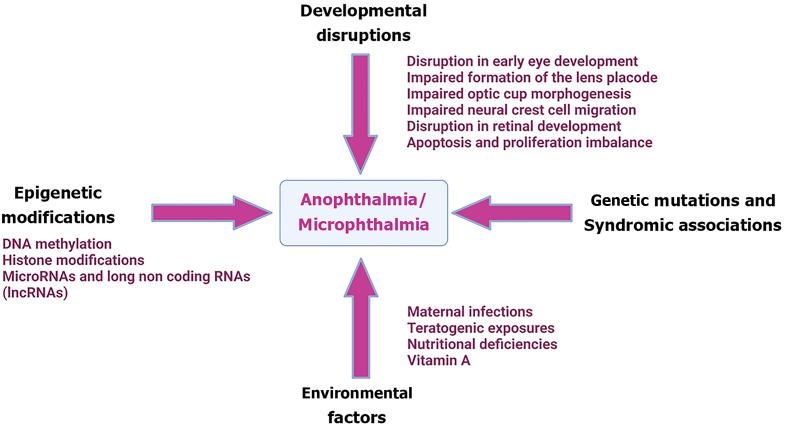
Anophthalmia is defined as a complete absence of one eye or both the eyes, while microphthalmia represents the presence of a small eye within the orbit. The estimated birth prevalence for anophthalmia is approximately 3 per 100000 live births, and for microphthalmia, it is around 14 per 100000 live births. However, combined evidence suggests that the prevalence of these malformations could be as high as 30 per 100000 individuals. Microphthalmia is reported to occur in 3.2% to 11.2% of blind children. Anophthalmia and microphthalmia (A/M) are part of a phenotypic spectrum alongside ocular coloboma, hypothesized to share a common genetic basis. Both A/M can occur in isolation or as part of a syndrome. Their complex etiology involves chromosomal aberrations, monogenic inheritance pattern, and the contribution of environmental factors such as gestational-acquired infections, maternal vitamin A deficiency (VAD), exposure to X-rays, solvent misuse, and thalidomide exposure. A/M exhibit significant clinical and genetic heterogeneity with over 90 genes identified so far. Familial cases of A/M have a complex genetic basis, including all Mendelian modes of inheritance, , autosomal dominant, recessive, and X-linked. Most cases arise sporadically due to mutations. Examining gene expression during eye development and the effects of various environmental variables will help us better understand the phenotypic heterogeneity found in A/M, leading to more effective diagnosis and management strategies. The present review focuses on key genetic factors, developmental abnormalities, and environmental modifiers linked with A/M. It also emphasizes at potential research areas including multiomic methods and disease modeling with induced pluripotent stem cell technologies, which aim to create innovative treatment options.
无眼症的定义是一只眼睛或双眼完全缺失,而小眼症是指眼眶内存在一只小眼睛。据估计,无眼症的出生患病率约为每10万例活产中有3例,小眼症约为每10万例活产中有14例。然而,综合证据表明,这些畸形的患病率可能高达每10万人中有30例。据报道,小眼症在3.2%至11.2%的盲童中出现。无眼症和小眼症(A/M)是与眼裂相关的表型谱系的一部分,推测它们有共同的遗传基础。A/M既可以单独出现,也可以作为综合征的一部分出现。它们复杂的病因涉及染色体畸变、单基因遗传模式以及环境因素的影响,如孕期感染、母体维生素A缺乏(VAD)、接触X射线、滥用溶剂和接触沙利度胺。A/M表现出显著的临床和遗传异质性,迄今已鉴定出90多个基因。A/M的家族病例有复杂的遗传基础,包括所有孟德尔遗传模式,即常染色体显性、隐性和X连锁。大多数病例是由于突变而散发出现的。研究眼睛发育过程中的基因表达以及各种环境变量的影响,将有助于我们更好地理解A/M中发现的表型异质性,从而制定更有效的诊断和管理策略。本综述重点关注与A/M相关的关键遗传因素、发育异常和环境修饰因子。它还强调了潜在的研究领域,包括多组学方法和诱导多能干细胞技术的疾病建模,旨在创造创新的治疗方案。
 Zotero 插件