
感染性脑小血管病发病机制综述。
Review of the mechanism of infection induced cerebral small vessel disease.
作者信息
Song Jiamei, Wang Yiqin, Xie Zhaoxia, Wei Jiayi, Wang Jue
机构信息
Department of Neurology, Shengjing Hospital of China Medical University, Shenyang, China.
Department of Developmental Cell Biology, Key Laboratory of Cell Biology, Ministry of Public Health, and Key Laboratory of Medical Cell Biology, Ministry of Education, China Medical University, Shenyang, China.
出版信息
Front Immunol. 2025 May 26;16:1594891. doi: 10.3389/fimmu.2025.1594891. eCollection 2025.
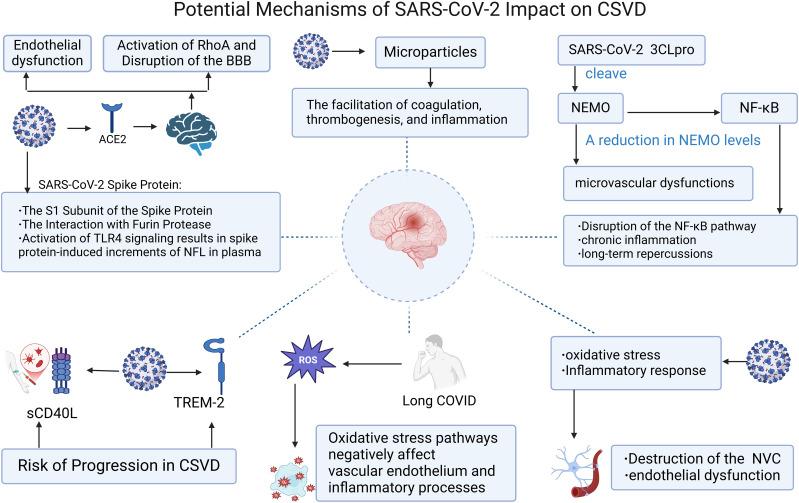
Cerebral small vessel disease (CSVD) refers to a group of pathological syndromes that affect the brain's microcirculation. These conditions involve damage to small arteries, arterioles, capillaries, venules, and small veins. Cerebrovascular risk factors, immunosenescence, and inflammatory responses contribute to the pathogenesis of cerebral small vessel disease. The global impact of Severe Acute Respiratory Syndrome Coronavirus 2 (SARS-CoV-2) has drawn significant attention to chronic inflammation caused by infections. Research into the mechanisms by which infections induce CSVD has made continual advancements. It is imperative to reassess the importance of managing infections and the chronic inflammatory phase that follows, highlighting their critical role in the pathogenesis. Our focus encompasses SARS-CoV-2, Human Immunodeficiency Virus (HIV), Hepatitis C Virus (HCV), Zika Virus(ZIKV), Treponema pallidum, as well as the microbial communities within the gut and oral cavity. These pathogen infections and chronic inflammation can contribute to CSVD through mechanisms such as neuroinflammation, blood-brain barrier disruption, microthrombosis, and endothelial cell damage, thereby promoting the occurrence and progression of the disease. This highlights the need for detailed mechanistic research on CSVD associated with these pathogens. Furthermore, we hope that in the future, we will be able to devise targeted prevention and treatment strategies for CSVD based on the unique characteristics of the pathogenic mechanisms associated with various infections.
脑小血管病(CSVD)是指影响脑微循环的一组病理综合征。这些病症涉及小动脉、小动脉、毛细血管、小静脉和小静脉的损伤。脑血管危险因素、免疫衰老和炎症反应促成了脑小血管病的发病机制。严重急性呼吸综合征冠状病毒2(SARS-CoV-2)的全球影响引起了人们对感染所致慢性炎症的高度关注。关于感染诱发CSVD机制的研究不断取得进展。重新评估控制感染及后续慢性炎症阶段的重要性势在必行,这凸显了它们在发病机制中的关键作用。我们关注的病原体包括SARS-CoV-2、人类免疫缺陷病毒(HIV)、丙型肝炎病毒(HCV)、寨卡病毒(ZIKV)、梅毒螺旋体,以及肠道和口腔内的微生物群落。这些病原体感染和慢性炎症可通过神经炎症、血脑屏障破坏、微血栓形成和内皮细胞损伤等机制导致CSVD,从而促进疾病的发生和发展。这凸显了对与这些病原体相关的CSVD进行详细机制研究的必要性。此外,我们希望未来能够根据与各种感染相关的致病机制的独特特征,设计出针对CSVD的预防和治疗策略。


 Zotero 插件