
HIV感染中的血栓形成和心血管事件(综述)
Thrombotic and cardiovascular events in HIV infection (Review).
作者信息
Dryllis Georgios, Vasilopoulou Mavra, Politou Marianna, Gerogkiokas Achilleas, Pittaras Theodoros, Zoumpourlis Vassilis, Spandidos Demetrios A, Gialeraki Argyri
机构信息
Laboratory of Reliability and Quality Control in Laboratory Hematology, Department of Biomedical Sciences, School of Health and Caring Sciences, University of West Attica, 12243 Athens, Greece.
Hemorrhage-Thrombosis-Transfusion Medicine, Department of Medicine, National and Kapodistrian University of Athens, 11527 Athens, Greece.
出版信息
Biomed Rep. 2025 May 21;23(1):122. doi: 10.3892/br.2025.2000. eCollection 2025 Jul.
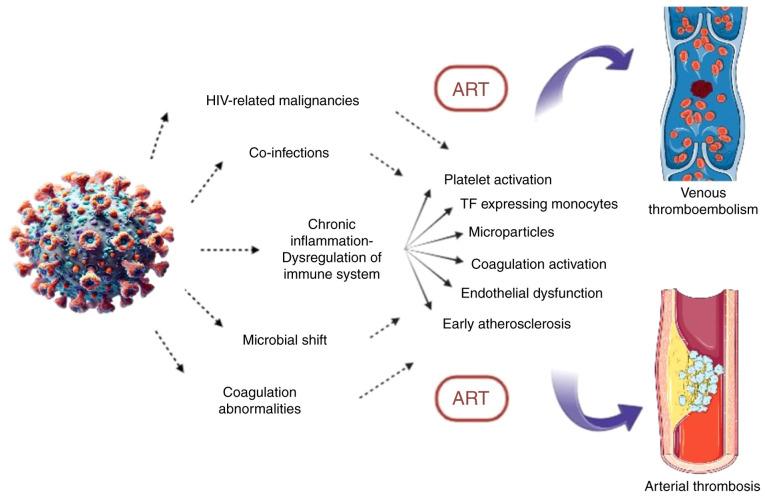
Human Immunodeficiency Virus (HIV) infection has nowadays become a chronic disease, due to the introduction of antiretroviral therapy (ART), which has improved both life expectancy and quality of life of patients with HIV but has also led to the emergence of previously unrecognized complications. Thromboembolic events constitute a serious and frequent comorbidity in patients with HIV. The thrombogenic potential of HIV infection is multifactorial and is attributed to persistent chronic inflammation, endothelial dysfunction and ART itself, mainly through the resulting metabolic alterations. Co-infections and gut microbe translocation observed in patients with HIV, also maintain the inflammatory prothrombotic microenvironment. Individuals with HIV are at higher risk for venous thromboembolism and cardiovascular disease, compared with general population. Among patients with HIV, those receiving specific ART regimens have a significant higher risk for myocardial infraction. HIV infection is also involved in other coagulation disorders, such as heparin-induced thrombocytopenia and thrombotic thrombocytopenic purpura. Therapeutic choices do not differ from individuals without HIV but should be cautiously administered due to drug interactions. Further studies are required in order to fully understand the pathophysiological mechanisms involved and develop new treatment options for patients with HIV.
由于抗逆转录病毒疗法(ART)的引入,人类免疫缺陷病毒(HIV)感染如今已成为一种慢性疾病。抗逆转录病毒疗法提高了HIV患者的预期寿命和生活质量,但也导致了一些先前未被认识到的并发症的出现。血栓栓塞事件是HIV患者中一种严重且常见的合并症。HIV感染的血栓形成潜能是多因素的,主要归因于持续的慢性炎症、内皮功能障碍以及抗逆转录病毒疗法本身,这主要是通过其导致的代谢改变。在HIV患者中观察到的合并感染和肠道微生物易位,也维持了促炎促血栓的微环境。与普通人群相比,HIV感染者发生静脉血栓栓塞和心血管疾病的风险更高。在HIV患者中,接受特定抗逆转录病毒疗法方案的患者发生心肌梗死的风险显著更高。HIV感染还与其他凝血障碍有关,如肝素诱导的血小板减少症和血栓性血小板减少性紫癜。治疗选择与非HIV感染者并无不同,但由于药物相互作用,应谨慎用药。需要进一步研究以充分了解其中涉及的病理生理机制,并为HIV患者开发新的治疗方案。
 Zotero 插件