
巴西初级医疗保健机构中孕妇的超加工食品消费情况。
Consumption of Ultraprocessed Foods Among Brazilian Pregnant Women Attended in Primary Healthcare.
作者信息
Silva Gabriele B, Silva Débora L F, C Franceschini Sylvia C, Macedo Mariana S, Almeida Claudia C B, Carvalho Carolina A, Pereira Renata J, da Silva Danielle G, Pizato Nathalia, Faria Franciane R, Sperandio Naiara, Barbosa Míriam C R, Navarro Anderson M, Crispim Sandra P
机构信息
Postgraduate Program in Food and Nutrition, Federal University of Paraná, Curitiba, Paraná, Brazil.
Postgraduate Program in Nutrition Science, Federal University of Viçosa, Viçosa, Minas Gerais, Brazil.
出版信息
J Nutr Metab. 2025 Jun 2;2025:4538910. doi: 10.1155/jnme/4538910. eCollection 2025.
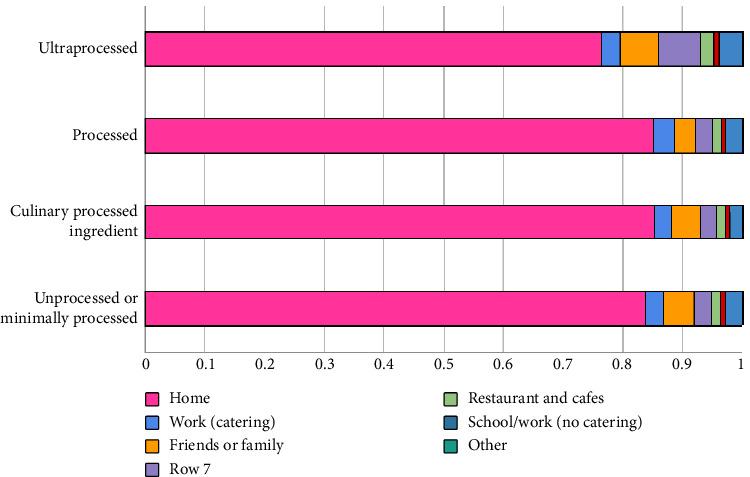
The objective of the study was to describe the dietary intake of Brazilian pregnant women assisted by primary healthcare, focusing on the degree of food processing. Data from the cross-sectional multicenter study of iodine deficiency were analyzed. Participants were selected from basic health units in 11 research centers and completed questionnaires regarding socioeconomic status, demographics, and health. Dietary intake information was collected through 24 h recall and analyzed using GloboDiet software. Descriptive analyses estimated the average energy contribution and confidence interval (%) of NOVA food groups in total energy intake, considering the research center, sociodemographic factors, health status, and pregnancy characteristics. The analysis included 2247 pregnant women without history of thyroid disease or surgery, hypothyroidism, or hypertension. Unprocessed or minimally processed foods accounted for 62.1% of total energy intake, while ultraprocessed foods accounted for 23.8%. Food consumption predominantly occurred at home across all NOVA food groups. Ultraprocessed food consumption was lower during lunch and dinner but higher after dinner and when consumed outside the home, particularly in street settings, markets, parks, and/or beaches, compared with other food groups. This pattern was more prevalent among younger pregnant women ( < 0.001), those of white or yellow race (=0.007), residing in urban areas (=0.03), and with higher monthly household income (=0.001). These findings indicate a significant impact on the overall nutritional quality of the diet among pregnant women, with variations based on factors such as age, place of residence, race, income, place of consumption, and occasion of consumption.
本研究的目的是描述接受初级医疗保健的巴西孕妇的饮食摄入情况,重点关注食品加工程度。对碘缺乏横断面多中心研究的数据进行了分析。参与者从11个研究中心的基层卫生单位中选取,并完成了关于社会经济地位、人口统计学和健康状况的问卷。通过24小时回忆法收集饮食摄入信息,并使用GloboDiet软件进行分析。描述性分析估计了考虑研究中心、社会人口学因素、健康状况和妊娠特征的情况下,新诺瓦食物组在总能量摄入中的平均能量贡献和置信区间(%)。分析纳入了2247名无甲状腺疾病或手术史、甲状腺功能减退或高血压的孕妇。未加工或最少加工的食物占总能量摄入的62.1%,而超加工食物占23.8%。所有新诺瓦食物组的食物消费主要在家中进行。与其他食物组相比,超加工食物在午餐和晚餐时的消费量较低,但在晚餐后以及在家外消费时,尤其是在街头、市场、公园和/或海滩消费时,消费量较高。这种模式在年轻孕妇(<0.001)、白种或黄种孕妇(=0.007)、居住在城市地区的孕妇(=0.03)以及家庭月收入较高的孕妇(=0.001)中更为普遍。这些发现表明,孕妇饮食的整体营养质量受到显著影响,且因年龄、居住地、种族、收入、消费地点和消费场合等因素而有所不同。


 Zotero 插件