
伴有镶嵌性SMARCB1缺失的复发性神经鞘瘤病:一例报告。
Recurrent schwannomatosis with mosaic SMARCB1 loss: A case report.
作者信息
Lakhina Yuliya, Lim Megan A, Yonk Marybeth G, Campbell Melissa, Tora Muhibullah S, Du Yuhong, Koshkin Sergei, Lei Kecheng, Boulis Nicholas M
机构信息
Department of Neurosurgery, Emory University School of Medicine, Atlanta, GA 30322, USA.
Carle Illinois College of Medicine, University of Illinois Urbana Champaign, Champaign, IL 61801, USA.
出版信息
Exp Ther Med. 2025 May 27;30(1):147. doi: 10.3892/etm.2025.12897. eCollection 2025 Jul.
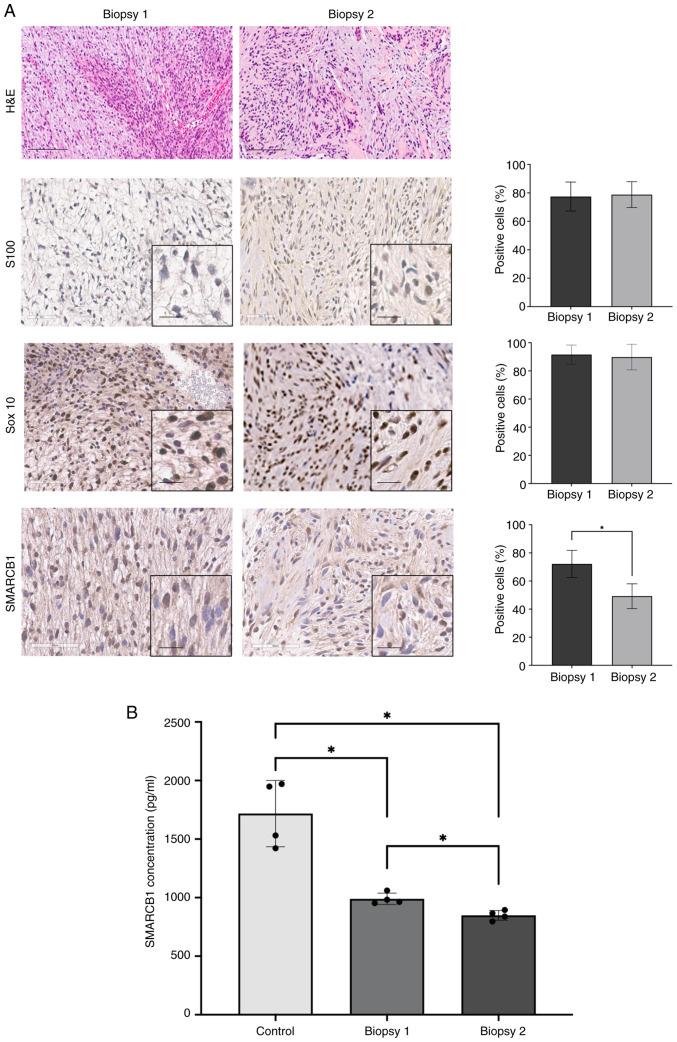
Schwannomatosis is a non-cancerous disorder causing peripheral nerve sheath tumors (schwannomas), often leading to chronic pain. It is linked to loss of SWI/SNF related, matrix associated, actin dependent regulator of chromatin subfamily B member 1 ( or leucine zipper-transcription regulator 1 gene function, though some patients may initially show minor mutations or no clinical signs, resulting in misdiagnosis, missed assessments, increased recurrence risk, unawareness of malignancy and overlooked genetic counseling during pregnancy. The present study reports a patient with a sporadic synonymous mutation in the gene [SNP in exon 8]. This patient, a 53-year-old female with an 8-year history of schwannomatosis, presented to the neurosurgical department for recurrent tumor removal. Tumor tissue was analyzed using immunohistochemistry, hematoxylin and eosin staining, and enzyme-linked immunosorbent assay. Initially, the clinical impact of the mutation on schwannomatosis was unclear. However, resected schwannomas showed 10-60% mosaic loss of nuclear protein, with protein assays confirming low levels, particularly in the distal thigh schwannoma. This case highlights the tumorigenic potential of single nucleotide polymorphisms, emphasizing the need for multimodal diagnosis, long-term follow-up, awareness of recurrence and malignancy, and timely surgical planning in schwannomatosis patients.
神经鞘瘤病是一种非癌性疾病,可导致周围神经鞘瘤(神经鞘瘤),常引发慢性疼痛。它与SWI/SNF相关、基质相关、肌动蛋白依赖性染色质调节因子B亚家族成员1(或亮氨酸拉链转录调节因子1)基因功能丧失有关,尽管有些患者最初可能表现出轻微突变或无临床症状,从而导致误诊、漏诊、复发风险增加、对恶性肿瘤认识不足以及孕期忽视遗传咨询。本研究报告了一名在该基因[外显子8中的单核苷酸多态性]存在散发性同义突变的患者。该患者为一名53岁女性,有8年神经鞘瘤病病史,因复发性肿瘤切除就诊于神经外科。使用免疫组织化学、苏木精和伊红染色以及酶联免疫吸附测定法对肿瘤组织进行了分析。最初,该突变对神经鞘瘤病的临床影响尚不清楚。然而,切除的神经鞘瘤显示核蛋白有10%-60%的镶嵌性缺失,蛋白质检测证实水平较低,尤其是在大腿远端神经鞘瘤中。该病例突出了单核苷酸多态性的致瘤潜力,强调了神经鞘瘤病患者进行多模式诊断、长期随访、认识复发和恶性肿瘤以及及时进行手术规划的必要性。


 Zotero 插件