
用于评估和预测非小细胞肺癌免疫治疗疗效的多模态成像技术进展
Advances in Multimodal Imaging Techniques for Evaluating and Predicting the Efficacy of Immunotherapy for NSCLC.
作者信息
Liu Jingyi, Xie Mei, Shen Jing, Yao Jie, Lin Xuwen, Bao Xinyu, Zhang Xin, Liang Yiran, Yang Yun, Jiang Gege, Diao Ximeng, Han Wenya, Du Hai, Xue Xinying, Wu Jianlin
机构信息
Department of Radiology, Affiliated Zhongshan Hospital of Dalian University, Dalian, 116001, People's Republic of China.
Department of Respiratory and Critical Care, Emergency and Critical Care Medical Center, Beijing Shijitan Hospital, Capital Medical University, Beijing, 100038, People's Republic of China.
出版信息
Cancer Manag Res. 2025 Jun 7;17:1073-1086. doi: 10.2147/CMAR.S522136. eCollection 2025.
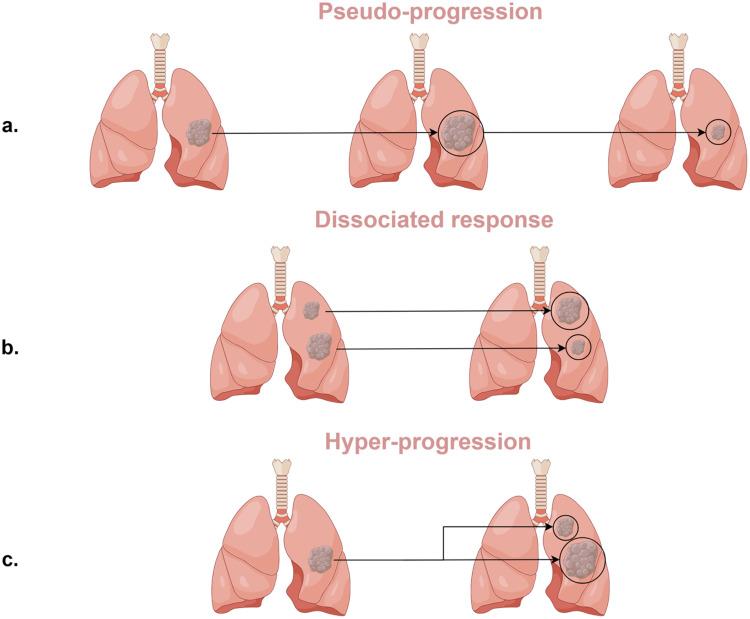
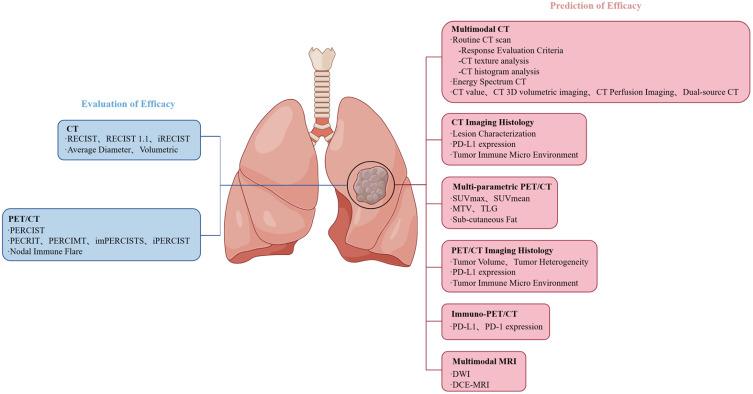
Immunotherapy has emerged as a transformative treatment for non-small cell lung cancer (NSCLC), yet its clinical benefits remain variable among patients. Early and accurate evaluation of treatment response is critical to guide therapeutic adjustments and improve outcomes. This review synthesizes recent advancements in multimodal imaging techniques-computed tomography (CT), positron emission tomography (PET)/CT, magnetic resonance imaging (MRI), and radiomics-for evaluating and predicting immunotherapy efficacy in NSCLC. We analyze the strengths and limitations of conventional morphological criteria (eg, RECIST, iRECIST) and highlight emerging quantitative biomarkers, including CT texture analysis, metabolic parameters (MTV, TLG), and diffusion-weighted MRI metrics. Notably, radiomics demonstrates promise in decoding tumor heterogeneity, PD-L1 expression, and immune microenvironment features, while immuno-PET probes targeting immune checkpoints offer novel insights into immune activity in vivo. Challenges such as pseudo-progression, nodal immune flare, and discrepancies between imaging responses and pathological responses are critically discussed. By integrating morphological, metabolic, and microenvironmental data, multimodal imaging enhances precision in patient stratification and therapeutic monitoring. Future research should prioritize multicenter, AI-driven radiomics validation and targeted tracer development to optimize NSCLC immunotherapy management. This review provides clinicians and researchers with new directions for utilizing multimodal imaging techniques in developing personalized treatment strategies.
免疫疗法已成为非小细胞肺癌(NSCLC)的一种变革性治疗方法,但其临床益处在患者中仍存在差异。早期准确评估治疗反应对于指导治疗调整和改善预后至关重要。本综述综合了多模态成像技术——计算机断层扫描(CT)、正电子发射断层扫描(PET)/CT、磁共振成像(MRI)和放射组学——在评估和预测NSCLC免疫治疗疗效方面的最新进展。我们分析了传统形态学标准(如RECIST、iRECIST)的优势和局限性,并强调了新兴的定量生物标志物,包括CT纹理分析、代谢参数(MTV、TLG)和扩散加权MRI指标。值得注意的是,放射组学在解码肿瘤异质性、PD-L1表达和免疫微环境特征方面显示出前景,而靶向免疫检查点的免疫PET探针为体内免疫活性提供了新的见解。本文还对伪进展、淋巴结免疫反应、成像反应与病理反应之间的差异等挑战进行了批判性讨论。通过整合形态学、代谢和微环境数据,多模态成像提高了患者分层和治疗监测的精准度。未来的研究应优先开展多中心、人工智能驱动的放射组学验证和靶向示踪剂开发,以优化NSCLC免疫治疗管理。本综述为临床医生和研究人员利用多模态成像技术制定个性化治疗策略提供了新的方向。
 Zotero 插件