
火灾烟雾提高了美国本土及加拿大南部地区的碳质颗粒物浓度和死亡负担。
Fire Smoke Elevated the Carbonaceous PM Concentration and Mortality Burden in the Contiguous U.S. and Southern Canada.
作者信息
Jin Zhihao, Ferrada Gonzalo A, Zhang Danlu, Scovronick Noah, Fu Joshua S, Chen Kai, Liu Yang
机构信息
Gangarosa Department of Environmental Health, Rollins School of Public Health, Emory University, Atlanta, Georgia 30322, United States.
Deparent of Civil and Environmental Engineering, University of Tennessee, Knoxville, Tennessee 37996, United States.
出版信息
Environ Sci Technol. 2025 Jun 24;59(24):12196-12210. doi: 10.1021/acs.est.5c01641. Epub 2025 Jun 12.
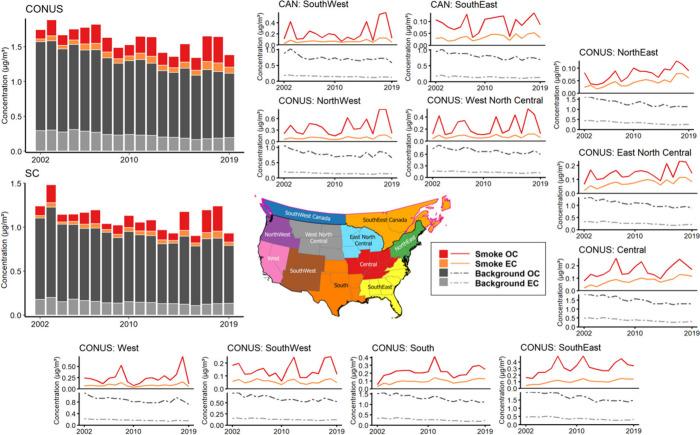
Despite emerging evidence on the health impacts of fine particulate matter (PM) from wildland fire smoke, the specific effects of PM composition on health outcomes remain uncertain. We developed a three-level, chemical transport model-based framework to estimate daily full-coverage concentrations of smoke-derived carbonaceous PM, specifically organic carbon (OC) and elemental carbon (EC), at a 1 × 1 km spatial resolution from 2002 to 2019 across the contiguous U.S. (CONUS) and Southern Canada (SC). A 10-fold random cross-validation confirmed robust performance, with daily = 0.77 (OC) and 0.80 (EC) in the smoke-off scenario and 0.67 (OC) and 0.71 (EC) in the smoke-on scenario, and exceeded 0.90 at the monthly scale after residual adjustment. Modeling results indicated that increases in wildland fire smoke have offset approximately one-third of the improvements in background air quality. In recent years, wildland fire smoke has become more frequent and carbonaceous PM concentrations have intensified, especially in the Western CONUS and Southwestern Canada. Wildfire season is also starting earlier and lengthens throughout the year, leading to more population being exposed. We estimated that long-term exposure to fire smoke carbonaceous PM is responsible for approximately 7455 and 259 non-accidental deaths annually in the CONUS and SC, respectively, with associated annual monetized damage of 68.3 billion USD for the CONUS and 1.9 billion CAD for SC. The Southeastern CONUS, where prescribed fires are prevalent, contributed most to these health impacts and monetized damages. Our findings offer critical insights to inform policy development and assess future health burdens associated with fire smoke exposure.
尽管有新证据表明野火烟雾中的细颗粒物(PM)对健康有影响,但PM成分对健康结果的具体影响仍不确定。我们开发了一个基于化学传输模型的三级框架,以估计2002年至2019年期间美国本土(CONUS)和加拿大南部(SC)1×1公里空间分辨率下烟雾衍生的含碳PM(特别是有机碳(OC)和元素碳(EC))的每日全覆盖浓度。10倍随机交叉验证证实了该模型的稳健性能,在无烟情景下,每日OC的 = 0.77,EC的 = 0.80;在有烟情景下,OC的 = 0.67,EC的 = 0.71,经残差调整后,月度尺度上超过0.90。建模结果表明,野火烟雾的增加抵消了背景空气质量改善的约三分之一。近年来,野火烟雾变得更加频繁,含碳PM浓度加剧,特别是在美国本土西部和加拿大西南部。野火季节也开始得更早,且全年延长,导致更多人口暴露。我们估计,长期暴露于火灾烟雾中的含碳PM分别导致美国本土和加拿大南部每年约7455例和259例非意外死亡,美国本土相关的年度货币化损失为683亿美元,加拿大南部为19亿加元。美国本土东南部规定火烧盛行,对这些健康影响和货币化损失贡献最大。我们的研究结果为政策制定提供了关键见解,并评估了与火灾烟雾暴露相关的未来健康负担。




 Zotero 插件