
基于RNA的癌症疫苗的当前进展与未来展望:2025年更新
Current Progress and Future Perspectives of RNA-Based Cancer Vaccines: A 2025 Update.
作者信息
Magoola Matthias, Niazi Sarfaraz K
机构信息
DEI Biopharma, Kampala P.O. Box 35854, Uganda.
College of Pharmacy, University of Illinois, Chicago, IL 60612, USA.
出版信息
Cancers (Basel). 2025 Jun 4;17(11):1882. doi: 10.3390/cancers17111882.
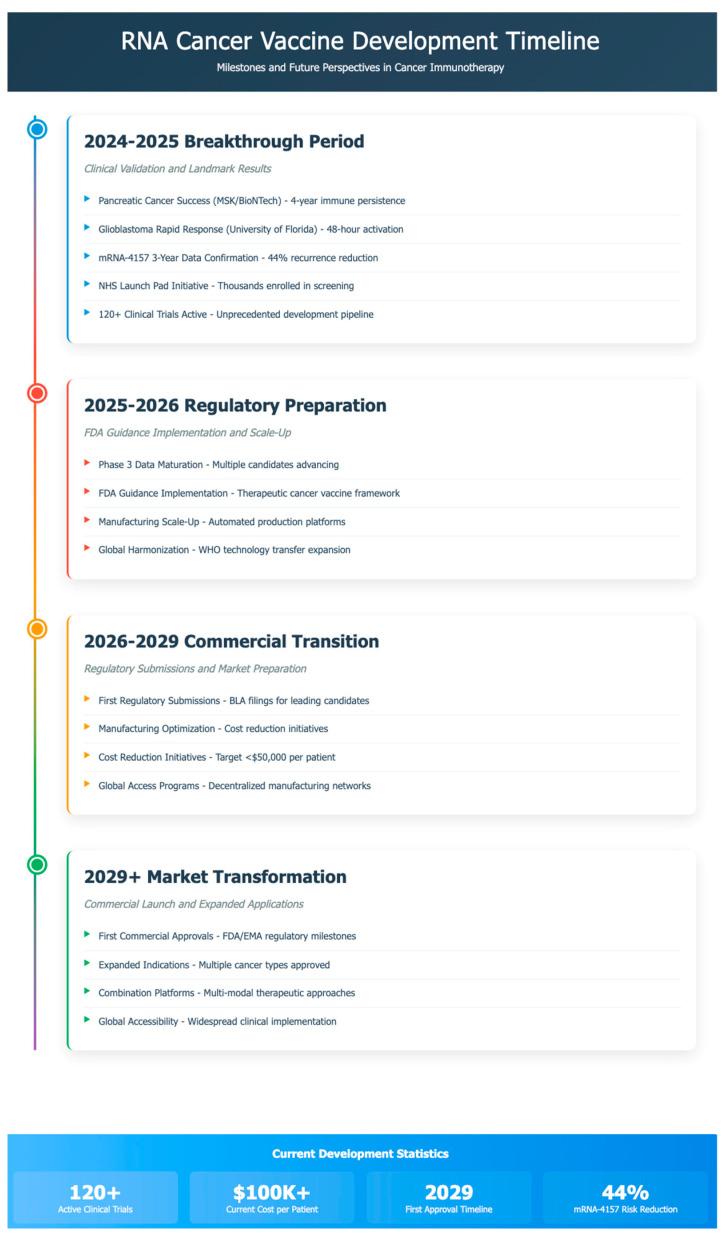
RNA-based cancer vaccines have emerged as transformative immunotherapeutic platforms, leveraging advances in mRNA technology and personalized medicine approaches. Recent clinical breakthroughs, particularly the success of mRNA-4157 combined with pembrolizumab in melanoma patients, have demonstrated significant improvements in efficacy, with a 44% reduction in recurrence risk compared to checkpoint inhibitor monotherapy. Breakthrough results from pancreatic cancer vaccines and novel glioblastoma treatments using layered nanoparticle delivery systems mark 2024-2025 as a pivotal period for RNA cancer vaccine development. Current RNA vaccine platforms include conventional mRNA, self-amplifying RNA, trans-amplifying RNA, and emerging circular RNA technologies, with over 120 clinical trials currently underway across various malignancies. Critical advances in delivery optimization include next-generation lipid nanoparticles with tissue-specific targeting and novel nanoengineered systems achieving rapid immune system reprogramming. Manufacturing innovations focus on automated platforms, reducing production timelines from nine weeks to under four weeks for personalized vaccines, while costs remain challenging at over $ 100,000 per patient. Artificial intelligence integration is revolutionizing neoantigen selection through advanced algorithms and CRISPR-enhanced platforms, while regulatory frameworks are evolving with new FDA guidance for therapeutic cancer vaccines. Non-coding RNA applications, including microRNA and long non-coding RNA therapeutics, represent emerging frontiers with potential for enhanced immune modulation. With over 60 candidates in clinical development and the first commercial approvals anticipated by 2029, RNA cancer vaccines are positioned to become cornerstone therapeutics in personalized oncology, offering transformative hope for cancer patients worldwide.
基于RNA的癌症疫苗已成为变革性的免疫治疗平台,它利用了mRNA技术和个性化医疗方法的进展。近期的临床突破,特别是mRNA-4157与帕博利珠单抗联合用于黑色素瘤患者所取得的成功,已显示出疗效上的显著改善,与检查点抑制剂单药治疗相比,复发风险降低了44%。胰腺癌疫苗以及使用层状纳米颗粒递送系统的新型胶质母细胞瘤治疗方法所取得的突破性成果,标志着2024年至2025年是RNA癌症疫苗开发的关键时期。当前的RNA疫苗平台包括传统mRNA、自我扩增RNA、转扩增RNA以及新兴的环状RNA技术,目前有超过120项针对各种恶性肿瘤的临床试验正在进行中。递送优化方面的关键进展包括具有组织特异性靶向的下一代脂质纳米颗粒以及能够实现免疫系统快速重编程的新型纳米工程系统。制造创新聚焦于自动化平台,将个性化疫苗的生产时间从九周缩短至四周以内,不过每位患者的成本仍高达十多万美元,颇具挑战性。人工智能整合正通过先进算法和CRISPR增强平台彻底改变新抗原的选择,同时监管框架也随着美国食品药品监督管理局(FDA)对治疗性癌症疫苗的新指南而不断演变。非编码RNA的应用,包括微小RNA和长链非编码RNA疗法,代表着具有增强免疫调节潜力的新兴前沿领域。随着60多个候选药物进入临床开发阶段,预计到2029年将首次获得商业批准,RNA癌症疫苗有望成为个性化肿瘤学的基石疗法,为全球癌症患者带来变革性的希望。
 Zotero 插件