
利用人工智能和机器学习识别与作物种子质量性状相关的数量性状基因座(QTL)
Harnessing Artificial Intelligence and Machine Learning for Identifying Quantitative Trait Loci (QTL) Associated with Seed Quality Traits in Crops.
作者信息
Kassem My Abdelmajid
机构信息
Plant Genomics and Bioinformatics Lab, Department of Biological and Forensic Sciences, Fayetteville State University, Fayetteville, NC 28301, USA.
出版信息
Plants (Basel). 2025 Jun 5;14(11):1727. doi: 10.3390/plants14111727.
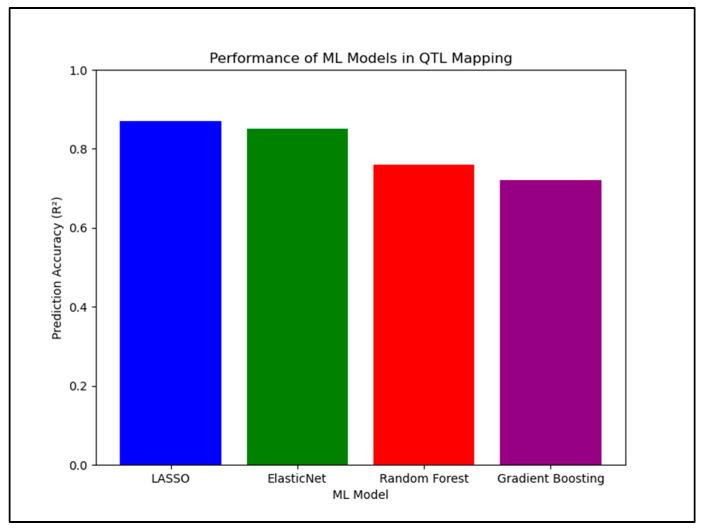
Seed quality traits, such as seed size, oil and protein content, mineral accumulation, and morphological characteristics, are crucial for enhancing crop productivity, nutritional value, and marketability. Traditional quantitative trait loci (QTL) mapping methods, such as linkage analysis and genome-wide association studies (GWAS), have played fundamental role in identifying loci associated with these complex traits. However, these approaches often struggle with high-dimensional genomic data, polygenic inheritance, and genotype-by-environment (GXE) interactions. Recent advances in artificial intelligence (AI) and machine learning (ML) provide powerful alternatives that enable more accurate trait prediction, robust marker-trait associations, and efficient feature selection. This review presents an integrated overview of AI/ML applications in QTL mapping and seed trait prediction, highlighting key methodologies such as LASSO regression, Random Forest, Gradient Boosting, ElasticNet, and deep learning techniques including convolutional neural networks (CNNs) and graph neural networks (GNNs). A case study on soybean seed mineral nutrients accumulation illustrates the effectiveness of ML models in identifying significant SNPs on chromosomes 8, 9, and 14. LASSO and ElasticNet consistently achieved superior predictive accuracy compared to tree-based models. Beyond soybean, AI/ML methods have enhanced QTL detection in wheat, lettuce, rice, and cotton, supporting trait dissection across diverse crop species. I also explored AI-driven integration of multi-omics data-genomics, transcriptomics, metabolomics, and phenomics-to improve resolution in QTL mapping. While challenges remain in terms of model interpretability, biological validation, and computational scalability, ongoing developments in explainable AI, multi-view learning, and high-throughput phenotyping offer promising avenues. This review underscores the transformative potential of AI in accelerating genomic-assisted breeding and developing high-quality, climate-resilient crop varieties.
种子质量性状,如种子大小、油和蛋白质含量、矿物质积累以及形态特征,对于提高作物产量、营养价值和市场适销性至关重要。传统的数量性状位点(QTL)定位方法,如连锁分析和全基因组关联研究(GWAS),在识别与这些复杂性状相关的位点方面发挥了重要作用。然而,这些方法在处理高维基因组数据、多基因遗传以及基因型与环境(GXE)相互作用时常常面临困难。人工智能(AI)和机器学习(ML)的最新进展提供了强大的替代方法,能够实现更准确的性状预测、稳健的标记-性状关联以及高效的特征选择。本文综述了AI/ML在QTL定位和种子性状预测中的综合应用,重点介绍了关键方法,如套索回归、随机森林、梯度提升、弹性网络,以及深度学习技术,包括卷积神经网络(CNN)和图神经网络(GNN)。一项关于大豆种子矿物质营养积累的案例研究说明了ML模型在识别8号、9号和14号染色体上显著单核苷酸多态性(SNP)方面的有效性。与基于树的模型相比,套索回归和弹性网络始终具有更高的预测准确性。除了大豆,AI/ML方法还增强了小麦、生菜、水稻和棉花中的QTL检测,支持了对多种作物品种性状的剖析。我还探讨了AI驱动下多组学数据(基因组学、转录组学、代谢组学和表型组学)的整合,以提高QTL定位的分辨率。尽管在模型可解释性、生物学验证和计算可扩展性方面仍存在挑战,但可解释AI、多视图学习和高通量表型分析的不断发展提供了有前景的途径。本文综述强调了AI在加速基因组辅助育种以及培育高质量、适应气候变化作物品种方面的变革潜力。

 Zotero 插件