
用户与医疗服务提供者分享可穿戴活动追踪器数据的体验与态度:一项横断面研究。
User Experiences and Attitudes Toward Sharing Wearable Activity Tracker Data with Healthcare Providers: A Cross-Sectional Study.
作者信息
Szeto Kimberley, Maher Carol, Curtis Rachel G, Singh Ben, Cain Tara, Beckett Darcy, Ferguson Ty
机构信息
Alliance for Research in Exercise, Nutrition and Activity, UniSA Allied Health and Human Performance, University of South Australia, Adelaide, SA 5001, Australia.
出版信息
Healthcare (Basel). 2025 May 22;13(11):1215. doi: 10.3390/healthcare13111215.
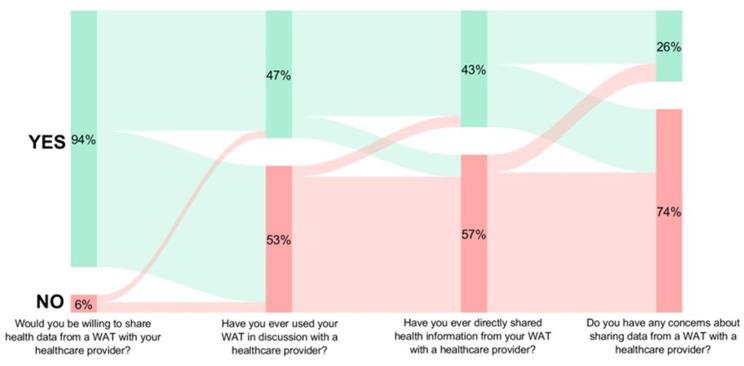
: Wearable activity trackers (WATs) are increasingly used by individuals to monitor physical activity, sleep, and other health behaviors. Integrating WAT data into clinical care may offer a cost-effective strategy to support health behavior change. However, little is known about users' willingness to share their WAT data with healthcare providers. This study aimed to explore attitudes and experiences of WAT users regarding the sharing of WAT data with healthcare providers and to examine how these vary according to user characteristics. : An international online cross-sectional survey was conducted on adults who had used a WAT within the past three years. The survey assessed user demographics, usage patterns, experiences of sharing data with healthcare providers, and willingness or concerns regarding data sharing. Multivariate logistic regression was used to examine associations between user characteristics and data-sharing experiences or attitudes. : 447 participants completed the survey (60.0% female; 83.9% < 45 years; 60.0% from the United States). Most (94%) participants expressed willingness to share WAT data with healthcare providers, 47% had discussed it, and 43% had shared WAT data in clinical settings. Privacy was the most commonly reported concern, cited by 10% of participants. Participants with chronic health conditions were more likely to have shared or discussed WAT data, but also more likely to report concerns. Geographic differences were also observed, with Australian participants less likely to have shared or discussed their WAT data with providers, and US participants reporting fewer privacy concerns. : The high willingness to share WAT data suggests that there is a possibility for integrating patient-owned WATs into clinical care. Addressing privacy concerns and equipping healthcare professionals with the skills to use WAT data will be essential to fully realize this opportunity. These findings highlight the need for further development of secure WAT systems, clinician training, and expanded evidence on WATs' clinical utility.
可穿戴活动追踪器(WATs)越来越多地被个人用于监测身体活动、睡眠及其他健康行为。将WAT数据整合到临床护理中可能提供一种具有成本效益的策略来支持健康行为改变。然而,对于用户与医疗服务提供者分享其WAT数据的意愿知之甚少。本研究旨在探讨WAT用户对于与医疗服务提供者分享WAT数据的态度和经历,并研究这些态度和经历如何因用户特征而异。
对过去三年内使用过WAT的成年人进行了一项国际在线横断面调查。该调查评估了用户的人口统计学特征、使用模式、与医疗服务提供者分享数据的经历以及对数据共享的意愿或担忧。采用多变量逻辑回归分析来研究用户特征与数据共享经历或态度之间的关联。
447名参与者完成了调查(女性占60.0%;83.9%年龄小于45岁;60.0%来自美国)。大多数(94%)参与者表示愿意与医疗服务提供者分享WAT数据,47%的人曾讨论过此事,43%的人曾在临床环境中分享过WAT数据。隐私是最常被提及的担忧,10%的参与者提到了这一点。患有慢性健康问题的参与者更有可能分享或讨论过WAT数据,但也更有可能报告担忧。还观察到了地域差异,澳大利亚参与者与医疗服务提供者分享或讨论WAT数据的可能性较小,而美国参与者报告的隐私担忧较少。
分享WAT数据的意愿较高,这表明将患者拥有的WAT整合到临床护理中是有可能的。解决隐私担忧并使医疗专业人员具备使用WAT数据的技能对于充分实现这一机会至关重要。这些发现凸显了进一步开发安全的WAT系统、开展临床医生培训以及扩大关于WAT临床效用的证据的必要性。

 Zotero 插件