
失代偿性心力衰竭患者腿部热疗联合标准心脏康复的对照临床试验。
A controlled clinical trial of leg thermal therapy in conjunction with standard cardiac rehabilitation in patients with decompensated heart failure.
作者信息
Ogino Tomoyuki, Kondo Hideyuki, Okada Makoto, Tanaka Hiroyuki
机构信息
Department of Physical Therapy, Hyogo Medical University, Japan.
Department of General Medicine and Community Health Science, Sasayama Medical Center Hyogo Medical University: 5 Kurooka, Tanbasasayama, Hyogo 669-2321, Japan.
出版信息
J Phys Ther Sci. 2025 Jun;37(6):262-269. doi: 10.1589/jpts.37.262. Epub 2025 Jun 1.
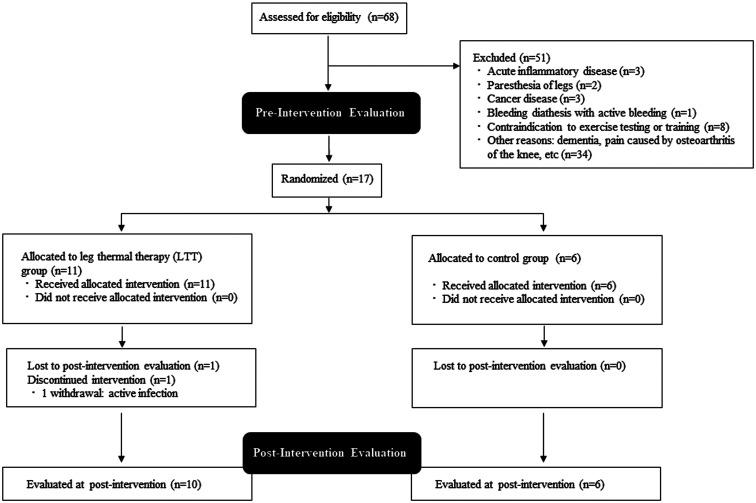
[Purpose] Leg thermal therapy (LTT) using far-infrared-ray dry sauna stimulation improves hemodynamics in patients with heart failure (HF); however, its additive effect when combined with cardiac rehabilitation (CR) remains unknown. This study aimed to investigate whether incorporating LTT into acute-phase CR confers exercise capacity in hospitalized patients with HF. [Participants and Methods] Seventeen patients with decompensated HF (median age 75 years) admitted between June 2018 and November 2019 were prospectively assigned to the CR plus LTT (11 participants) or the CR group (6 participants). Both groups performed structured exercise sessions for 40 min, five times a week. The LTT group received additional leg heating at 45°C for 20 min. Cardiopulmonary function and blood tests were performed before and after the intervention. [Results] At one month, peak oxygen uptake was equal between groups. However, anaerobic threshold oxygen uptake increased in the CR plus LTT group, noradrenaline levels decreased, and no complications were observed. [Conclusion] The addition of LTT to CR did not improve overall exercise capacity in hospitalized patients with HF, but it contributes to specific physiological improvements. Hence, this could be a potential approach to optimize cardiac rehabilitation for patients with decompensated HF.
[目的] 使用远红外线干蒸刺激的腿部热疗法(LTT)可改善心力衰竭(HF)患者的血流动力学;然而,其与心脏康复(CR)联合使用时的附加效果尚不清楚。本研究旨在调查在急性期CR中加入LTT是否能提高住院HF患者的运动能力。[参与者与方法] 前瞻性地将2018年6月至2019年11月期间收治的17例失代偿性HF患者(中位年龄75岁)分为CR加LTT组(11例参与者)或CR组(6例参与者)。两组均每周进行5次,每次40分钟的结构化运动训练。LTT组额外接受45°C的腿部加热20分钟。干预前后进行心肺功能和血液检查。[结果] 1个月时,两组的峰值摄氧量相等。然而,CR加LTT组的无氧阈摄氧量增加,去甲肾上腺素水平降低,且未观察到并发症。[结论] 在住院HF患者中,CR联合LTT并未改善整体运动能力,但有助于特定的生理改善。因此,这可能是优化失代偿性HF患者心脏康复的一种潜在方法。


 Zotero 插件