
内皮细胞CHOP作为肾血管性高血压所致血管内皮功能障碍和心脏纤维化的核心机制。
Endothelial CHOP as a central mechanism in renovascular hypertension-induced vascular endothelial dysfunction and cardiac fibrosis.
作者信息
Srinivas B, Alluri K, Fortuno P, Rizzi M, Suhail H, Rhaleb N, Matrougui K
机构信息
Department of Physiological Sciences, EVMS, Norfolk, VA, 23501, USA.
Department of Physiology, Wayne State University, Detroit, MI, 48202, USA.
出版信息
Cell Mol Life Sci. 2025 Jun 13;82(1):232. doi: 10.1007/s00018-025-05741-6.
OBJECTIVE
In this study, we sought to determine the significant impact of the vascular endothelial endoplasmic reticulum (ER) stress C/EBP homologous protein (CHOP) in renovascular hypertension-induced vascular endothelial dysfunction and cardiac fibrosis.
APPROACH AND RESULTS
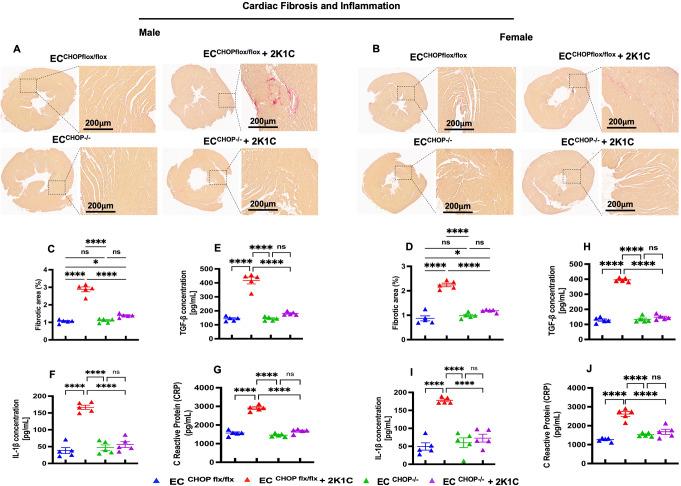
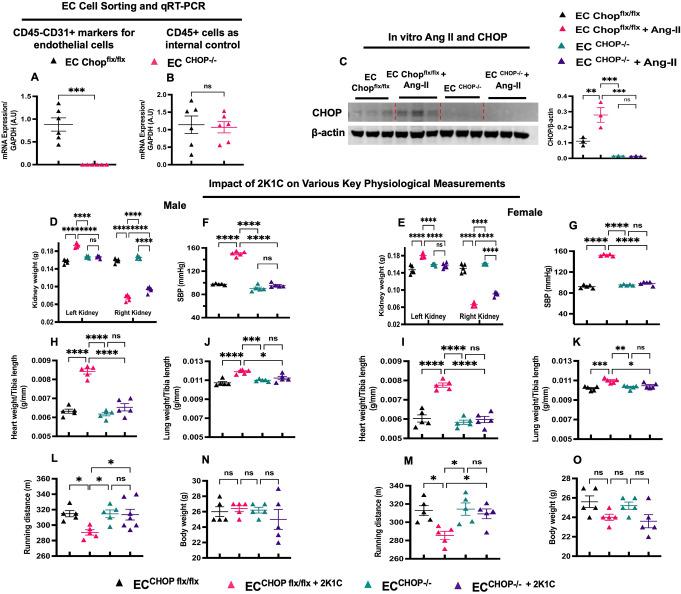
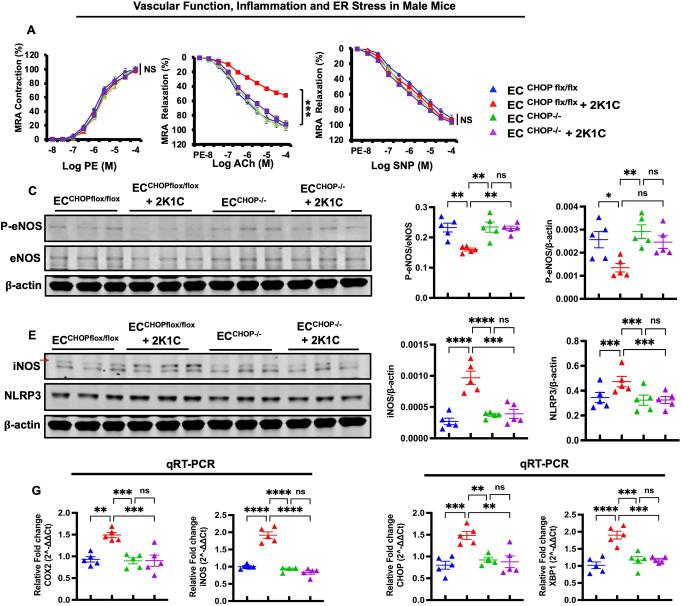
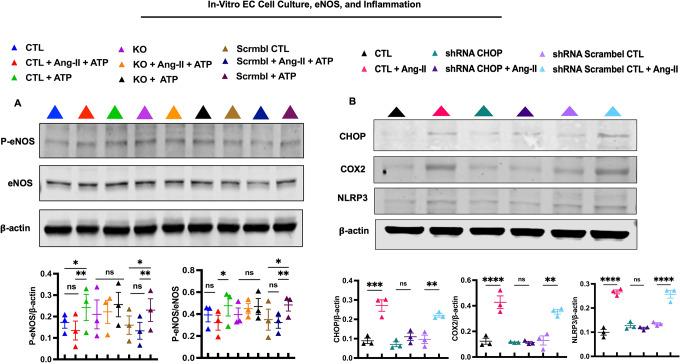
Eight-week-old male and female CHOP and EC mice were randomly divided into eight groups with and without 2-Kidney-1-Clip (2K1C) surgery for four weeks. Body weight, systolic blood pressure, running performance, cardiac hypertrophy and fibrosis, lung edema, inflammation, vascular endothelial function, and signaling were assessed. For the mechanism, we utilized human coronary endothelial cells, both with and without CHOP down-regulation, and then stimulated them with and without angiotensin II ± ATP to determine eNOS phosphorylation level and the presence of inflammatory factors. Male and female CHOP mice subjected to 2K1C for four weeks exhibited hypertension, cardiac hypertrophy and fibrosis, lung edema, impaired running performance, endothelium-dependent vascular relaxation dysfunction, reduction in eNOS phosphorylation, and inflammation induction. In contrast, male and female EC mice subjected to 2K1C for four weeks were protected against the pathogenesis of renovascular hypertension. In vitro, data showed that deletion of CHOP in endothelial cells protected eNOS phosphorylation level and blunted the induction of inflammation in response to angiotensin II ± ATP.
CONCLUSION
Our research findings determined that CHOP is a central mechanism driving vascular endothelial dysfunction and cardiac fibrosis in renovascular hypertension. Therefore, targeting CHOP in endothelial cells could be a potential therapeutic approach to protect against the pathogenesis of renovascular hypertension.
目的
在本研究中,我们试图确定血管内皮内质网(ER)应激C/EBP同源蛋白(CHOP)在肾血管性高血压诱导的血管内皮功能障碍和心脏纤维化中的显著影响。
方法与结果
将8周龄的雄性和雌性CHOP和EC小鼠随机分为八组,分别进行或不进行双肾单夹(2K1C)手术,持续四周。评估体重、收缩压、跑步能力、心脏肥大和纤维化、肺水肿、炎症、血管内皮功能及信号传导。对于作用机制,我们使用人冠状动脉内皮细胞,分别下调或未下调CHOP,然后用或不用血管紧张素II ± ATP刺激细胞,以确定内皮型一氧化氮合酶(eNOS)的磷酸化水平及炎症因子的存在情况。接受2K1C手术四周的雄性和雌性CHOP小鼠出现高血压、心脏肥大和纤维化、肺水肿、跑步能力受损、内皮依赖性血管舒张功能障碍、eNOS磷酸化减少以及炎症诱导。相比之下,接受2K1C手术四周的雄性和雌性EC小鼠对肾血管性高血压的发病机制具有保护作用。在体外,数据显示内皮细胞中CHOP的缺失可保护eNOS磷酸化水平,并减弱血管紧张素II ± ATP诱导的炎症反应。
结论
我们的研究结果表明,CHOP是肾血管性高血压中驱动血管内皮功能障碍和心脏纤维化的核心机制。因此,以内皮细胞中的CHOP为靶点可能是预防肾血管性高血压发病机制的一种潜在治疗方法。
 Zotero 插件