
代谢综合征、血浆代谢物与女性生殖疾病之间的因果关系:来自两步孟德尔随机化方法的见解
Causal relationships between metabolic syndrome, plasma metabolites, and female reproductive diseases: insights from a two-step mendelian randomization approach.
作者信息
Li Li, Ma Juanjuan, Sun Ningyu, Hu Panwei, Lin Yi, Zhang Qinhua
机构信息
Department of Gynecology, Shuguang Hospital, affiliated to Shanghai University of Traditional Chinese Medicine, Shanghai, China.
Department of Reproductive Medicine, Shuguang Hospital, affiliated to Shanghai University of Traditional Chinese Medicine, Shanghai, China.
出版信息
Nutr Metab (Lond). 2025 Jun 13;22(1):60. doi: 10.1186/s12986-025-00955-8.
BACKGROUND
Female reproductive diseases-including endometriosis (EMs), uterine fibroids (UFs), polycystic ovary syndrome (PCOS), gestational diabetes mellitus (GDM), eclampsia, ectopic pregnancy (EP), infertility, miscarriage, and ovarian aging-pose significant global health challenges. Metabolic syndrome (MetS) is characterized by a series of metabolic irregularities and has been linked to distinct plasma metabolomic profiles. Investigating the etiological connections among MetS, plasma metabolites, and female reproductive diseases is essential for devising effective prevention and treatment strategies.
OBJECTIVE
This study sought to evaluate the causal relationships among MetS, plasma metabolites, and female reproductive diseases using a two-step Mendelian randomization (MR) methodology.
METHODS
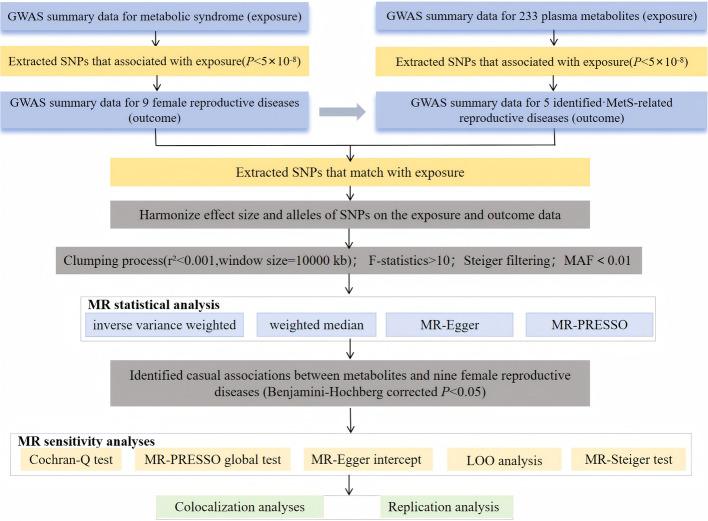
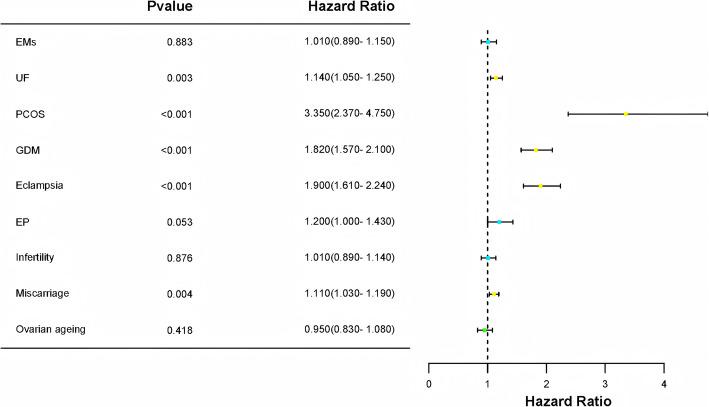
Initially, MR investigations were conducted to determine the causative impact of MetS on nine female reproductive diseases utilizing genome-wide association study (GWAS) data procured from European-descent populations. Statistically significant associations were identified for five diseases: UF, PCOS, GDM, eclampsia, and miscarriage. One hypothesis is that plasma metabolites may contribute to these associations. Subsequently, comprehensive MR analyses were performed using GWAS data on 233 plasma metabolites to examine causal relationships between these MetS-associated reproductive conditions and eight distinct classes of plasma metabolites. Sensitivity analyses, replication studies, and colocalization assessments were performed to validate the reliability of the outcomes.
RESULTS
MetS was identified as a causal factor for increased risks of UF, PCOS, GDM, eclampsia, and miscarriage. Further MR analyses revealed that specific plasma metabolites might causally affect the risk of female reproductive diseases: Eclampsia: Protective associations were observed with lipid molecules in large and very large high-density lipoprotein (HDL) particles, including cholesterol esters and total cholesterol. Conversely, triglycerides in large HDL particles and indicators related to small HDL particles were linked to increased risk. PCOS: Risk factors included elevated levels of triglycerides in HDL particles, various very low-density lipoprotein metabolites, acetone, 3-hydroxybutyrate, and conjugated linoleic acid. GDM: Increased glucose levels were associated with increased GDM risk.
CONCLUSIONS
This investigation established that MetS causally elevates the risk of certain female reproductive diseases and identified plasma metabolites that influence these conditions. These findings enhance the understanding of the etiological pathways involved in MetS and reproductive disorders, highlighting plasma metabolites as potential biomarkers or therapeutic targets.
背景
女性生殖疾病,包括子宫内膜异位症(EMs)、子宫肌瘤(UFs)、多囊卵巢综合征(PCOS)、妊娠期糖尿病(GDM)、子痫、异位妊娠(EP)、不孕症、流产和卵巢衰老,对全球健康构成重大挑战。代谢综合征(MetS)的特征是一系列代谢异常,并与不同的血浆代谢组学特征相关。研究MetS、血浆代谢物和女性生殖疾病之间的病因联系对于制定有效的预防和治疗策略至关重要。
目的
本研究旨在使用两步孟德尔随机化(MR)方法评估MetS、血浆代谢物和女性生殖疾病之间的因果关系。
方法
首先,利用从欧洲裔人群中获取的全基因组关联研究(GWAS)数据,进行MR研究以确定MetS对九种女性生殖疾病的因果影响。在五种疾病中发现了具有统计学意义的关联:UF、PCOS、GDM、子痫和流产。一种假设是血浆代谢物可能导致这些关联。随后,使用关于233种血浆代谢物的GWAS数据进行全面的MR分析,以检查这些与MetS相关的生殖状况与八类不同血浆代谢物之间的因果关系。进行了敏感性分析、重复研究和共定位评估以验证结果的可靠性。
结果
MetS被确定为UF、PCOS、GDM、子痫和流产风险增加的因果因素。进一步的MR分析表明,特定的血浆代谢物可能因果性地影响女性生殖疾病的风险:子痫:观察到与大的和非常大的高密度脂蛋白(HDL)颗粒中的脂质分子存在保护性关联,包括胆固醇酯和总胆固醇。相反,大HDL颗粒中的甘油三酯和与小HDL颗粒相关的指标与风险增加有关。PCOS:风险因素包括HDL颗粒中甘油三酯水平升高、各种极低密度脂蛋白代谢物、丙酮、3-羟基丁酸和共轭亚油酸。GDM:血糖水平升高与GDM风险增加有关。
结论
本研究确定MetS因果性地增加了某些女性生殖疾病的风险,并确定了影响这些疾病的血浆代谢物。这些发现增进了对MetS和生殖障碍所涉及的病因途径的理解,突出了血浆代谢物作为潜在生物标志物或治疗靶点的作用。

 Zotero 插件