
病例报告:母细胞中存在21三体的短暂性骨髓增殖性疾病。
Case Report: Transient myeloproliferative disorder with trisomy 21 in blast cells.
作者信息
Zacny Aleksandra, Saniewska Barbara, Orzeł Maria, Borek-Dzięcioł Beata, Kociszewska-Najman Bożena
机构信息
Student Scientific Association ProNeo at the Department of Neonatology and Rare Diseases, Medical University of Warsaw, Warsaw, Poland.
Department of Neonatology and Rare Diseases, Medical University of Warsaw, Warsaw, Poland.
出版信息
Front Pediatr. 2025 May 30;13:1604803. doi: 10.3389/fped.2025.1604803. eCollection 2025.
BACKGROUND
Transient myeloproliferative disorder is a clonal myeloproliferative syndrome that occurs in the presence of mutations in the GATA1 gene and chromosome 21 trisomy. It affects almost exclusively newborns with Down syndrome and usually resolves spontaneously. Neonatal leukemia is a rare childhood disease. Its prognosis is worse. We report a novel case of transient myeloproliferative disorder in a neonate without phenotypic features of Down syndrome, emphasizing the importance of comprehensive genetic diagnostics in atypical presentations.
CASE PRESENTATION
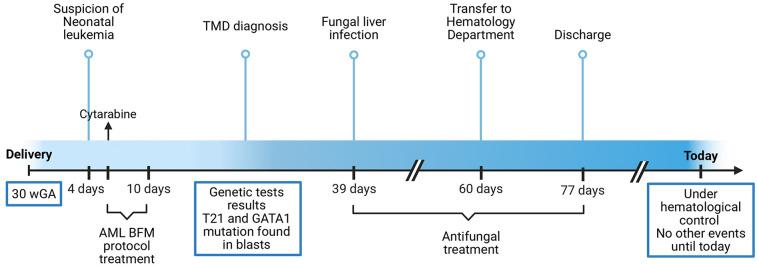
We present a case of a 4-day-old female neonate without phenotypic features of Down syndrome with suspected proliferative hematopoietic disease. A blood smear at birth showed severe anemia, leukocytosis and the presence of blasts. Abdominal ultrasound showed hepatosplenomegaly. In the bone marrow, 70.2% blast cell infiltration was described. An abnormal karyotype of 47XX+21 and GATA1 mutation were detected only in the blood cells. Transient myeloproliferative syndrome with t21 mosaicism was diagnosed. The patient received cytoreductive treatment according to the AML BFM protocol.
CONCLUSIONS
This case highlights the importance of genetic testing in neonates with congenital anemia and hyperleukocytosis, particularly when Down syndrome is not phenotypically apparent. Detecting trisomy 21 mosaicism and the GATA1 mutation is critical for diagnosing transient myeloproliferative disorder, planning the best treatment and determining prognosis.
背景
短暂性骨髓增殖性疾病是一种克隆性骨髓增殖综合征,发生于存在GATA1基因突变和21号染色体三体的情况下。它几乎只影响患有唐氏综合征的新生儿,通常会自发缓解。新生儿白血病是一种罕见的儿童疾病。其预后较差。我们报告了一例无唐氏综合征表型特征的新生儿短暂性骨髓增殖性疾病的新病例,强调了在非典型表现中进行全面基因诊断的重要性。
病例介绍
我们报告一例4日龄无唐氏综合征表型特征的女婴,怀疑患有增殖性造血疾病。出生时的血涂片显示严重贫血、白细胞增多和原始细胞存在。腹部超声显示肝脾肿大。骨髓中描述有70.2%的原始细胞浸润。仅在血细胞中检测到47XX+21的异常核型和GATA1突变。诊断为伴有21号染色体镶嵌现象的短暂性骨髓增殖综合征。患者根据AML BFM方案接受了细胞减灭治疗。
结论
该病例突出了对先天性贫血和白细胞增多症新生儿进行基因检测的重要性,尤其是在唐氏综合征无明显表型时。检测21号染色体镶嵌现象和GATA1突变对于诊断短暂性骨髓增殖性疾病、规划最佳治疗方案和确定预后至关重要。
 Zotero 插件