
苁蓉舒静颗粒改善线粒体相关膜以对抗帕金森病细胞模型中MPP诱导的神经损伤。
Congrong Shujing Granules ameliorates mitochondrial associated membranes to against MPP-induced neurological damage in the cellular model of Parkinson's disease.
作者信息
Zhang Chutian, Huang Peizhen, Cheng Huiling, Yuan Xinxin, Zhou Mei, Liu Ying, Liu Ting, Chen Dan, Xu Qian, Cai Jing
机构信息
Academy of Integrative Medicine, College of Integrative Medicine, Fujian University of Traditional Chinese Medicine, Fuzhou, Fujian, China.
Department of Neurology, Hubei Provincial Hospital of Traditional Chinese Medicine, Affiliated Hospital of Hubei University of Traditional Chinese Medicine, Wuhan, Hubei, China.
出版信息
Front Pharmacol. 2025 May 30;16:1509317. doi: 10.3389/fphar.2025.1509317. eCollection 2025.
CONTEXT
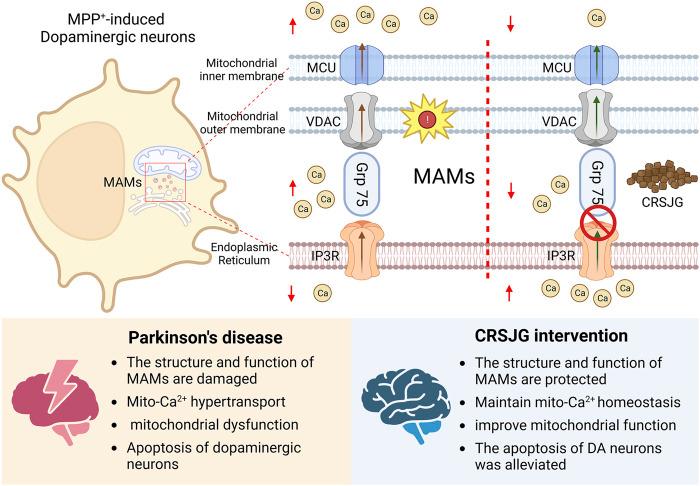
Congrong-Shujing Granules (CRSJG) are known to protect dopaminergic neurons in Parkinson's disease (PD), and the mechanism may be related to the improvement of mitochondria-associated membranes (MAMs).
OBJECTIVE
To investigate the impact of CRSJG-medicated serum on MAMs in the 1-methyl-4-phenylpyridinium (MPP)-induced PD cell model.
MATERIALS AND METHODS
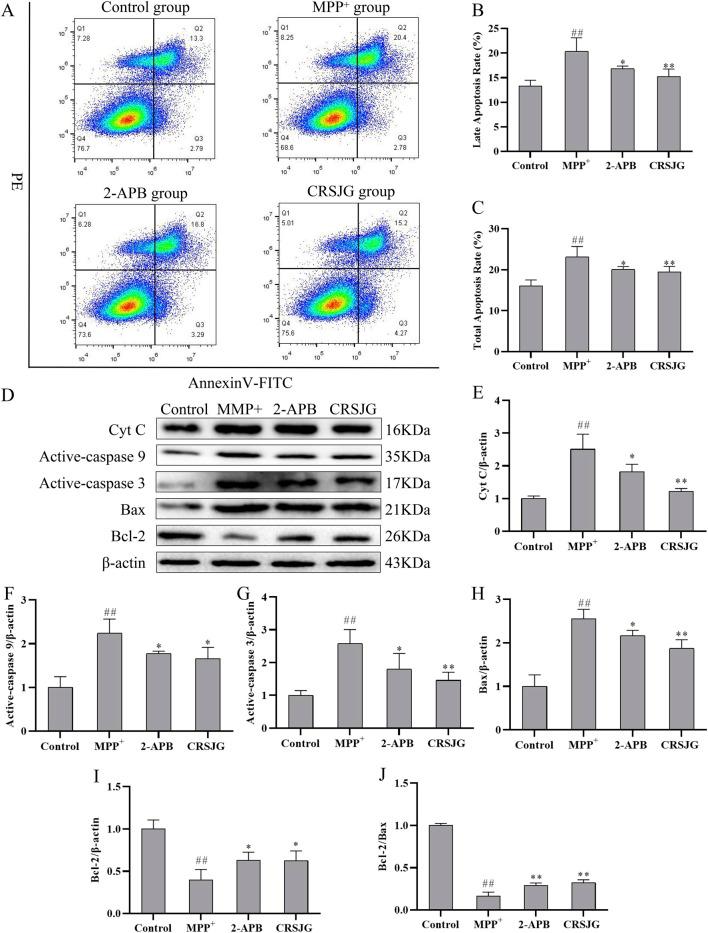
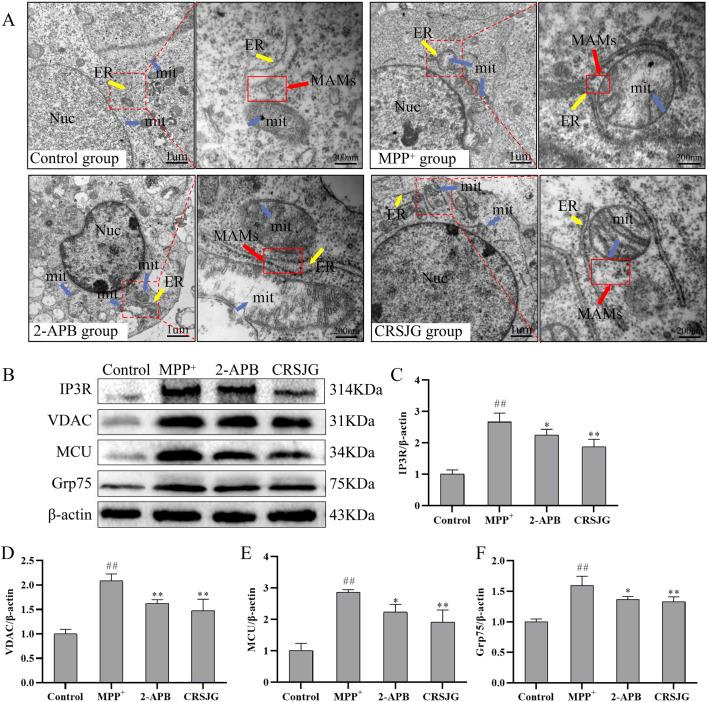
Human neuroblastoma (SH-SY5Y) cells were treated with 1,000 μmol/L MPP for 24 h, resulting in three experimental groups: MPP, CRSJG, and 2-APB. The MPP group received blank serum, CRSJG group was treated with CRSJG-medicated serum, and the 2-APB group was given 100 μmol/L 2-APB. An untreated control group was also included. Serum pharmacokinetics for the CRSJG group were analyzed using ultra-performance liquid chromatography-tandem mass spectrometry. Intracellular-Ca, reactive oxygen species (ROS), mitochondrial membrane potential (MMP), and apoptosis rates were measured using fluorescent probes and flow cytometry. Transmission electron microscopy was employed to examine the morphology of MAMs. Western blot was conducted to identify proteins related to apoptosis and Ca transport.
RESULTS
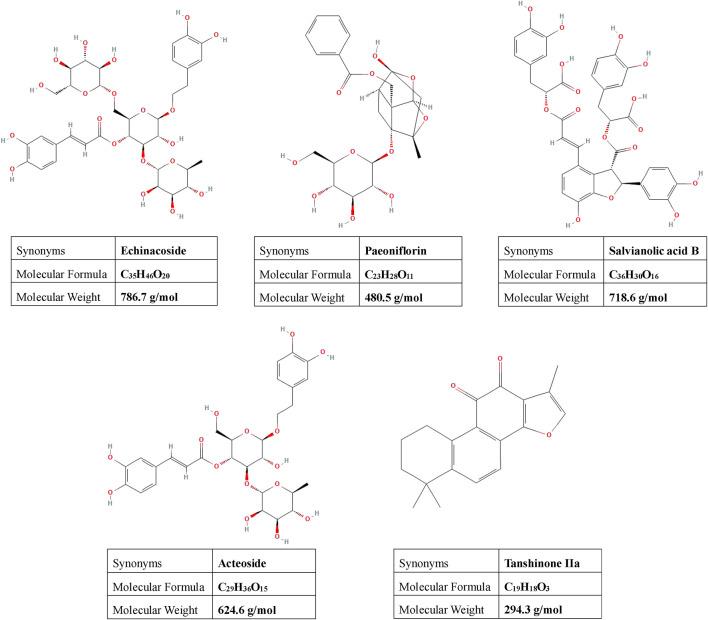
CRSJG-medicated serum identified by pharmacokinetic markers including echinacoside, paeoniflorin, salvianolic acid B, acteoside, and tanshinone IIa. The EC for MPP-induced reduction in cell proliferation was 1,110 μmol/L. CRSJG-medicated serum, especially at 2.5%, significantly improved cell proliferation after 24 h. The serum effectively mitigated damage within the MAMs region and reduced both the mitochondrial-Ca fluorescence intensity and the expression of the IPR-VDAC-MCU complex in MPP-induced neuronal cells. Additionally, it significantly decreased the levels of ROS, the decline in MMP, and apoptosis rates in these cells.
DISCUSSION AND CONCLUSION
The findings provide novel insights into the potential of CRSJG in treating neuronal loss in PD.
背景
已知苁蓉舒静颗粒(CRSJG)可保护帕金森病(PD)中的多巴胺能神经元,其机制可能与线粒体相关膜(MAMs)的改善有关。
目的
研究CRSJG含药血清对1-甲基-4-苯基吡啶鎓(MPP)诱导的PD细胞模型中MAMs的影响。
材料与方法
将人神经母细胞瘤(SH-SY5Y)细胞用1000μmol/L MPP处理24小时,得到三个实验组:MPP组、CRSJG组和2-APB组。MPP组给予空白血清,CRSJG组用CRSJG含药血清处理,2-APB组给予100μmol/L 2-APB。还包括一个未处理的对照组。使用超高效液相色谱-串联质谱法分析CRSJG组的血清药代动力学。使用荧光探针和流式细胞术测量细胞内钙、活性氧(ROS)、线粒体膜电位(MMP)和凋亡率。采用透射电子显微镜检查MAMs的形态。进行蛋白质印迹法以鉴定与凋亡和钙转运相关的蛋白质。
结果
通过包括紫锥菊苷、芍药苷、丹酚酸B、毛蕊花糖苷和丹参酮IIa在内的药代动力学标志物鉴定出CRSJG含药血清。MPP诱导细胞增殖减少的半数效应浓度(EC)为1110μmol/L。CRSJG含药血清,尤其是2.5%浓度的血清,在24小时后显著改善细胞增殖。该血清有效减轻了MAMs区域内的损伤,并降低了MPP诱导的神经元细胞中线粒体钙荧光强度以及IPR-VDAC-MCU复合物的表达。此外,它还显著降低了这些细胞中ROS的水平、MMP的下降以及凋亡率。
讨论与结论
这些发现为CRSJG在治疗PD神经元损失方面的潜力提供了新的见解。


 Zotero 插件