
基于铜铁双金属过氧化物的纳米酶,具有微环境触发的级联催化作用,用于三模态伤口感染治疗中的协同产生羟基自由基、一氧化氮和氧气。
Cu-Fe bimetallic peroxide-based nanozyme with microenvironment-triggered cascade catalysis for synergistic hydroxyl radical, nitric oxide, and oxygen generation in trimodal wound infection therapy.
作者信息
Liu Wei, Fang Yuan, Xu Ping, Cai Wanqin, Peng Yunping, Xue Wei, Yu Siming
机构信息
Department of Orthopedics, The First Affiliated Hospital, Jinan University, Guangzhou, 510632, China.
Key Laboratory of Biomaterials of Guangdong Higher Education Institutes, Department of Biomedical Engineering, Jinan University, Guangzhou, 510632, China.
出版信息
Mater Today Bio. 2025 May 28;32:101912. doi: 10.1016/j.mtbio.2025.101912. eCollection 2025 Jun.
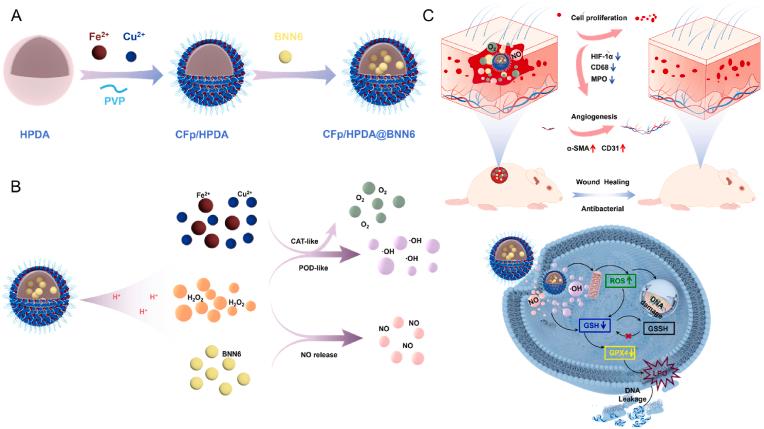
Recently, chemodynamic therapy (CDT) and gas therapy (GT) have garnered significant attention for antibacterial applications. However, effectively integrating CDT and GT into a single nanocomposite for synergistic therapy remains challenging. Herein, Cu-Fe bimetallic peroxide nanoparticles (CFp)-decorated hollow polydopamine (HPDA) nanozyme (CFp/HPDA) was fabricated and used as the carrier for nitric oxide (NO) donor BNN6 loading, resulting in the NO-releasing nanozyme of CFp/HPDA@BNN6. In the acidic bacterial infection microenvironment (BIME), CFp could rapidly dissociate by releasing Cu and Fe ions and self-supplying abundant HO. On one hand, the Fenton - like catalytic reaction enabled the generation of a high level of hydroxyl radical (•OH) for CDT. On the other hand, HO could effectively trigger BNN6 to release NO for NO-based GT. Consequently, CFp/HPDA@BNN6 exhibited remarkable antibacterial and antibiofilm activities by exerting the bimodal GT/CDT therapy. In-depth mechanism study revealed that NO synergized the antibacterial effect of •OH by promoting bacterial ferroptosis-like death. Moreover, CFp could responsively produce a substantial amount of O in the BIME, which, in combination with NO, synergistically promoted wound healing by reprogramming M1-type macrophages, downregulating hypoxia-inducible factor (HIF)-1α expression and upregulating vascular endothelial growth factor (VEGF), α-SMA and CD31 expressions. In summary, CFp/HPDA@BNN6 displayed highly efficient treatment of wound infections through the trimodal therapeutic effects of •OH, NO and O, offering a promising strategy for wound infection therapy.
近年来,化学动力疗法(CDT)和气体疗法(GT)在抗菌应用方面备受关注。然而,将CDT和GT有效地整合到单一纳米复合材料中以实现协同治疗仍然具有挑战性。在此,制备了负载有一氧化氮(NO)供体BNN6的铜铁双金属过氧化物纳米颗粒(CFp)修饰的中空聚多巴胺(HPDA)纳米酶(CFp/HPDA),得到了释放NO的纳米酶CFp/HPDA@BNN6。在酸性细菌感染微环境(BIME)中,CFp可通过释放铜离子和铁离子迅速解离,并自身提供大量的HO。一方面,类芬顿催化反应能够产生高水平的羟基自由基(•OH)用于CDT。另一方面,HO能够有效地触发BNN6释放NO用于基于NO的GT。因此,CFp/HPDA@BNN6通过发挥双峰GT/CDT疗法展现出显著的抗菌和抗生物膜活性。深入的机制研究表明,NO通过促进细菌铁死亡样死亡来协同增强•OH的抗菌作用。此外,CFp能够在BIME中响应性地产生大量的O,其与NO相结合,通过重编程M1型巨噬细胞、下调缺氧诱导因子(HIF)-1α表达以及上调血管内皮生长因子(VEGF)、α-SMA和CD31表达来协同促进伤口愈合。综上所述,CFp/HPDA@BNN6通过•OH、NO和O的三峰治疗作用高效治疗伤口感染,为伤口感染治疗提供了一种有前景的策略。




 Zotero 插件