
非酒精性脂肪性肝炎中的自身免疫:聚焦自身抗体、抗载脂蛋白A1 IgG和G蛋白偶联受体。
Autoimmunity in MASLD: Focus on autoantibodies, anti-apolipoprotein A1 IgG and G protein-coupled receptors.
作者信息
Pagano Sabrina, Somm Emmanuel, Jornayvaz François R, Vuilleumier Nicolas
机构信息
Division of Laboratory Medicine, Diagnostic Department, Geneva University Hospitals, Geneva, Switzerland.
Department of Medicine, Medical Faculty, Geneva University, Geneva, Switzerland.
出版信息
Eur J Clin Invest. 2025 Oct;55(10):e70092. doi: 10.1111/eci.70092. Epub 2025 Jun 16.
BACKGROUND
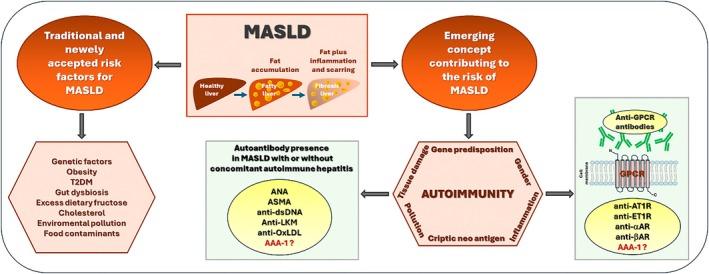
The increasing prevalence of metabolic dysfunction-associated steatotic liver disease (MASLD), formerly known as non-alcoholic fatty liver disease (NAFLD), represents a significant public health concern, as it is closely linked to rising obesity rates and metabolic syndrome, affecting approximately 30% of the global population. In addition, MASLD, along with its more severe form, metabolic dysfunction-associated steatohepatitis (MASH), increases the risk of cardio-metabolic diseases and hepatocellular carcinoma. In recent years, multiple G-protein-coupled receptors (GPCRs) have been identified as potential therapeutic targets for these disorders. Additionally, autoimmunity is believed to potentially play a role in the development of mechanisms contributing to the pathogenesis of MASLD/MASH. This narrative review examines the diverse autoantibodies associated with the disease, with a particular emphasis on antibodies targeting apolipoprotein A-1 (AAA-1) and their relationship with anti-GPCRs antibodies.
RESULTS
Several autoantibodies have been identified in up to 30% of individuals with MASLD/MASH, both with and without concomitant autoimmune diseases. Among the anti-GPCR autoantibodies identified in MASLD to date are those targeting the angiotensin II type 1 receptor and the endothelin-1 type A receptor. While the contribution of this class of autoantibodies to MASLD/NASH remains unclear, AAA-1 appears to be pathogenic, acting as pro-steatotic and pro-inflammatory mediators. Additionally, current data suggest shared functional responses between anti-GPCR antibodies and AAA1 in cell-based assays used to detect anti-GPCR presence.
CONCLUSION
A better understanding of the role of humoral autoimmunity and the interactions among its various components in the metabolic dysfunction underlying MASLD/MASH has the potential to open new perspectives for early detection and therapeutic interventions.
背景
代谢功能障碍相关脂肪性肝病(MASLD),以前称为非酒精性脂肪性肝病(NAFLD),其患病率不断上升,这是一个重大的公共卫生问题,因为它与肥胖率上升和代谢综合征密切相关,影响着全球约30%的人口。此外,MASLD及其更严重的形式,即代谢功能障碍相关脂肪性肝炎(MASH),增加了心血管代谢疾病和肝细胞癌的风险。近年来,多种G蛋白偶联受体(GPCRs)已被确定为这些疾病的潜在治疗靶点。此外,自身免疫被认为可能在导致MASLD/MASH发病机制的发展中起作用。本叙述性综述探讨了与该疾病相关的多种自身抗体,特别强调了靶向载脂蛋白A-1的抗体(AAA-1)及其与抗GPCRs抗体的关系。
结果
在高达30%的MASLD/MASH患者中,无论是否伴有自身免疫性疾病,都发现了几种自身抗体。迄今为止,在MASLD中鉴定出的抗GPCR自身抗体包括靶向血管紧张素II 1型受体和内皮素-1 A型受体的抗体。虽然这类自身抗体对MASLD/NASH的作用尚不清楚,但AAA-1似乎具有致病性,可作为促脂肪变性和促炎介质。此外,目前的数据表明,在用于检测抗GPCR存在的基于细胞的试验中,抗GPCR抗体和AAA1之间存在共同的功能反应。
结论
更好地了解体液自身免疫的作用及其在MASLD/MASH潜在代谢功能障碍中各组成部分之间的相互作用,有可能为早期检测和治疗干预开辟新的前景。

 Zotero 插件