
使用压缩感知缩短7T MP2RAGE采集时间:评估定量准确性和结构一致性。
Shortening 7T MP2RAGE acquisition with compressed sensing: Evaluating quantitative accuracy and structural consistency.
作者信息
Kida Ikuhiro
机构信息
Center for Information and Neural Networks, National Institute of Information and Communications Technology, and Osaka University, Suita, Osaka, Japan.
出版信息
PLoS One. 2025 Jun 16;20(6):e0325783. doi: 10.1371/journal.pone.0325783. eCollection 2025.
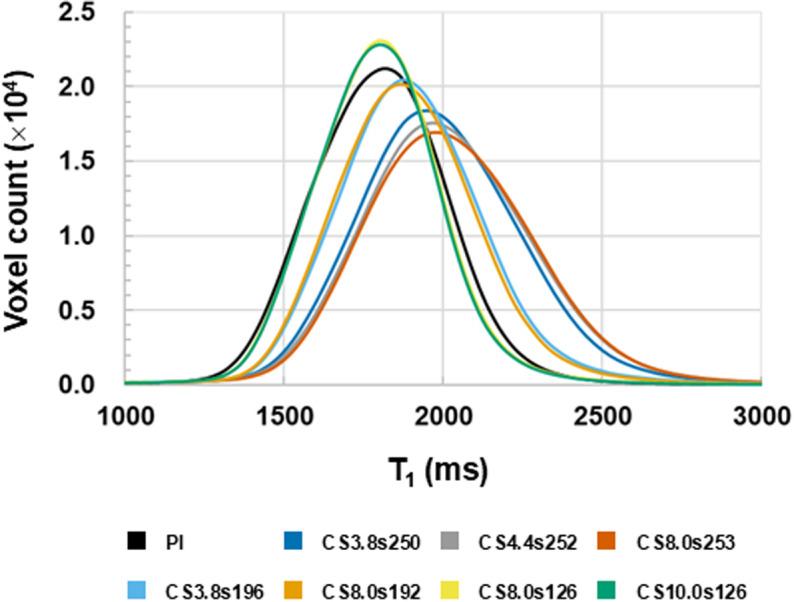
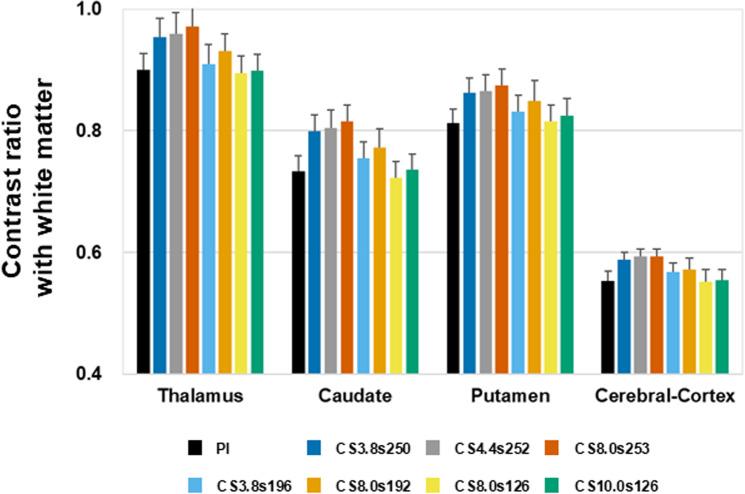
The aim of this study was to systematically evaluate the impact of compressed sensing (CS) on acquisition time, image quality, T1 mapping accuracy, and segmentation consistency in magnetization-prepared 2 rapid acquisition gradient echo (MP2RAGE) at ultra-high fields (UHF). MP2RAGE sequences were acquired using the CS and parallel imaging (PI) technique, i.e., generalized autocalibrating partially parallel acquisitions (GRAPPA), with varying undersampling factors and samples per repetition time (TR). The acquisition time, quantitative accuracy of T1 mapping, and segmentation consistency across regions of interest (ROIs) were assessed. CS-MP2RAGE achieved a 61% reduction in acquisition time (< 3 min) compared with PI-MP2RAGE and maintained comparable image quality, segmentation accuracy, and T1-mapping fidelity. Higher undersampling factors effectively reduced scan duration but introduced segmentation volume mismatches of up to 20% and increased T1 values, despite the images appearing similar to PI-MP2RAGE. Reducing the number of samples per TR enhanced image quality, allowing for higher undersampling factors without a significant loss of fidelity, a finding consistent with previous studies. However, excessively low sampling densities destabilized reconstruction in complex ROIs. Our findings demonstrate that CS-MP2RAGE significantly reduces scan time while maintaining high image quality and quantitative accuracy, making it a viable alternative to GRAPPA in UHF applications. The interplay between undersampling factors and samples per TR is crucial for optimizing scan efficiency. Future studies should explore its application in clinical and research settings.
本研究的目的是系统评估压缩感知(CS)对超高场(UHF)下磁化准备快速采集梯度回波序列(MP2RAGE)的采集时间、图像质量、T1映射准确性和分割一致性的影响。使用CS和平行成像(PI)技术,即广义自校准部分并行采集(GRAPPA),以不同的欠采样因子和每个重复时间(TR)的样本数采集MP2RAGE序列。评估采集时间、T1映射的定量准确性以及跨感兴趣区域(ROI)的分割一致性。与PI-MP2RAGE相比,CS-MP2RAGE的采集时间减少了61%(<3分钟),并保持了相当的图像质量、分割准确性和T1映射保真度。更高的欠采样因子有效缩短了扫描持续时间,但尽管图像与PI-MP2RAGE相似,却引入了高达20%的分割体积不匹配并增加了T1值。减少每个TR的样本数可提高图像质量,允许更高的欠采样因子而不会显著损失保真度,这一发现与先前的研究一致。然而,过低的采样密度会使复杂ROI中的重建不稳定。我们的研究结果表明,CS-MP2RAGE在保持高图像质量和定量准确性的同时,显著缩短了扫描时间,使其成为UHF应用中GRAPPA的可行替代方案。欠采样因子与每个TR的样本数之间的相互作用对于优化扫描效率至关重要。未来的研究应探索其在临床和研究环境中的应用。



 Zotero 插件