
整合MRI影像组学与种系遗传学以预测胶质瘤的异柠檬酸脱氢酶(IDH)突变状态
Integration of MRI radiomics and germline genetics to predict the IDH mutation status of gliomas.
作者信息
Nakase Taishi, Henderson George A, Barba Thomas, Bareja Rohan, Guerra Geno, Zhao Qingyu, Francis Stephen S, Gevaert Olivier, Kachuri Linda
机构信息
Department of Epidemiology and Population Health, Stanford University, Stanford, CA, USA.
Stanford Center for Biomedical Informatics Research (BMIR), Stanford University, Stanford, CA, USA.
出版信息
NPJ Precis Oncol. 2025 Jun 16;9(1):187. doi: 10.1038/s41698-025-00980-z.
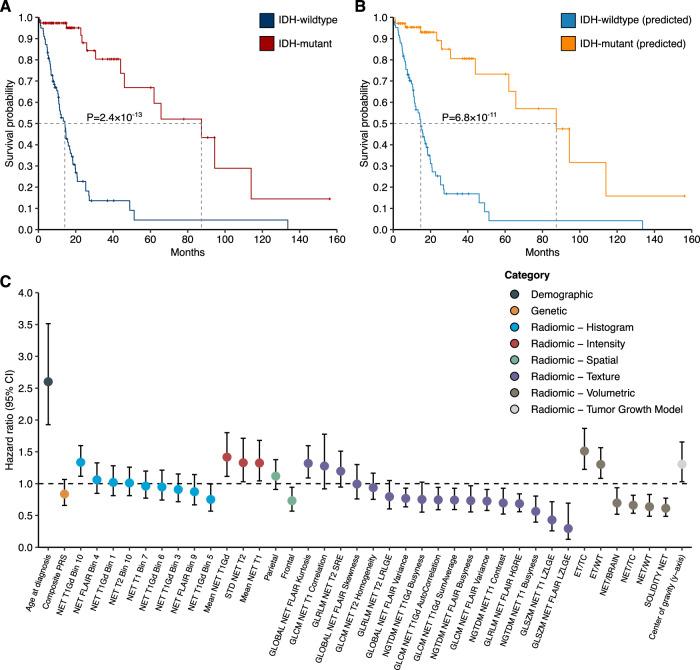
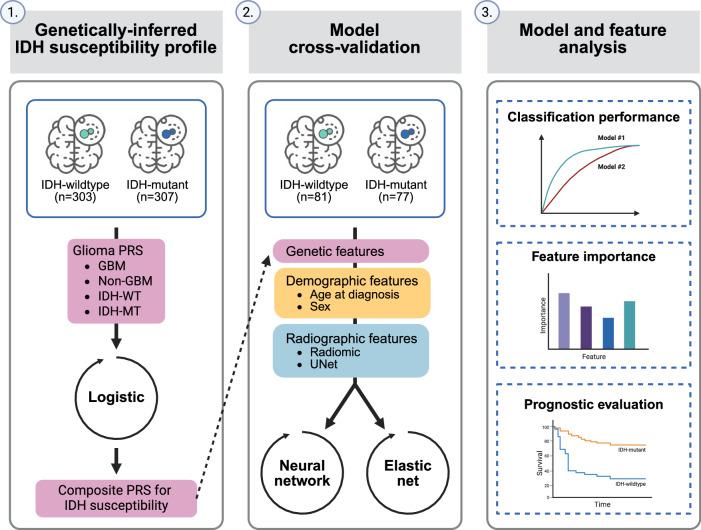
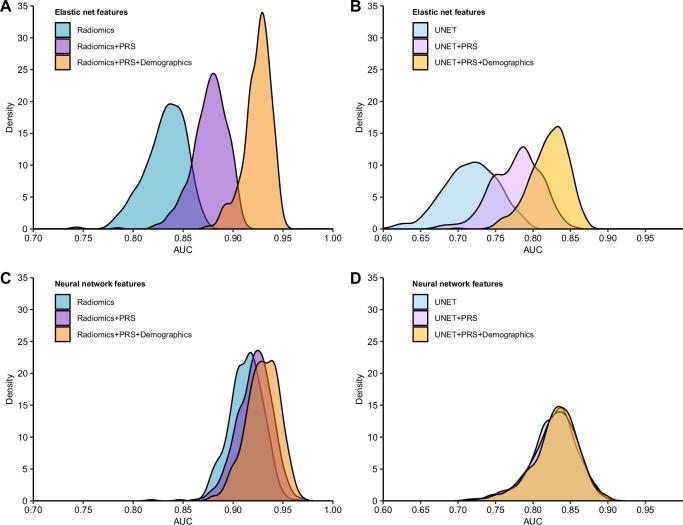
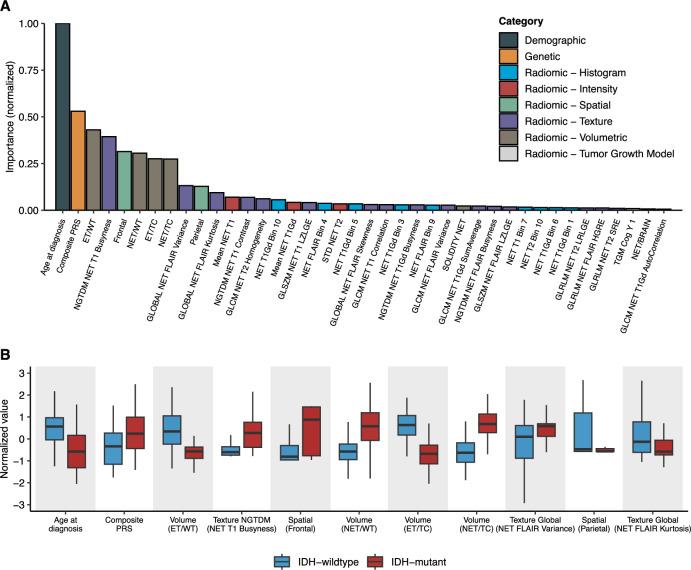
The molecular profiling of gliomas for isocitrate dehydrogenase (IDH) mutations currently relies on resected tumor samples, highlighting the need for non-invasive, preoperative biomarkers. We investigated the integration of glioma polygenic risk scores (PRS) and radiographic features for prediction of IDH mutation status. We used 256 radiomic features, a glioma PRS and demographic information in 158 glioma cases within elastic net and neural network models. The integration of glioma PRS with radiomics increased the area under the receiver operating characteristic curve (AUC) for distinguishing IDH-wildtype vs. IDH-mutant glioma from 0.83 to 0.88 (P = 6.9 × 10) in the elastic net model and from 0.91 to 0.92 (P = 0.32) in the neural network model. Incorporating age at diagnosis and sex further improved the classifiers (elastic net: AUC = 0.93, neural network: AUC = 0.93). Patients predicted to have IDH-mutant vs. IDH-wildtype tumors had significantly lower mortality risk (hazard ratio (HR) = 0.18, 95% CI: 0.08-0.40, P = 2.1 × 10), comparable to prognostic trajectories for biopsy-confirmed IDH status. The augmentation of imaging-based classifiers with genetic risk profiles may help delineate molecular subtypes and improve the timely, non-invasive clinical assessment of glioma patients.
目前,胶质瘤异柠檬酸脱氢酶(IDH)突变的分子特征分析依赖于切除的肿瘤样本,这凸显了对非侵入性术前生物标志物的需求。我们研究了胶质瘤多基因风险评分(PRS)与影像学特征相结合以预测IDH突变状态的情况。我们在弹性网络模型和神经网络模型中,使用了158例胶质瘤病例的256个放射组学特征、一个胶质瘤PRS和人口统计学信息。在弹性网络模型中,胶质瘤PRS与放射组学相结合,将区分IDH野生型与IDH突变型胶质瘤的受试者工作特征曲线下面积(AUC)从0.83提高到0.88(P = 6.9×10),在神经网络模型中从0.91提高到0.92(P = 0.32)。纳入诊断时的年龄和性别进一步改善了分类器(弹性网络:AUC = 0.93,神经网络:AUC = 0.93)。预测为IDH突变型与IDH野生型肿瘤的患者死亡风险显著更低(风险比(HR)= 并与活检确诊的IDH状态的预后轨迹相当。基于成像的分类器与遗传风险概况相结合,可能有助于界定分子亚型,并改善对胶质瘤患者的及时、非侵入性临床评估。
 Zotero 插件