
评估住院患者糖尿病性多发性神经病的患病率:一项使用密歇根自我报告问卷和体格检查方法的比较研究
Assessing Diabetic Polyneuropathy Prevalence in Hospitalized Patients: A Comparative Study Using the Michigan Self-Report Questionnaire and Physical Examination Methods.
作者信息
EsnaAshari Parastoo, Mianehsaz Elaheh, Afarini Maryam, Azadchehr Mohammad Javad
机构信息
Kashan University of Medical Sciences, Kashan, Iran.
Department of Physical Medicine and Rehabilitation, Faculty of Medicine, Kashan University of Medical Sciences, Kashan, Iran.
出版信息
J Diabetes Res. 2025 Jun 8;2025:7027972. doi: 10.1155/jdr/7027972. eCollection 2025.
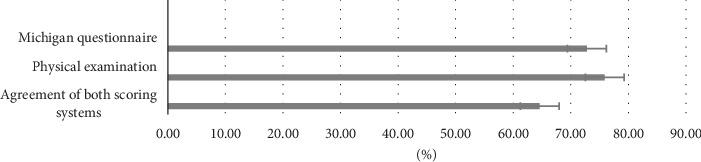
Chronic complications of diabetes, such as diabetic polyneuropathy (DPN), are major contributors to disability and mortality among diabetic patients. Effective screening for DPN is crucial to prevent severe complications, including limb amputation. This study was aimed at assessing the prevalence of DPN among hospitalized diabetic patients using both self-report (Michigan questionnaire) and physical examination methods and at evaluating the level of agreement between these two screening approaches. This cross-sectional study included 158 adult diabetic patients admitted to Shahid Beheshti Hospital in Kashan, Iran, between April and September 2023. Patients were screened for DPN using the Michigan self-report questionnaire and physical examination. Sociodemographic and clinical data were collected through patient interviews and medical records. Random sampling was used to ensure representativeness. Data analysis was conducted using SPSS Version 26, applying descriptive and inferential statistics. Cohen's kappa statistic was used to assess the level of agreement between the two screening methods. The validity and reliability of the assessment tools were confirmed through previous studies. The study found a moderate agreement between the physical examination and the Michigan self-report questionnaire in diagnosing DPN ( = 0.486, < 0.001). The overall prevalence of DPN, based on the agreement of both methods, was 64.6%. The prevalence was 75.9% based on physical examination and 72.8% based on the questionnaire. This study found a high prevalence of DPN among hospitalized diabetic patients, highlighting the urgent need for effective screening methods. The moderate agreement between the Michigan questionnaire and physical examination suggests that the questionnaire could serve as a simple, cost-effective tool for early DPN detection. Further research and wider implementation of these screening tools may enhance early diagnosis and help reduce the risk of severe complications, such as limb amputation.
糖尿病的慢性并发症,如糖尿病性多发性神经病变(DPN),是糖尿病患者致残和死亡的主要原因。对DPN进行有效筛查对于预防包括肢体截肢在内的严重并发症至关重要。本研究旨在使用自我报告(密歇根问卷)和体格检查方法评估住院糖尿病患者中DPN的患病率,并评估这两种筛查方法之间的一致性水平。这项横断面研究纳入了2023年4月至9月期间入住伊朗卡尚的沙希德·贝赫什提医院的158名成年糖尿病患者。使用密歇根自我报告问卷和体格检查对患者进行DPN筛查。通过患者访谈和病历收集社会人口统计学和临床数据。采用随机抽样以确保代表性。使用SPSS 26版进行数据分析,应用描述性和推断性统计。采用科恩kappa统计量评估两种筛查方法之间的一致性水平。评估工具的有效性和可靠性通过先前的研究得到了证实。研究发现,在诊断DPN方面,体格检查与密歇根自我报告问卷之间存在中度一致性(κ = 0.486,P < 0.001)。基于两种方法的一致性,DPN的总体患病率为64.6%。基于体格检查的患病率为75.9%,基于问卷的患病率为72.8%。本研究发现住院糖尿病患者中DPN的患病率很高,凸显了对有效筛查方法的迫切需求。密歇根问卷与体格检查之间的中度一致性表明,该问卷可作为早期检测DPN的简单、经济有效的工具。对这些筛查工具进行进一步研究并更广泛地应用,可能会提高早期诊断率,并有助于降低诸如肢体截肢等严重并发症的风险。

 Zotero 插件