
南亚国家孕产妇保健服务可及性方面的社会经济不平等:一项系统评价。
Socioeconomic inequalities in access to maternal healthcare in South-Asian countries: A systematic review.
作者信息
Aftab Ishrat Binte, Chakma Tisha, Ahmed Akash, Haque Syed Mohammad Raysul
机构信息
BRAC James P Grant School of Public Health, BRAC University, Dhaka, Bangladesh.
Department of Mathematics and Natural Sciences, BRAC University, Dhaka, Bangladesh.
出版信息
PLoS One. 2025 Jun 17;20(6):e0326130. doi: 10.1371/journal.pone.0326130. eCollection 2025.
BACKGROUND
Despite numerous efforts, South Asia is the second most leading region for maternal mortality and morbidity. Although there have been notable advancements on this continent, progress in maternal healthcare access has been slow. Inequalities remain in different maternal health services across diverse population groups. The aim of this study is to better understand the socioeconomic inequalities in maternal healthcare access in South Asian countries.
METHODS
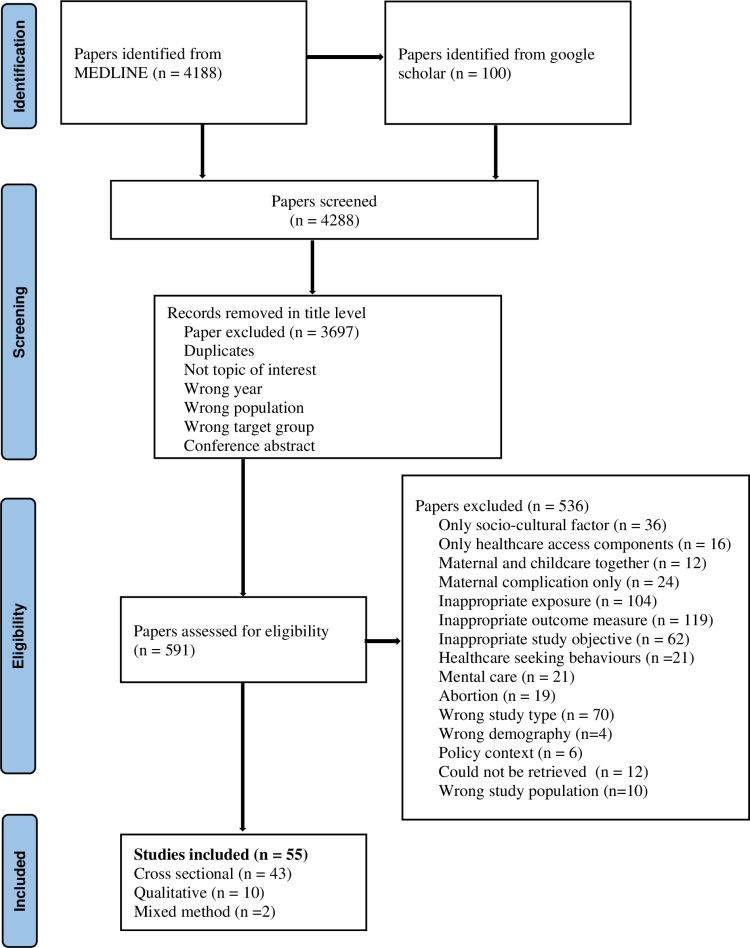
Two databases (MEDLINE and Google Scholar) were searched for identifying studies. Studies with data on socioeconomic factors, maternal healthcare, inequality, and South-Asian countries were included. Mixed method appraisal tool was used for quality assessment of the identified studies.
RESULTS
A total of 55 studies from India, Nepal, Bangladesh, Afghanistan and Pakistan were included in the final analysis. Overall, quantitative study showed that maternal healthcare access is linked to economic status, education, occupation, and women's autonomy. Qualitative studies demonstrated poverty, lack of awareness of complication and service and inability in decision making on healthcare was the reason for not accessing maternal health care. Significant finding from this review includes effect of education mostly evident after secondary education and paternal occupation was significant rather than maternal occupation.
CONCLUSION
Findings of this review indicates a large disparity in access to maternal health care services. Policymakers should create interventions and financial schemes that are tailored to the mothers from low socioeconomic background.
背景
尽管做出了诸多努力,但南亚仍是孕产妇死亡率和发病率第二高的地区。尽管该大陆已取得显著进展,但孕产妇保健服务的普及进展缓慢。不同人群在各种孕产妇保健服务方面仍存在不平等现象。本研究的目的是更好地了解南亚国家孕产妇保健服务获取方面的社会经济不平等情况。
方法
检索了两个数据库(MEDLINE和谷歌学术)以识别相关研究。纳入了包含社会经济因素、孕产妇保健、不平等以及南亚国家数据的研究。采用混合方法评估工具对所识别的研究进行质量评估。
结果
最终分析纳入了来自印度、尼泊尔、孟加拉国、阿富汗和巴基斯坦的55项研究。总体而言,定量研究表明,孕产妇保健服务的获取与经济状况、教育程度、职业以及女性自主权相关。定性研究表明,贫困、对并发症和服务缺乏认识以及在医疗保健决策方面的无能是无法获得孕产妇保健服务的原因。本次综述的重要发现包括,教育的影响在中等教育之后最为明显,父亲的职业比母亲的职业更具显著性。
结论
本次综述的结果表明,在孕产妇保健服务获取方面存在巨大差距。政策制定者应制定针对社会经济背景较低母亲的干预措施和财政计划。
 Zotero 插件