
人博卡病毒在污水、地表水及其他环境介质中的流行情况:一项Meta回归模型研究
Prevalence of Human Bocavirus in Sewage, Surface Waters, and Other Environmental Milieux: A Meta-regression Modelling.
作者信息
Ekundayo Temitope C, Tabit Frederick T
机构信息
Department of Life and Consumer Sciences, University of South Africa, Roodepoort, South Africa.
出版信息
Food Environ Virol. 2025 Jun 17;17(3):34. doi: 10.1007/s12560-025-09648-0.
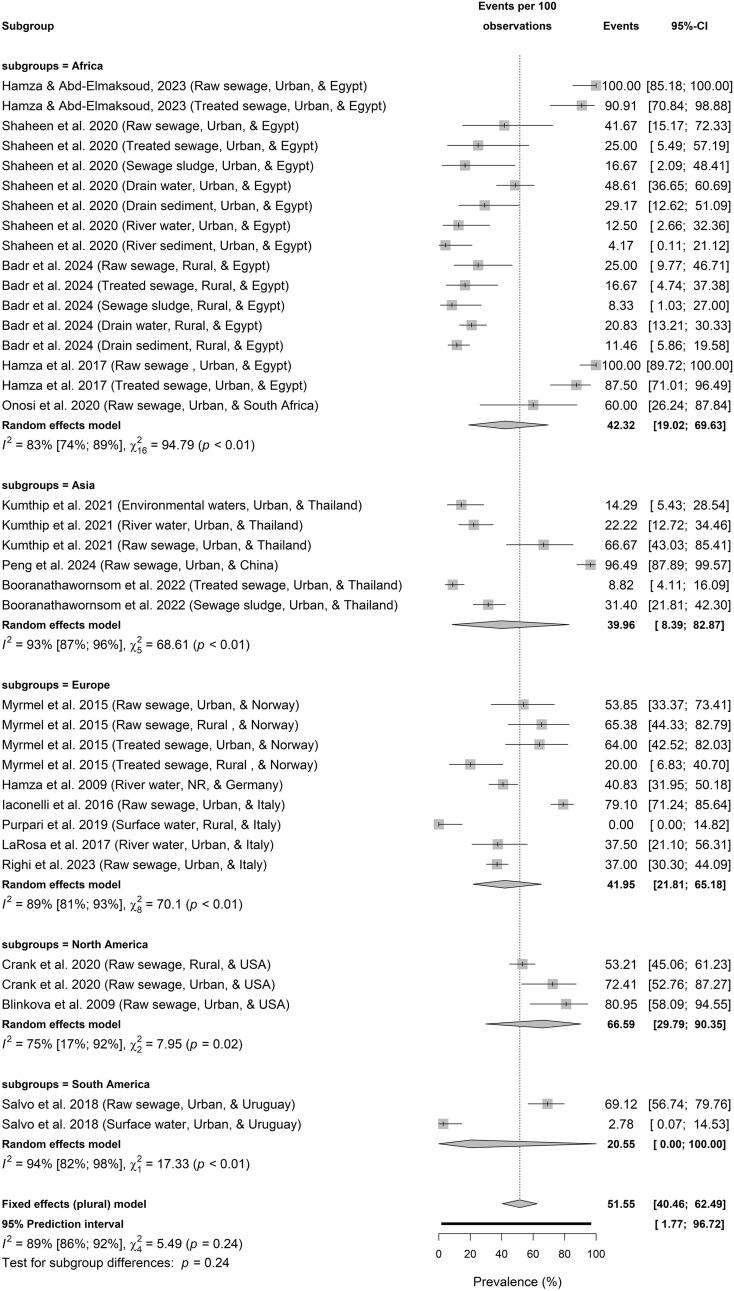
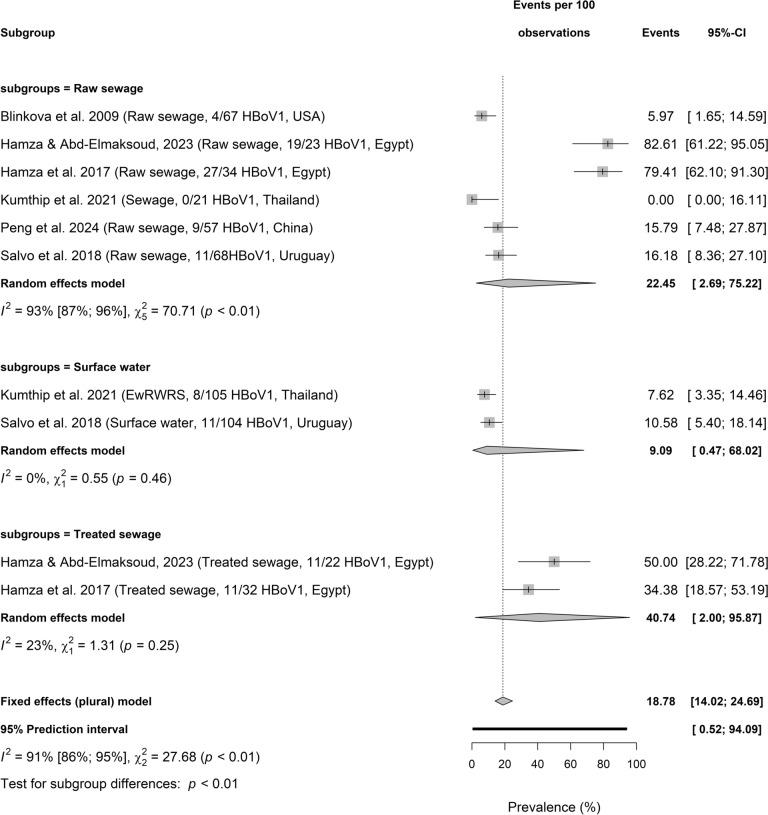
Environmental matrices (EMs) are important reservoirs for the human bocavirus (HBoV). This study aimed to determine HBoV prevalence in EMs and model its association with SDG6.3.1 (wastewater production (WWp), collection (WWc), treatment (WWt), and reuse (WWr)). HBoV data-mined from EMs were fitted to a random-intercept-logistic regression/1000-bootstrapped-based meta-regressions. HBoV global prevalence in EMs was 42.19% (95%CI: 28.07-57.72), and varied non-statistically across continents (North America (66.59%), Africa (42.32%), Europe (41.95%), Asia (39.96%), South America (20.55%)), economies (high-income (45.04%) > upper-middle-income (42.56%) > lower-middle-income (41.35%)), WHO regions (Western Europe (41.95%) > Middle East & North Africa (41.35%) > East Asia & Pacific (39.96%) > North America (66.59%) > Latin America & Caribbean (20.55%)) but significantly across dwelling settings (urban: 52.02% versus rural: 20.29%) and sample types (raw sewage (RS, 73.16%) > treated sewage (TS, 43.47%) > sewage sludge (SS, 19.87%) > sediment (13.24%) > surface waters (18.55%)). HBoV subtypes circulating in EMs varied among sample types (HBoV1 in TS (40.74%) > RS (22.45%) > surface water (9.09%); HBoV2 in RS (75.42%) > TS (54.82%) > surface water (18.24%); HBoV3 in RS (64.74%) > TS (58.95%) > surface water (6.48%) > SS (3.49%)). HBoV prevalence in EMs had direct relationship (p ≤ 0.05) with SDG6.3.1 variables (WWp: F = 4.5822), and WWr: F = 4.3735; WWt: F = 3.9517; and WWc: F = 3.3510) accounted for 17.13%, 15.79%,15.65%, and 12.92% of the estimate variance, respectively. In conclusion, HBoV prevalence is high in EMs globally, across regions, sample types and showed considerable affinity with SDG6.3.1 variables.
环境基质(EMs)是人类博卡病毒(HBoV)的重要储存库。本研究旨在确定环境基质中HBoV的流行率,并建立其与可持续发展目标6.3.1(废水产生(WWp)、收集(WWc)、处理(WWt)和再利用(WWr))之间的关联模型。从环境基质中挖掘的HBoV数据被拟合到随机截距逻辑回归/基于1000次自抽样的元回归模型中。环境基质中HBoV的全球流行率为42.19%(95%置信区间:28.07 - 57.72),在各大洲(北美洲(66.59%)、非洲(42.32%)、欧洲(41.95%)、亚洲(39.96%)、南美洲(20.55%))、经济体(高收入(45.04%)>中高收入(42.56%)>中低收入(41.35%))、世界卫生组织区域(西欧(41.95%)>中东和北非(41.35%)>东亚和太平洋(39.96%)>北美洲(66.59%)>拉丁美洲和加勒比地区(20.55%))之间无统计学差异,但在居住环境(城市:52.02%,农村:20.29%)和样本类型(原污水(RS,73.16%)>处理后污水(TS,43.47%)>污水污泥(SS,19.87%)>沉积物(13.24%)>地表水(18.55%))之间存在显著差异。环境基质中传播的HBoV亚型在样本类型之间也有所不同(TS中HBoV1(40.74%)>RS(22.45%)>地表水(9.09%);RS中HBoV2(75.42%)>TS(54.82%)>地表水(18.24%);RS中HBoV3(64.74%)>TS(58.95%)>地表水(6.48%)>SS(3.49%))。环境基质中HBoV的流行率与可持续发展目标6.3.1变量(WWp:F = 4.5822)、WWr(F = 4.3735)、WWt(F = 3.9517)和WWc(F = 3.3510)存在直接关系(p≤0.05),分别占估计方差的17.13%、15.79%、15.65%和12.92%。总之,全球环境基质中HBoV的流行率较高,在不同地区、样本类型中均如此,并且与可持续发展目标6.3.1变量表现出相当的相关性。



 Zotero 插件