
数字问卷响应时间(DQRT):一种普遍存在且低成本的认知处理速度数字检测方法。
Digital questionnaire response time (DQRT): A ubiquitous and low-cost digital assay of cognitive processing speed.
作者信息
Teckentrup Vanessa, Rosická Anna M, Donegan Kelly R, Gallagher Eoghan, Hanlon Anna K, Gillan Claire M
机构信息
School of Psychology and Trinity College Institute of Neuroscience, Trinity College Dublin, Dublin 2, Ireland.
Global Brain Health Institute, Trinity College Dublin, Dublin 2, Ireland.
出版信息
Behav Res Methods. 2025 Jun 17;57(7):200. doi: 10.3758/s13428-025-02727-x.
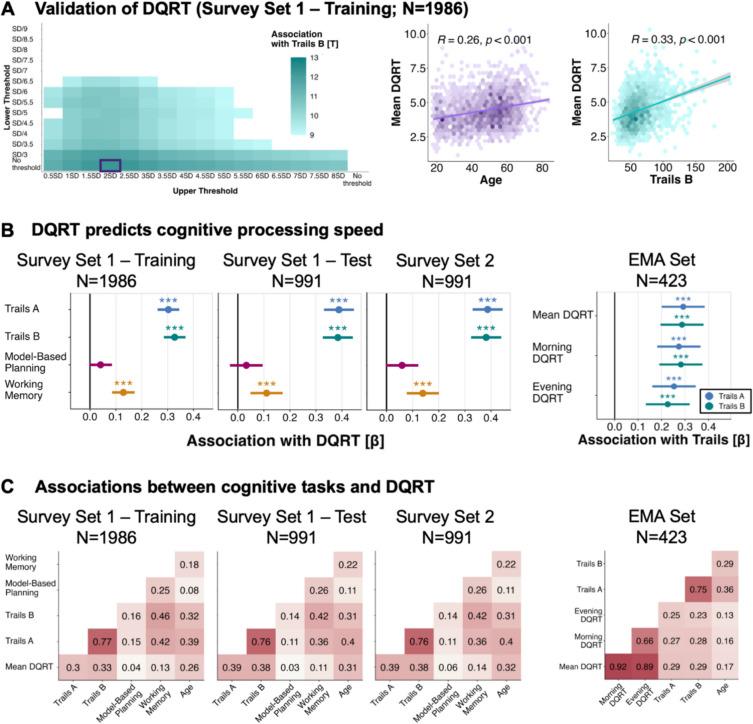
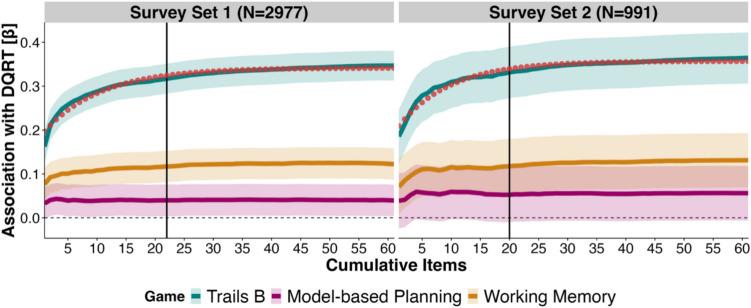
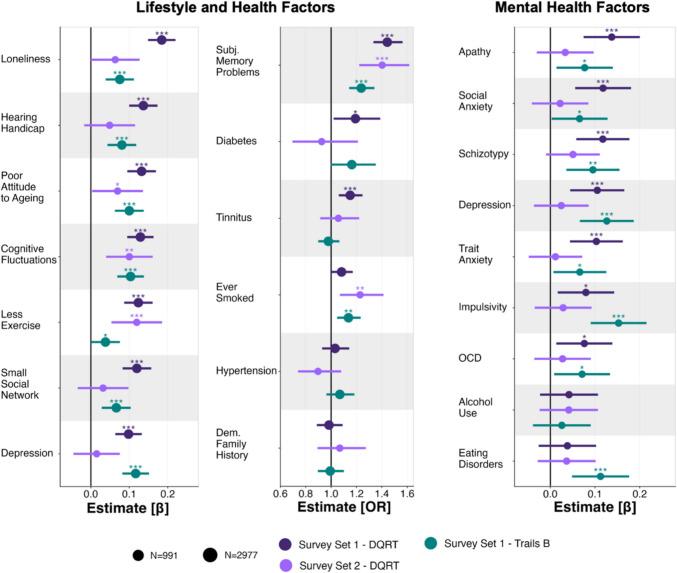
Digital survey tools have all but replaced paper and pen in the psychological sciences, and consequently new forms of potentially useful research paradata are now routinely gathered. A particularly common byproduct of research is questionnaire timestamps, which some have suggested can be used as a measure of cognitive function. Here, we conducted a comprehensive validation of this measure, which we call the "digital questionnaire response time," or "DQRT." Using data from N = 2,977 users of a smartphone app, we first ran a data-driven bootstrapping approach to examine how best to quantify DQRT. DQRT was slower in older adults (r = 0.26) and in those with lower educational attainment and socioeconomic status. Testing the association between DQRT and working memory (range r = 0.11-0.14), model-based planning (range r = 0.03-0.06), and processing speed (range r = 0.29-0.39) across cross-sectional and longitudinal subsamples, we found support for a cognitive characterization of DQRT as a measure of cognitive processing speed. DQRT was more strongly correlated with nine out of 13 lifestyle and health factors, and four out of nine mental health factors than a task-based measure of processing speed. DQRT showed good test-retest reliability, and associations between DQRT and task-based processing speed were higher within individuals (r = 0.35) than between individuals (r = 0.25). Finally, we highlight substantial, but addressable, potential confounds inherent in the measure. We conclude that DQRT has important limitations, but overall can serve as a valid and reliable index of cognitive processing speed that can be gathered at unprecedented scale, unobtrusively, and repeatedly, during a variety of real-world digital behaviors.
在心理学领域,数字调查工具几乎已经完全取代了纸笔,因此现在经常会收集到各种形式的潜在有用的研究副数据。研究中一个特别常见的副产品是问卷时间戳,有人认为它可以用作认知功能的一种衡量指标。在此,我们对这一指标进行了全面验证,我们将其称为“数字问卷响应时间”,简称“DQRT”。利用来自一款智能手机应用的2977名用户的数据,我们首先采用了一种数据驱动的自抽样方法,以研究如何最好地量化DQRT。老年人的DQRT较慢(r = 0.26),受教育程度较低和社会经济地位较低的人也是如此。在横断面和纵向子样本中测试DQRT与工作记忆(范围r = 0.11 - 0.14)、基于模型的规划(范围r = 0.03 - 0.06)以及处理速度(范围r = 0.29 - 0.39)之间的关联,我们发现有证据支持将DQRT作为认知处理速度的一种衡量指标进行认知特征描述。与基于任务的处理速度衡量指标相比,DQRT与13种生活方式和健康因素中的9种以及9种心理健康因素中的4种的相关性更强。DQRT显示出良好的重测信度,并且DQRT与基于任务的处理速度之间的关联在个体内部(r = 0.35)高于个体之间(r = 0.25)。最后,我们强调了该指标中存在的重大但可解决的潜在混杂因素。我们的结论是,DQRT有重要局限性,但总体而言可作为认知处理速度的有效且可靠指标,它能够在各种现实世界的数字行为中以前所未有的规模、不显眼地且反复地收集。


 Zotero 插件