
自身免疫性疾病:分子发病机制与治疗靶点
Autoimmune Diseases: Molecular Pathogenesis and Therapeutic Targets.
作者信息
Song Xiaoshuang, Liang Hantian, Nan Fang, Chen Wenjing, Li Junyao, He Liu, Cun Yiping, Li Zhenhong, Zhang Wei, Zhang Dunfang
机构信息
Department of Biotherapy, State Key Laboratory of Biotherapy and Cancer Center, Collaborative Innovation Center of Biotherapy West China Hospital Sichuan University Chengdu Sichuan China.
Center for Immunology and Hematology Department of Biotherapy and Cancer Center and State Key Laboratory of Biotherapy West China Hospital Sichuan University Chengdu Sichuan China.
出版信息
MedComm (2020). 2025 Jun 16;6(7):e70262. doi: 10.1002/mco2.70262. eCollection 2025 Jul.
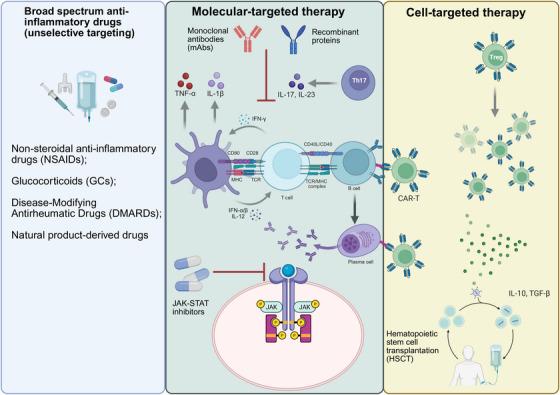
Autoimmune diseases are a set of disorders in which the immune system attacks one's own tissues, leading to chronic inflammation, tissue damage, and systemic dysfunction. Affecting approximately 10% of the global population, these diseases impose significant health and economic burdens worldwide. The pathogenesis of autoimmune diseases is complex, involving not only genetic predisposition (e.g., human leukocyte antigen variants), environmental triggers (e.g., infections), and a dysregulated immune response but also various interacting components that contribute to the development of diverse clinical phenotypes. This review provides a comprehensive overview of common autoimmune diseases, covering their clinical manifestations, pathogenic mechanisms, and diagnostic approaches such as disease-specific autoantibodies. We also explore current therapeutic strategies, including commonly used broad-spectrum anti-inflammatory drugs, recent molecular-targeted therapies (e.g., Janus kinase inhibitors, monoclonal antibodies), and emerging cellular therapies such as chimeric antigen receptor T cells therapy and regulatory T-cell adoptive transfer. Incorporating knowledge from preclinical and clinical studies, this review synthesizes relevant information to inform about autoimmune diseases, bridge the gap from lab to clinic, and promote future advances through exploring precision medicine applications to meet clinical needs.
自身免疫性疾病是一组免疫系统攻击自身组织的病症,会导致慢性炎症、组织损伤和全身功能障碍。这些疾病影响着全球约10%的人口,在全球范围内造成了重大的健康和经济负担。自身免疫性疾病的发病机制很复杂,不仅涉及遗传易感性(如人类白细胞抗原变体)、环境触发因素(如感染)和免疫反应失调,还涉及导致多种临床表型发展的各种相互作用成分。本综述全面概述了常见的自身免疫性疾病,涵盖其临床表现、致病机制以及疾病特异性自身抗体等诊断方法。我们还探讨了当前的治疗策略,包括常用的广谱抗炎药物、近期的分子靶向疗法(如 Janus 激酶抑制剂、单克隆抗体)以及新兴的细胞疗法,如嵌合抗原受体 T 细胞疗法和调节性 T 细胞过继转移。本综述结合临床前和临床研究的知识,综合相关信息以增进对自身免疫性疾病的了解,弥合从实验室到临床的差距,并通过探索精准医学应用以满足临床需求来推动未来的进展。



 Zotero 插件