
在负重屈曲过程中无水泥股骨和胫骨部件的可诱导移位
Inducible Displacement of Cementless Femoral and Tibial Components Throughout Weight-bearing Flexion.
作者信息
Hext Rebecca A, Broberg Jordan S, Howard James L, Lanting Brent A, Teeter Matthew G
机构信息
Department of Medical Biophysics, Schulich School of Medicine & Dentistry, Western University, London, ON, Canada.
Division of Orthopaedic Surgery, Schulich School of Medicine & Dentistry, Western University, London, ON, Canada.
出版信息
Arthroplast Today. 2025 Jun 4;33:101723. doi: 10.1016/j.artd.2025.101723. eCollection 2025 Jun.
BACKGROUND
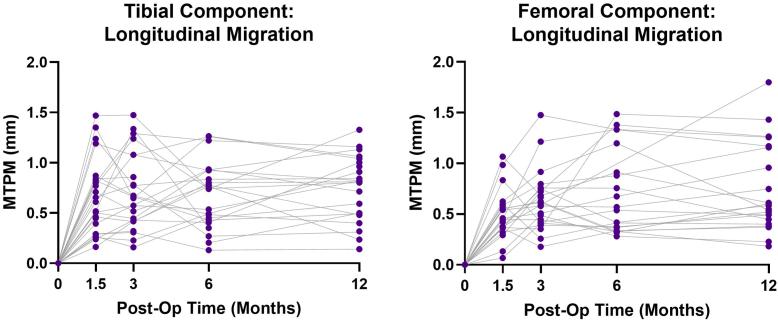
Cementless fixation for total knee arthroplasty has been increasing following advancements in implant designs. The use of cementless designs has been supported through longitudinal radiostereometric analysis (RSA) studies; however, few studies have used inducible displacement exams to assess fixation throughout flexion. Our primary aim was to assess patterns and locations of inducible displacement throughout flexion.
METHODS
Participants (n = 24) received a fixed-bearing, cruciate-retaining cementless implant. At 1-year postoperation, participants underwent a supine RSA exam and standing RSA exams at 0°, 20°, 40°, and 60° of knee flexion. Inducible displacements were reported as maximum total point motion and as 3-dimensional translations at points of interest.
RESULTS
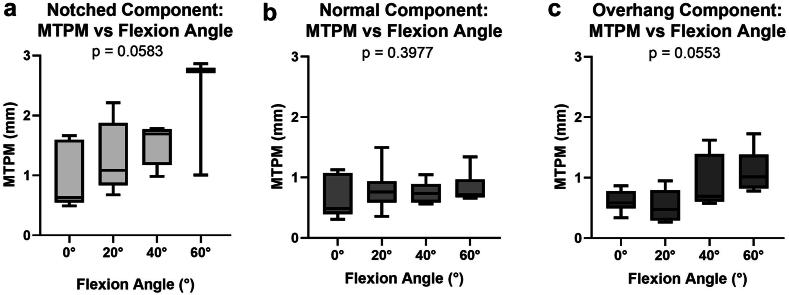
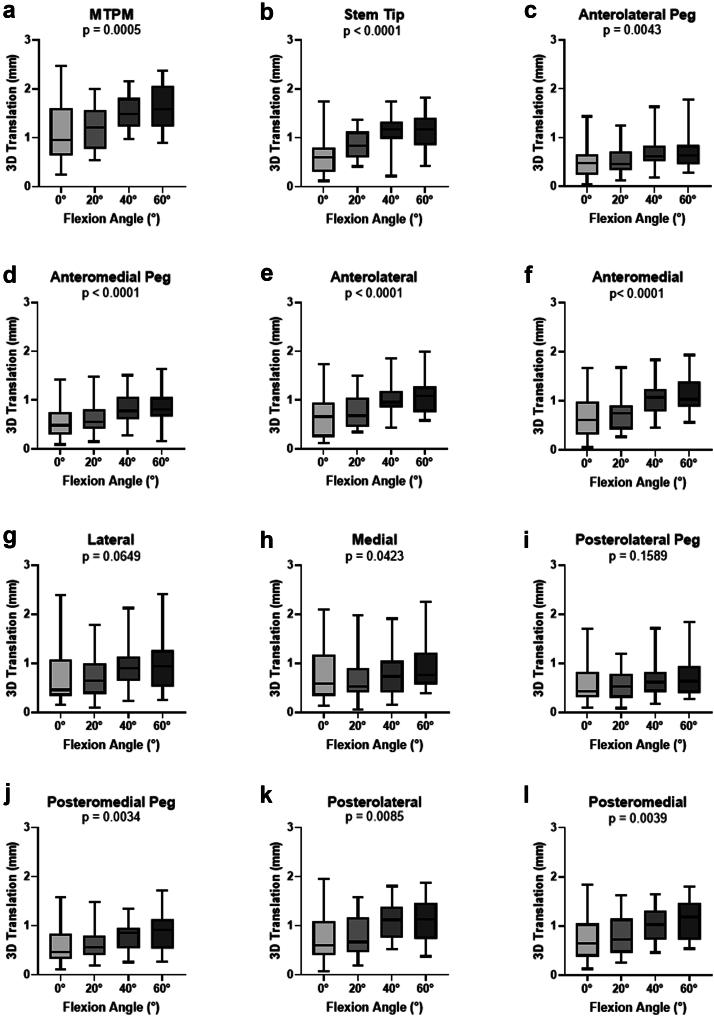
Inducible displacement of the tibial component increased with knee flexion angle and was 1.129 ± 0.644 mm at 0°, 1.181 ± 0.462 mm at 20°, 1.526 ± 0.386 mm at 40°, and 1.648 ± 0.461 mm at 60°. Inducible displacement of the femoral component increased with knee flexion angle and was 0.704 ± 0.364 mm at 0°, 0.839 ± 0.458 mm at 20°, 1.011 ± 0.451 mm at 40°, and 1.203 ± 0.708 mm at 60°. The strongest correlations between 3-dimensional translation and knee flexion angle were at the stem tip for the tibial component, and anterior flange tip for the femoral component.
CONCLUSIONS
Inducible displacement measurements increased with knee flexion angle. At 0°, both components had values consistent with well-fixed components. The locations of maximal displacements support these components are well-fixed and demonstrate that inducible displacement throughout flexion is due to mechanical loading.
背景
随着植入物设计的进步,全膝关节置换术的非骨水泥固定应用越来越多。纵向放射立体测量分析(RSA)研究支持了非骨水泥设计的使用;然而,很少有研究使用诱导位移检查来评估整个屈曲过程中的固定情况。我们的主要目的是评估整个屈曲过程中诱导位移的模式和位置。
方法
参与者(n = 24)接受了固定平台、保留交叉韧带的非骨水泥植入物。术后1年,参与者在膝关节屈曲0°、20°、40°和60°时分别进行仰卧位RSA检查和站立位RSA检查。诱导位移以最大总点运动和感兴趣点的三维平移来报告。
结果
胫骨组件的诱导位移随膝关节屈曲角度增加,在0°时为1.129±0.644mm,20°时为1.181±0.462mm,40°时为1.526±0.386mm,60°时为1.648±0.461mm。股骨组件的诱导位移也随膝关节屈曲角度增加,在0°时为0.704±0.364mm,20°时为0.839±0.458mm,40°时为1.011±0.451mm,60°时为1.203±0.708mm。三维平移与膝关节屈曲角度之间的最强相关性在胫骨组件的柄尖和股骨组件的前凸缘尖处。
结论
诱导位移测量值随膝关节屈曲角度增加。在0°时,两个组件的值与固定良好的组件一致。最大位移的位置表明这些组件固定良好,并证明整个屈曲过程中的诱导位移是由于机械负荷所致。



 Zotero 插件