
分离状态的诱导:一项元分析
The Induction of Dissociative States: A Meta-Analysis.
作者信息
Brake Benjamin, Wieder Lillian, Hughes Natasha, Lalinde Ivonne Saravia, Marr Danielle, Geagea Dali, Pick Susannah, Reinders Antje A T S, Kamboj Sunjeev K, Thompson Trevor, Terhune Devin B
机构信息
Department of Neuroscience, Institute of Psychiatry, Psychology and Neuroscience, King's College London, London, United Kingdom.
Department of Psychology, Institute of Psychiatry, Psychology and Neuroscience, King's College London, London, United Kingdom.
出版信息
Biol Psychiatry Glob Open Sci. 2025 Apr 28;5(4):100521. doi: 10.1016/j.bpsgos.2025.100521. eCollection 2025 Jul.
BACKGROUND
Dissociative states, characterized by discontinuities in awareness and perception, occur in a diverse array of psychiatric disorders and contexts. These states have been experimentally modeled in the laboratory through various induction methods, but relatively little is known about the efficacy and comparability of different experimental methods.
METHODS
In this meta-analysis, we quantified dissociative states, as indexed by a standardized instrument (Clinician-Administered Dissociative States Scale), at baseline in varied diagnostic categories and in response to different experimental induction methods (psychological techniques and pharmacological agents) in both clinical and nonclinical samples. Primary outcomes were state dissociation effect sizes (Hedges' ) (PROSPERO registration: CRD42022384886). A total of 2214 articles were screened, which yielded 123 eligible articles and 155 effect sizes comprising 6692 individuals.
RESULTS
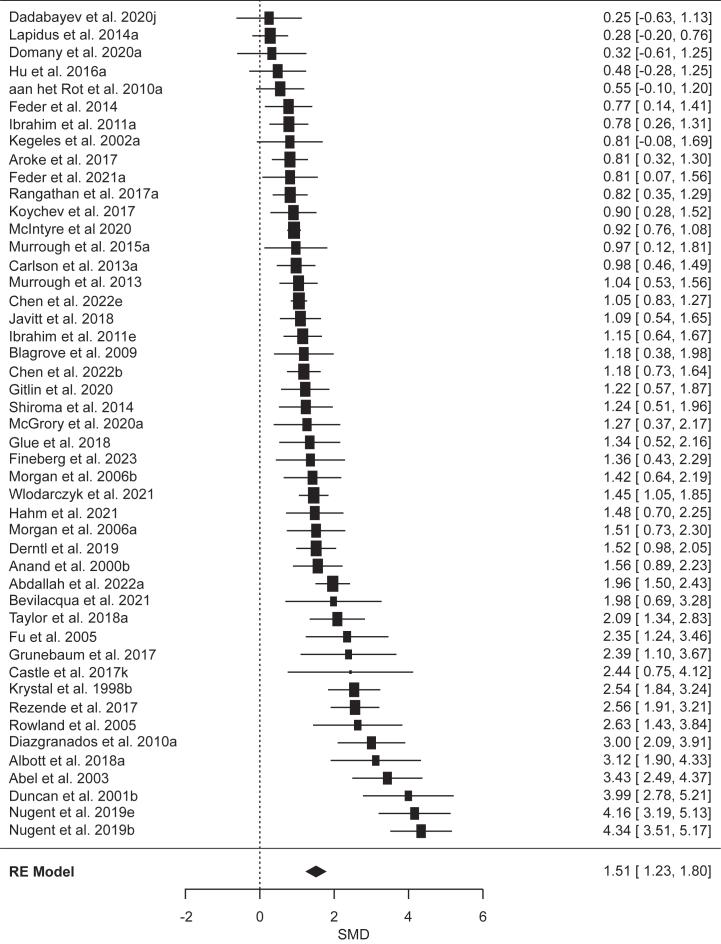
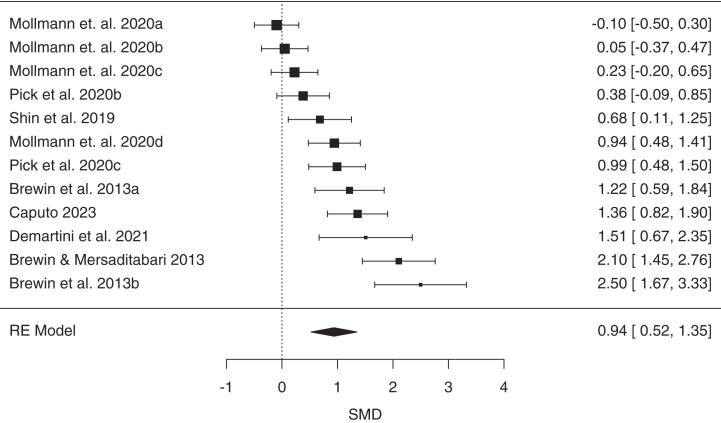
High levels of baseline state dissociation were observed in multiple diagnostic categories relative to controls, with the largest effects found in the dissociative and complex subtypes of posttraumatic stress disorder (PTSD-DC). In controlled experiments, induced state dissociation was most pronounced in response to mirror gazing and multiple pharmacological agents, with effects in ketamine and cannabis exceeding baseline state dissociation in PTSD-DC. The effect sizes were characterized by pronounced heterogeneity but were not reliably associated with methodological features of the original studies.
CONCLUSIONS
Elevated state dissociation is present in multiple diagnostic categories, and comparable or higher levels can be reliably induced in controlled experiments using psychological techniques and pharmacological agents. These results demonstrate the efficacy of several methods for experimentally modeling dissociation and have implications for measuring adverse events and predicting outcomes in clinical interventions that involve pharmacological agents.
背景
分离状态以意识和感知的间断为特征,出现在多种精神疾病和情境中。这些状态已在实验室中通过各种诱导方法进行了实验模拟,但对于不同实验方法的有效性和可比性了解相对较少。
方法
在这项荟萃分析中,我们使用标准化工具(临床医生实施的分离状态量表)对不同诊断类别中的基线分离状态进行量化,并在临床和非临床样本中对不同实验诱导方法(心理技术和药物制剂)的反应进行量化。主要结局是状态分离效应量(Hedges' )(PROSPERO注册号:CRD42022384886)。共筛选了2214篇文章,得到123篇符合条件的文章和155个效应量,涉及6692名个体。
结果
相对于对照组,在多个诊断类别中观察到高水平的基线状态分离,其中创伤后应激障碍的分离和复杂亚型(PTSD-DC)的效应最大。在对照实验中,诱导的状态分离在凝视镜子和多种药物制剂的反应中最为明显,氯胺酮和大麻的效应超过了PTSD-DC中的基线状态分离。效应量具有明显的异质性,但与原始研究的方法学特征没有可靠关联。
结论
多种诊断类别中存在升高的状态分离,并且在使用心理技术和药物制剂的对照实验中可以可靠地诱导出相当或更高水平的状态分离。这些结果证明了几种用于实验模拟分离的方法的有效性,并对测量不良事件和预测涉及药物制剂的临床干预中的结局具有启示意义。


 Zotero 插件