
用于预测……中抗菌药物耐药性的基因组学和机器学习方法 。(原文句子不完整,“in”后面缺少具体内容)
Genomic and machine learning approaches to predict antimicrobial resistance in .
作者信息
Liu Xin, Long Shanshan, Chen Fangyuan, Liu Chang, Han Peng, Yu Hua, Huang Xiaobo, Pan Chun, Yue Ruiming, Feng Wentao, Rao Guanhua, Shen Han, Pan Lingai
机构信息
Department of Laboratory Medicine, Sichuan Provincial People's Hospital, University of Electronic Science and Technology of China, Chengdu, Sichuan, China.
Genskey Medical Technology Co., Ltd, Beijing, China.
出版信息
Microbiol Spectr. 2025 Aug 5;13(8):e0263224. doi: 10.1128/spectrum.02632-24. Epub 2025 Jun 18.
UNLABELLED
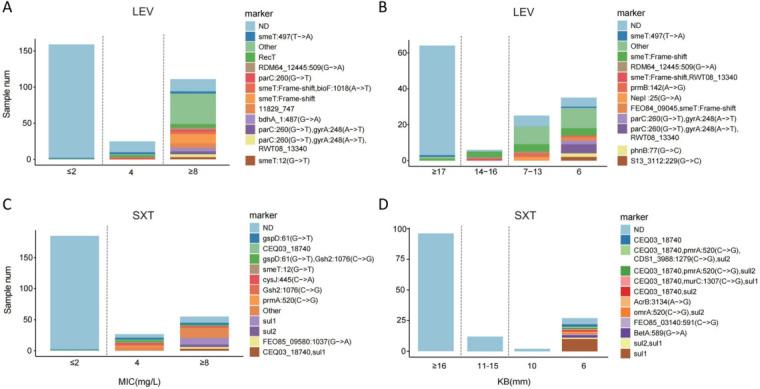
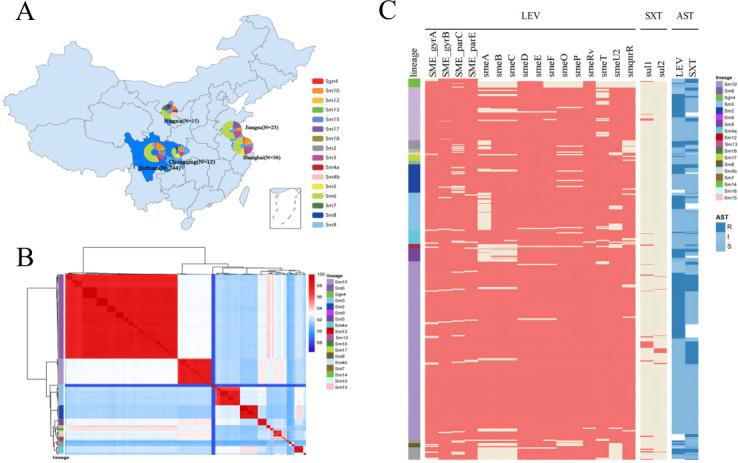
is a multidrug-resistant pathogen, which poses a major challenge to clinical management due to its increasing resistance to common antibiotics, such as levofloxacin (LEV) and trimethoprim-sulfamethoxazole (SXT), and poor clinical response to treatment. There is an urgent need for rapid and reliable antimicrobial susceptibility testing (AST) methods to improve treatment outcomes. This study collected 441 strains, performed whole-genome sequencing, and used machine learning to identify key resistance determinants for LEV and SXT, constructing predictive models for resistance phenotypes. The 441 . strains we collected show significant genomic diversity and representative lineage distribution. Machine learning identified key resistance markers for LEV and SXT, improving area under the curve values to 92.80% for LEV and 95.44% for SXT. Validation accuracies reached 94.87% for LEV and 96.27% for SXT. Mutations in parC, smeT, and gyrA were strongly associated with LEV resistance. The gene presence of sul1, sul2, and CEQ03_18740, as well as gene mutations in Gsh2, prmA, and gspD, were highly correlated with SXT resistance. These findings suggest that integrating genome-based markers can enhance the prediction of antimicrobial resistance, offering a robust method for clinical application. Genotypic AST can reliably predict resistance phenotypes, providing a promising alternative to traditional AST methods for infections.
IMPORTANCE
is an emerging multidrug-resistant pathogen, making treatment challenging and requiring more effective diagnostic methods. This study offers a novel approach by integrating whole-genome sequencing with machine learning to identify key resistance markers for levofloxacin and trimethoprim-sulfamethoxazole. The predictive models developed can reliably forecast antimicrobial resistance phenotypes, providing a faster and more accurate alternative to traditional susceptibility testing. This approach not only enhances clinical decision-making but also aids in the timely administration of appropriate therapies. By identifying specific genomic markers associated with resistance, this study lays the foundation for future development of personalized treatment strategies, addressing the growing concern of antibiotic resistance.
未标记
是一种多重耐药病原体,由于其对常见抗生素(如左氧氟沙星(LEV)和甲氧苄啶 - 磺胺甲恶唑(SXT))的耐药性不断增加以及治疗的临床反应不佳,给临床管理带来了重大挑战。迫切需要快速可靠的抗菌药物敏感性测试(AST)方法来改善治疗结果。本研究收集了441株菌株,进行了全基因组测序,并使用机器学习来识别LEV和SXT的关键耐药决定因素,构建耐药表型的预测模型。我们收集的441株菌株显示出显著的基因组多样性和代表性谱系分布。机器学习识别出了LEV和SXT的关键耐药标记,将LEV的曲线下面积值提高到92.80%,SXT的提高到95.44%。LEV的验证准确率达到94.87%,SXT的达到96.27%。parC、smeT和gyrA中的突变与LEV耐药性密切相关。sul1、sul2和CEQ03_18740的基因存在以及Gsh2、prmA和gspD中的基因突变与SXT耐药性高度相关。这些发现表明,整合基于基因组的标记可以增强对抗菌药物耐药性的预测,为临床应用提供一种强大的方法。基因型AST可以可靠地预测耐药表型,为感染的传统AST方法提供了一种有前景的替代方法。
重要性
是一种新兴的多重耐药病原体,使治疗具有挑战性,需要更有效的诊断方法。本研究通过将全基因组测序与机器学习相结合,提供了一种新方法来识别左氧氟沙星和甲氧苄啶 - 磺胺甲恶唑的关键耐药标记。所开发的预测模型可以可靠地预测抗菌药物耐药表型,为传统药敏试验提供了一种更快、更准确的替代方法。这种方法不仅增强了临床决策,还有助于及时给予适当的治疗。通过识别与耐药性相关的特定基因组标记,本研究为未来个性化治疗策略的发展奠定了基础,解决了对抗生素耐药性日益增长的担忧。


 Zotero 插件