
美国国家环境空气质量标准(NAAQS)中二氧化硫时间目标的变化降低了燃煤电厂的平均排放量和峰值排放量。
Changes in the Temporal Targeting of the U.S. National Ambient Air Quality Standards (NAAQS) for SO Reduce Average and Peak Emissions from Coal Power Plants.
作者信息
Slusarewicz Joanna H, Karplus Valerie J
机构信息
Department of Engineering and Public Policy, Carnegie Mellon University, 5000 Forbes Ave, Pittsburgh, Pennsylvania 15213, United States.
Wilton E. Scott Institute for Energy Innovation, Carnegie Mellon University, Pittsburgh, Pennsylvania 15213, United States.
出版信息
Environ Sci Technol. 2025 Jul 1;59(25):12437-12446. doi: 10.1021/acs.est.4c10718. Epub 2025 Jun 18.
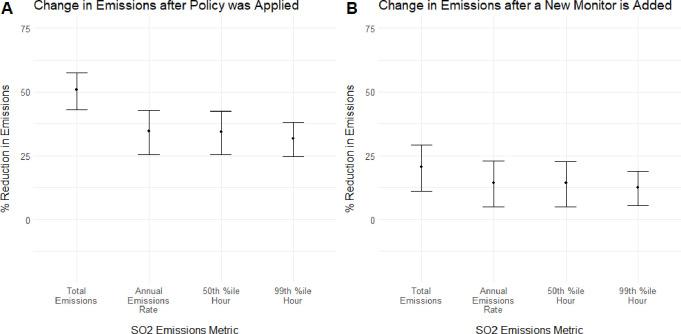
The U.S. National Ambient Air Quality Standards (NAAQS) protect public health by limiting ambient pollutant concentrations, but effects at power plants are not well characterized. We estimate how a 2010 SO NAAQS change that altered policy targeting from peak hourly emissions to annually aggregated hourly emissions affected SO emissions from coal-fired power plants. Using data on electricity generating unit (EGU) characteristics, SO emissions, fuel prices, and PM NAAQS classifications from 2001 to 2019 from public data sources, we estimate that, after a county was classified under the 2010 SO standard, EGUs reduced SO emissions during daily maximum hours by 31.6% (95% CI [-0.381, -0.247]) at the 99th percentile and 34.4% (95% CI [-0.424, -0.253]) at the 50th percentile. After a nearby ambient SO monitor was added to assess NAAQS compliance, hourly emissions fell by 12.4% (95% CI [-0.188, -0.054]) at the 99th percentile and 14.4% (95% CI [-0.228, -0.050]) at the 50th percentile. Our results also suggest the new standard had the same effect on peak hourly SO emissions as median and that plants in counties prioritized for early designation were less responsive to the policy change. These results suggest that the 2010 SO NAAQS change may have reduced SO emissions but may not have had an outsized impact on peak emissions despite policy guidance encouraging their control.
美国国家环境空气质量标准(NAAQS)通过限制环境污染物浓度来保护公众健康,但对发电厂的影响尚未得到充分描述。我们估计了2010年二氧化硫NAAQS的变化,该变化将政策目标从每小时峰值排放量改为年度累计每小时排放量,这对燃煤发电厂的二氧化硫排放产生了何种影响。利用2001年至2019年来自公共数据源的发电机组(EGU)特征、二氧化硫排放、燃料价格和颗粒物NAAQS分类数据,我们估计,在一个县被纳入2010年二氧化硫标准后,EGU在每日排放最高时段的二氧化硫排放在第99百分位数处减少了31.6%(95%置信区间[-0.381, -0.247]),在第50百分位数处减少了34.4%(95%置信区间[-0.424, -0.253])。在增加了附近的环境二氧化硫监测器以评估是否符合NAAQS之后,每小时排放在第99百分位数处下降了12.4%(95%置信区间[-0.188, -0.054]),在第50百分位数处下降了14.4%(95%置信区间[-0.228, -0.050])。我们的结果还表明,新标准对每小时峰值二氧化硫排放的影响与中位数相同,并且在优先进行早期指定的县中的电厂对政策变化的反应较小。这些结果表明2010年二氧化硫NAAQS的变化可能减少了二氧化硫排放,但尽管有政策指导鼓励控制峰值排放,其对峰值排放可能并未产生巨大影响。


 Zotero 插件