
早期肺癌筛查的创新技术及其临床前景
Innovative technologies and their clinical prospects for early lung cancer screening.
作者信息
Deng Zisu, Ma Xiaocao, Zou Shubiao, Tan Liling, Miao Tingting
机构信息
Department of Nuclear Medicine, The Second Affiliated Hospital, Jiangxi Medical College, Nanchang University, Nanchang, China.
Department of Preventive Medicine, School of Public Health, Nanchang University, Nanchang, Jiangxi, China.
出版信息
Clin Exp Med. 2025 Jun 18;25(1):212. doi: 10.1007/s10238-025-01752-6.
BACKGROUND
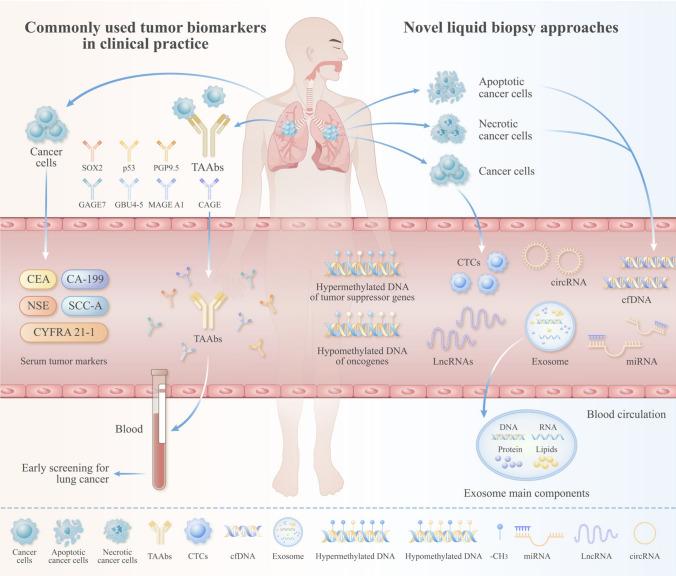
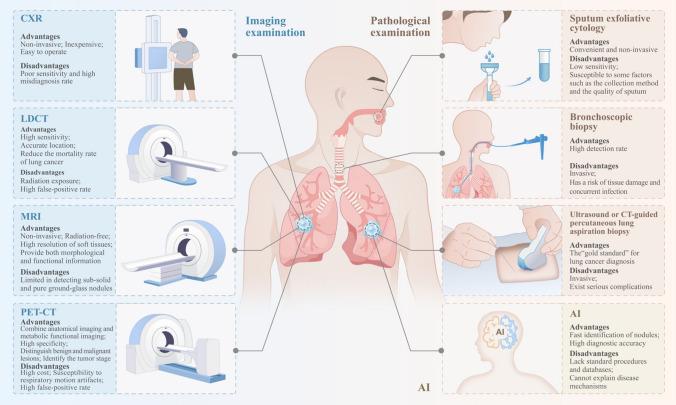
Lung cancer remains the leading cause of cancer-related mortality worldwide, due to lacking effective early-stage screening approaches. Imaging, such as low-dose CT, poses radiation risk, and biopsies can induce some complications. Additionally, traditional serum tumor markers lack diagnostic specificity. This highlights the urgent need for precise and non-invasive early detection techniques.
PURPOSE
This systematic review aims to evaluate the limitations of conventional screening methods (imaging/biopsy/tumor markers), seek breakthroughs in liquid biopsy for early lung cancer detection, and assess the potential value of Artificial Intelligence (AI), thereby providing evidence-based insights for establishing an optimal screening framework.
METHODS
We systematically searched the PubMed database for the literature published up to May 2025. Key words include "Artificial Intelligence", "Early Lung cancer screening", "Imaging examination", "Innovative technologies", "Liquid biopsy", and "Puncture biopsy". Our inclusion criteria focused on studies about traditional and innovative screening methods, with an emphasis on original research concerning diagnostic performance or high-quality reviews. This approach helps identify critical studies in early lung cancer screening.
CONCLUSIONS
Novel liquid biopsy techniques are non-invasive and have superior diagnostic efficacy. AI-assisted diagnostics further enhance accuracy. We propose three development directions: establishing risk-based liquid biopsy screening protocols, developing a stepwise "imaging-AI-liquid biopsy" diagnostic workflow, and creating standardized biomarker panel testing solutions. Integrating traditional methodologies, novel liquid biopsies, and AI to establish a comprehensive early lung cancer screening model is important. These innovative strategies aim to significantly increase early detection rates, substantially enhancing lung cancer control. This review provides both theoretical guidance for clinical practice and future research.
背景
由于缺乏有效的早期筛查方法,肺癌仍然是全球癌症相关死亡的主要原因。诸如低剂量CT等影像学检查存在辐射风险,而活检可能引发一些并发症。此外,传统的血清肿瘤标志物缺乏诊断特异性。这凸显了对精确且非侵入性早期检测技术的迫切需求。
目的
本系统评价旨在评估传统筛查方法(影像学检查/活检/肿瘤标志物)的局限性,寻找液体活检在早期肺癌检测方面的突破,并评估人工智能(AI)的潜在价值,从而为建立最佳筛查框架提供循证见解。
方法
我们系统检索了截至2025年5月发表在PubMed数据库中的文献。关键词包括“人工智能”“早期肺癌筛查”“影像学检查”“创新技术”“液体活检”和“穿刺活检”。我们的纳入标准侧重于关于传统和创新筛查方法的研究,重点是有关诊断性能的原创研究或高质量综述。这种方法有助于识别早期肺癌筛查中的关键研究。
结论
新型液体活检技术是非侵入性的,具有卓越的诊断效能。人工智能辅助诊断进一步提高了准确性。我们提出三个发展方向:建立基于风险的液体活检筛查方案,开发逐步的“影像学检查-人工智能-液体活检”诊断工作流程,以及创建标准化的生物标志物组合检测解决方案。整合传统方法、新型液体活检和人工智能以建立全面的早期肺癌筛查模型很重要。这些创新策略旨在显著提高早期检测率,大幅加强肺癌控制。本综述为临床实践和未来研究提供了理论指导。
 Zotero 插件