
关于播散的一种新观点:生殖细胞肿瘤从中枢神经系统的体细胞转移。
A novel perspective on dissemination: somatic metastasis of germ cell tumors from the central nervous system.
作者信息
Qi Shao-Pei, Zhao Chuan, Ge Jing-Jing, Li Cheng, Xue Feng-Jun, Zhao Chi, Kong Chen-Chen, Sun Hui-Jie, Zhang Jing-Jing, Zhang Ya-Qi, Zhang Jun-Ping
机构信息
Department of Neurosurgery, Sanbo Brain Hospital, Capital Medical University, Beijing, China.
Department of Neuro-Oncology, Sanbo Brain Hospital,Capital Medical University, Beijing, China.
出版信息
Discov Oncol. 2025 Jun 18;16(1):1147. doi: 10.1007/s12672-025-02467-6.
PURPOSE
Primary germ cell tumors (GCTs) of the central nervous system are rare malignancies, with somatic metastasis being even less common. This study aims to propose a novel classification framework for dissemination patterns in CNS GCTs.
METHODS
A group of 4 patients with somatic metastasis were identified among 284 germ cell tumors. The characteristics of patients were identified through clinical history, imaging, and histopathology. Hematoxylin-eosin (H&E) and Immunohistochemistry (IHC) confirmed the pathological features, while radiology was used to determine the temporal and spatial characteristics of metastasis. Univariate analysis was conducted to assess the factors contributing to abdominal spread. Fisher's exact test was used for categorical data analysis. The dissemination process was systematically analyzed.
RESULTS
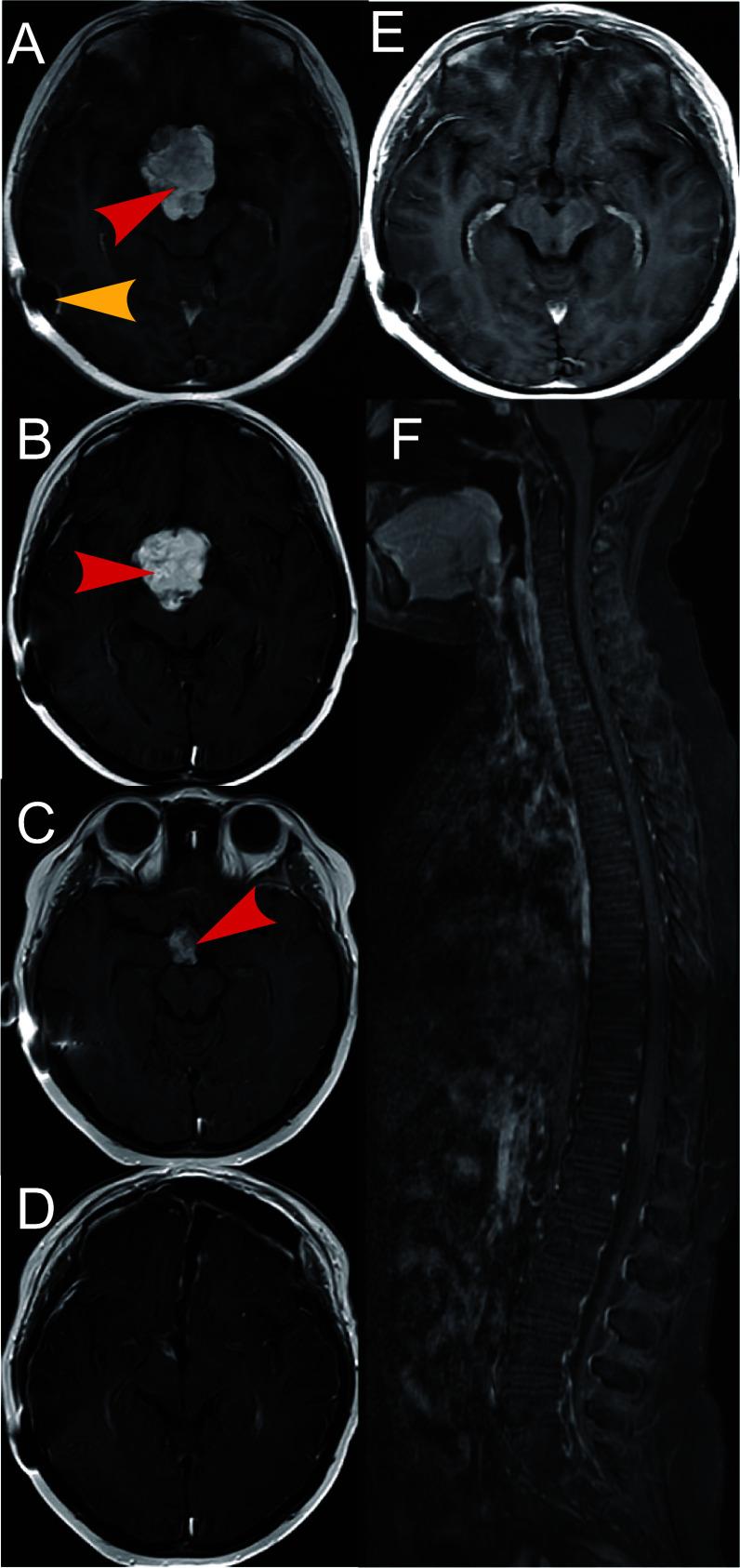
This disease is extremely rare, and the progression of metastatic germ cell tumors is often complex. All four patients underwent surgery, radiotherapy, and chemotherapy. In one case, the tumor spread to the anterior superior mediastinum via hematogenous metastasis; in two cases, it spread to the abdominal cavity through a ventriculoperitoneal shunt; and in one case, intraspinal spread occurred via cerebrospinal fluid. Over a follow-up period of 9 to 67 months, only one patient died from the disease. H&E and IHC staining confirmed pathological features. Analyzing dissemination introduced concepts like dynamics, components, mediums, ranges, portals, and patterns, creating a framework for understanding disease spread.
CONCLUSION
Our findings offer valuable insights for guiding treatment strategies and improving patient outcomes. CNS GCTs can be managed effectively with accurate diagnosis and appropriate treatment. The introduction of new concepts and classifications of dissemination can inform and guide treatment strategies.
目的
中枢神经系统原发性生殖细胞肿瘤(GCTs)是罕见的恶性肿瘤,发生躯体转移的情况更为少见。本研究旨在提出一种针对中枢神经系统GCTs播散模式的新型分类框架。
方法
在284例生殖细胞肿瘤中确定了4例发生躯体转移的患者。通过临床病史、影像学和组织病理学确定患者的特征。苏木精-伊红(H&E)染色和免疫组织化学(IHC)证实病理特征,而放射学用于确定转移的时间和空间特征。进行单因素分析以评估导致腹部播散的因素。采用Fisher精确检验进行分类数据分析。对播散过程进行系统分析。
结果
这种疾病极为罕见,转移性生殖细胞肿瘤的进展通常很复杂。所有4例患者均接受了手术、放疗和化疗。1例中,肿瘤通过血行转移扩散至前上纵隔;2例中,肿瘤通过脑室腹腔分流术扩散至腹腔;1例中,肿瘤通过脑脊液发生脊髓内播散。在9至67个月的随访期内,仅1例患者死于该疾病。H&E染色和IHC染色证实了病理特征。对播散的分析引入了动态、成分、介质、范围、门户和模式等概念,创建了一个理解疾病传播的框架。
结论
我们的研究结果为指导治疗策略和改善患者预后提供了有价值的见解。通过准确诊断和适当治疗,中枢神经系统GCTs可以得到有效管理。新的播散概念和分类的引入可以为治疗策略提供信息并加以指导。



 Zotero 插件