
理解并克服阻碍痴呆症护理中采用康复护理的消极态度:一项探索性定性研究
Understanding and Overcoming Negative Attitudes That Hinder Adoption of Reablement in Dementia Care: An Explorative Qualitative Study.
作者信息
Tuntland Hanne, Ashfaq Kiran, Zingmark Magnus, Metzelthin Silke F
机构信息
Department for Health and Functioning, Western Norway University of Applied Sciences, Bergen, Norway.
Department of Health Services Research, Maastricht University, Maastricht, the Netherlands.
出版信息
J Multidiscip Healthc. 2025 Jun 12;18:3411-3422. doi: 10.2147/JMDH.S522515. eCollection 2025.
PURPOSE
Dementia refers to a group of neuro-cognitive disorders that affect people worldwide. Reablement may facilitate people to maintain or regain abilities, encourage engagement in activities important to them, promote continued societal participation, and foster a meaningful life experience. However, the adoption of reablement in dementia care has been slow. This study aimed to explore the negative attitudes that hinder the adoption of reablement and to identify strategies to mitigate these factors.
METHODS
An exploratory qualitative approach involving semi-structured interviews was adopted. Interviews were conducted with reablement and/or dementia experts in five countries, namely Australia, Denmark, the Netherlands, Sweden, and the United Kingdom. The interviews were recorded and transcribed verbatim. The interviews were analyzed using a thematic analysis approach.
RESULTS
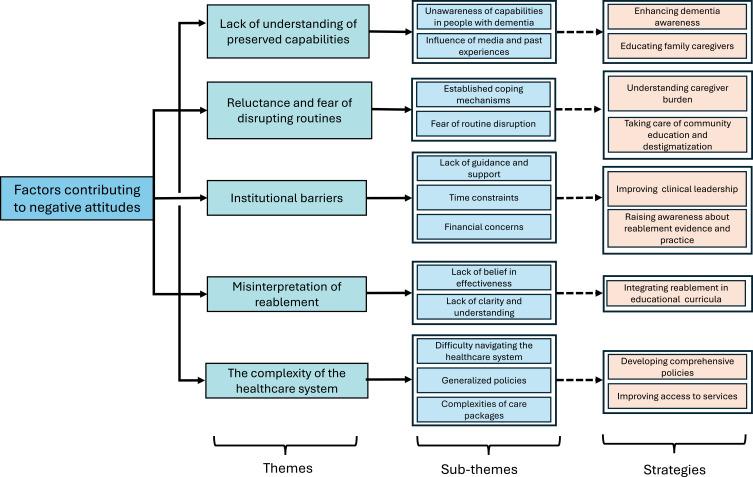
This study explored the views of 10 experts and identified negative attitudes that impede the adoption of reablement. These attitudes were grouped into five themes: 1) lack of understanding of the preserved capabilities in people with dementia, 2) reluctance and fear among family caregivers about disrupting established routines, 3) institutional barriers, 4) misinterpretation of what reablement is, and 5) complexity of the healthcare system. The proposed strategies to address these negative attitudes include enhancing dementia awareness, educating family caregivers, understanding caregiver burden, taking care of community education and destigmatization, improving clinical leadership, raising awareness about reablement evidence and practice, integrating reablement in educational curriculum, developing comprehensive policies, and improving access to services.
CONCLUSION
This study highlights the importance of addressing and mitigating negative attitudes which obstruct adoption of reablement. By identifying these attitudes and exploring their origin, strategies can be formulated to overcome them. Successful adoption of these strategies is anticipated to enhance the quality of life of people with dementia and their caregivers.
目的
痴呆症是指一组影响全球人群的神经认知障碍。功能恢复训练可能有助于人们维持或恢复能力,鼓励他们参与对其重要的活动,促进持续的社会参与,并培养有意义的生活体验。然而,功能恢复训练在痴呆症护理中的应用进展缓慢。本研究旨在探讨阻碍功能恢复训练应用的消极态度,并确定减轻这些因素的策略。
方法
采用探索性定性研究方法,进行半结构式访谈。对澳大利亚、丹麦、荷兰、瑞典和英国这五个国家的功能恢复训练专家和/或痴呆症专家进行了访谈。访谈进行了录音,并逐字转录。采用主题分析法对访谈进行分析。
结果
本研究探讨了10位专家的观点,确定了阻碍功能恢复训练应用的消极态度。这些态度分为五个主题:1)对痴呆症患者保留能力的理解不足;2)家庭护理人员对打破既定日常安排的不情愿和恐惧;3)制度障碍;4)对功能恢复训练的误解;5)医疗保健系统的复杂性。针对这些消极态度提出的策略包括提高对痴呆症的认识、对家庭护理人员进行教育、了解护理人员负担、关注社区教育和消除污名化、改善临床领导力、提高对功能恢复训练证据和实践的认识、将功能恢复训练纳入教育课程、制定综合政策以及改善服务获取途径。
结论
本研究强调了解决和减轻阻碍功能恢复训练应用的消极态度的重要性。通过识别这些态度并探究其根源,可以制定克服它们的策略。预计成功采用这些策略将提高痴呆症患者及其护理人员的生活质量。

 Zotero 插件