
严重烧伤后人类和小鼠细胞外囊泡蛋白质货物的时间变化及由此产生的免疫重编程。
Temporal changes in the protein cargo of extracellular vesicles and resultant immune reprogramming after severe burn injury in humans and mice.
作者信息
Willis Micah L, Seim Roland F, Herring Laura E, Mordant Angie L, Webb Thomas S, Upchurch Gilbert R, Sharma Ashish K, Cairns Bruce A, Efron Philip A, Wallet Shannon M, Coleman Leon G, Maile Robert
机构信息
Department of Oral Biology, College of Dentistry, University of Florida, Gainesville, FL, United States.
Curriculum in Toxicology and Environmental Medicine, School of Medicine, North Carolina, Chapel Hill, NC, United States.
出版信息
Front Immunol. 2025 Jun 4;16:1596598. doi: 10.3389/fimmu.2025.1596598. eCollection 2025.
INTRODUCTION
Severe injury, including burn trauma, leads to profound immune dysfunction, yet the mechanisms driving these changes remain incompletely defined. This lack of understanding has hindered efforts to modulate the immune response effectively. Additionally, a clear biomarker profile to guide clinicians in identifying burn patients at high risk for poor clinical outcomes is lacking. Extracellular vesicles (EVs) have emerged as novel mediators of immune dysfunction in various pathologies. Prior studies in mouse models have demonstrated that plasma EVs increase following burn injury and contribute to immune dysfunction. Furthermore, EVs have potential as biomarkers for predicting extended hospital stays in burn patients. This study hypothesizes that human EVs, purified early and late after burn injury, will exhibit immune reprogramming effects similar to those observed in mice and that specific EV protein cargo may serve as biomarkers of immune and physiological responses to burn injury.
METHODS
EVs were isolated from the plasma of burn-injury patients at early (<72h) and late (≥14 days) time points post-injury. Using unbiased immune transcriptome and bioinformatic causal network analyses, the immunomodulatory effects of these EVs were assessed in human THP-1 macrophages. Mass spectrometry-based quantitative proteomics and pathway analyses were conducted to characterize the protein cargo of EVs from both human and mouse models at different post-burn phases.
RESULTS
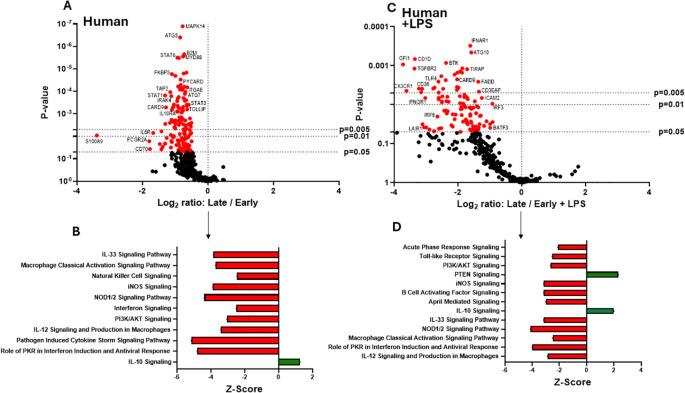
Early post-burn human EVs induced significant immune reprogramming in macrophages, increasing pro-inflammatory signaling while suppressing anti-inflammatory pathways. In contrast, late post-burn EVs exhibited an immunosuppressive profile, with downregulation of pro-inflammatory pathways and upregulation of anti-inflammatory signaling. Proteomic analyses revealed that human and mouse EVs contained unique and overlapping protein cargo across different time points. At day 7 post-burn, mouse EVs were enriched in circulation/complement and neuronal proteins, whereas by day 14, reductions in membrane and metabolism-associated proteins were observed. Similarly, in human EVs at 14 days post-burn, increased levels of circulation/complement, immune, and transport proteins were detected.
CONCLUSIONS
EVs from burn-injury patients at distinct time points differentially modulate immune responses in macrophages, mirroring the temporal immune phenotypes observed in clinical settings. These findings suggest that EV-macrophage interactions play a crucial role in burn-induced immune dysfunction and highlight the potential of EV protein cargo as biomarkers for immune status and patient outcomes following burn injury.
引言
严重损伤,包括烧伤创伤,会导致严重的免疫功能障碍,然而驱动这些变化的机制仍未完全明确。这种认识上的不足阻碍了有效调节免疫反应的努力。此外,目前缺乏一种清晰的生物标志物谱来指导临床医生识别临床预后不良的烧伤患者。细胞外囊泡(EVs)已成为各种病理状态下免疫功能障碍的新型介质。先前在小鼠模型中的研究表明,烧伤后血浆EVs会增加,并导致免疫功能障碍。此外,EVs有潜力作为预测烧伤患者延长住院时间的生物标志物。本研究假设,在烧伤后早期和晚期纯化的人EVs将表现出与在小鼠中观察到的类似的免疫重编程作用,并且特定的EV蛋白货物可能作为烧伤损伤免疫和生理反应的生物标志物。
方法
在烧伤患者受伤后的早期(<72小时)和晚期(≥14天)时间点,从其血浆中分离出EVs。使用无偏倚的免疫转录组和生物信息因果网络分析,在人THP-1巨噬细胞中评估这些EVs的免疫调节作用。进行基于质谱的定量蛋白质组学和通路分析,以表征来自人和小鼠模型在烧伤后不同阶段的EVs的蛋白质货物。
结果
烧伤后早期的人EVs在巨噬细胞中诱导了显著的免疫重编程,增加了促炎信号,同时抑制了抗炎途径。相比之下,烧伤后晚期的EVs表现出免疫抑制特征,促炎途径下调,抗炎信号上调。蛋白质组学分析表明,人和小鼠的EVs在不同时间点含有独特且重叠的蛋白质货物。烧伤后第7天,小鼠的EVs富含循环/补体和神经元蛋白,而到第14天,观察到膜和代谢相关蛋白减少。同样,在烧伤后14天的人EVs中,检测到循环/补体、免疫和转运蛋白水平升高。
结论
来自烧伤患者在不同时间点的EVs对巨噬细胞的免疫反应有不同的调节作用,反映了临床环境中观察到的时间性免疫表型。这些发现表明,EV-巨噬细胞相互作用在烧伤诱导的免疫功能障碍中起关键作用,并突出了EV蛋白货物作为烧伤后免疫状态和患者预后生物标志物的潜力。




 Zotero 插件