
格罗科特六胺银染色在肺隐球菌病中的卓越诊断性能:一项多中心、大样本队列研究
Superior diagnostic performance of Grocott methenamine silver staining in pulmonary cryptococcosis: a multicenter, large-sample cohort study.
作者信息
Wang Suijing, Lai Jieyi, Zheng Chengyou, Yang Pengfei, Zhou Zhengyi, Wu Haibo, Huang Mayan, Zhang Xinke, Xiao Yongbo, Chen Jierong, Ma Chao, Chen Keming, Lin Liyan, Liu Huanyu, Cai Yubo, Xue Xiaolei, Li Zizi, Chen Jiewei
机构信息
State Key Laboratory of Oncology in South China, Guangdong Provincial Clinical Research Center for Cancer, Guangzhou, China.
Department of Pathology, Sun Yat-sen University Cancer Center, Guangzhou, China.
出版信息
Front Microbiol. 2025 Jun 4;16:1615057. doi: 10.3389/fmicb.2025.1615057. eCollection 2025.
INTRODUCTION
In the histopathological diagnosis of pulmonary fungal infections, particularly pulmonary cryptococcosis, the diagnostic performance of different staining techniques varies significantly, often confounding pathologists. This study aims to systematically analyze Grocott methenamine silver (GMS), periodic acid-Schiff (PAS), and alcian blue (AB) staining methods to establish evidence-based diagnostic criteria.
METHODS
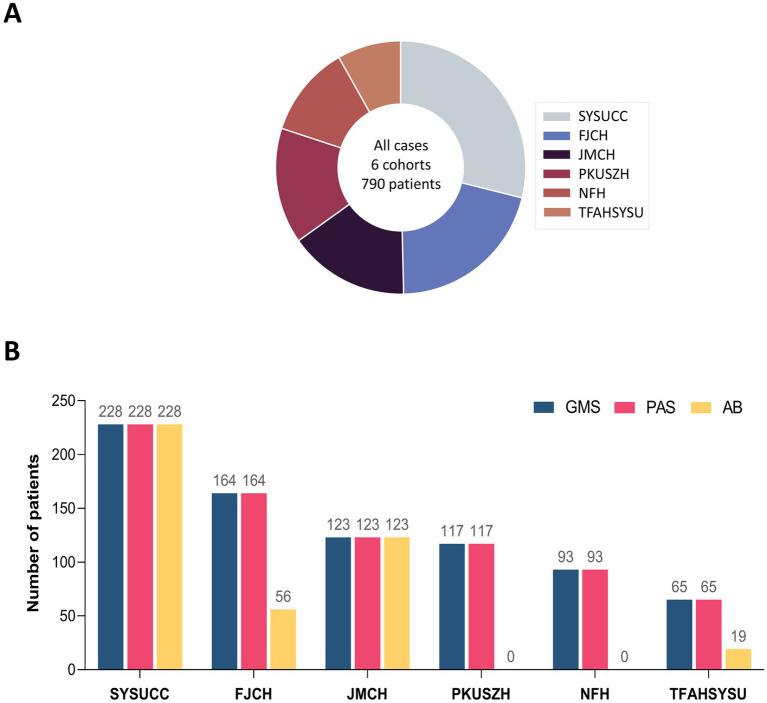
We incorporated histopathological data from 790 cases of pulmonary cryptococcosis that were definitively diagnosed in six tertiary hospitals. Multidimensional statistical analyses were performed to evaluate the performance of GMS, PAS, and AB staining methods.
RESULTS
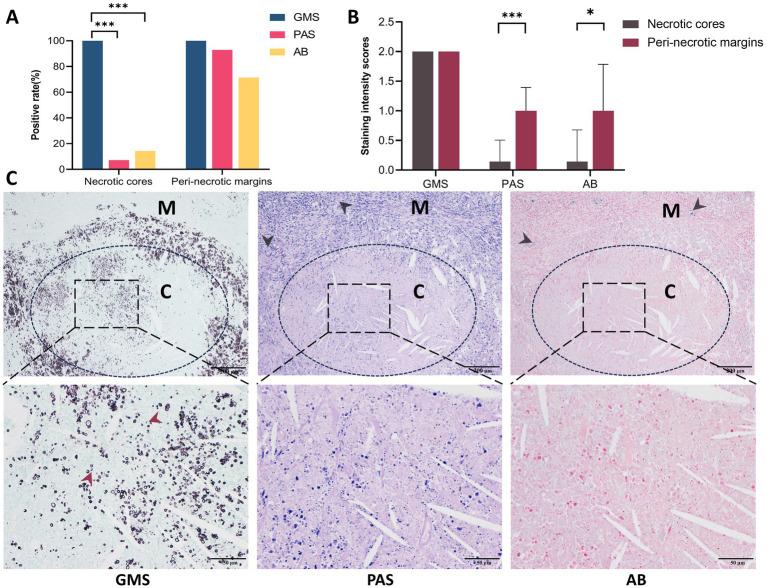
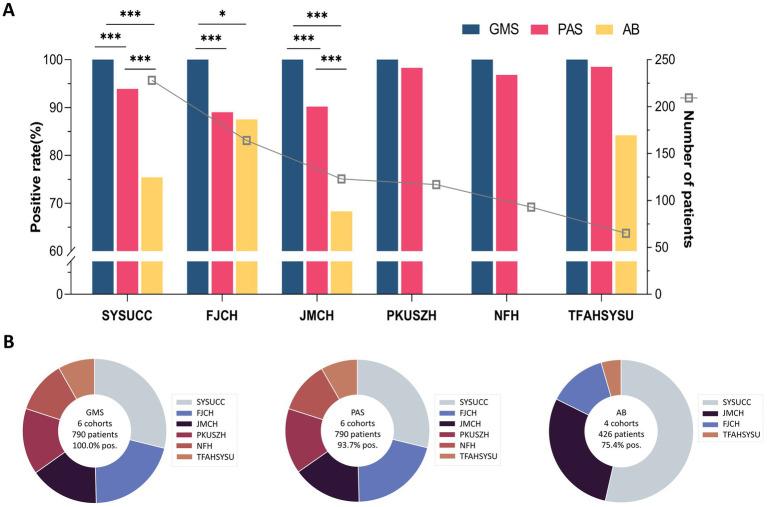
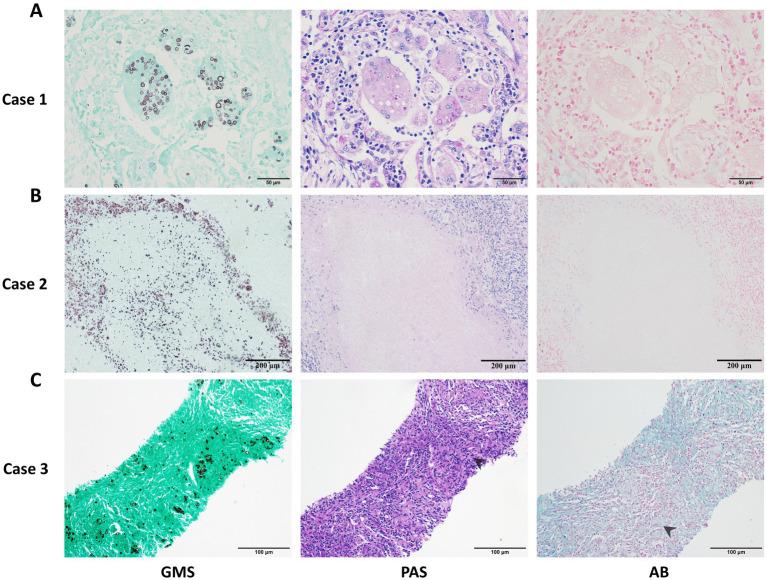
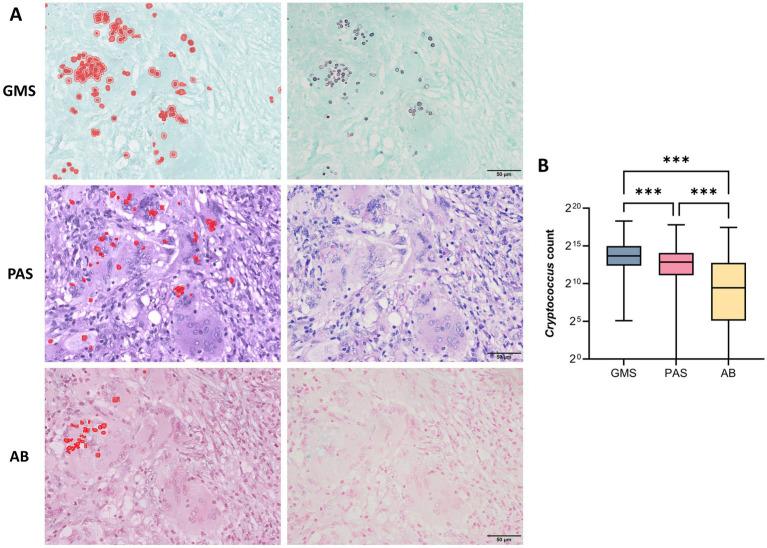
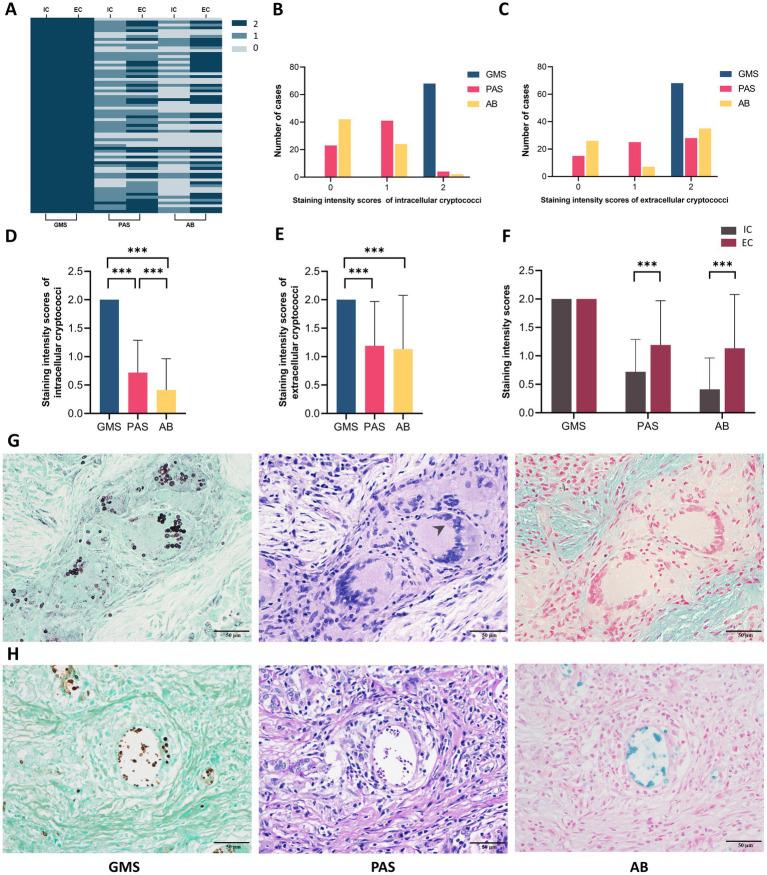
GMS staining had a 100% positive diagnostic rate among all cohorts, which was significantly higher than that of PAS staining (93.7%, 0.001) and AB staining (75.4%, 0.001). Further statistical analyses indicated that GMS was superior to PAS and AB in detecting the number of cryptococci and in demonstrating the staining intensities for both intracellular and extracellular cryptococci ( < 0.001 for all comparisons). In the necrotic cores and peri-necrotic margins of granulomas, GMS more clearly localized cryptococci and detected a higher fungal burden. Even in colonies with minimal polysaccharides in fungal cell walls and capsules, GMS exhibited high sensitivity and provided clear visualization.
CONCLUSION
GMS staining is the best method for diagnosing pulmonary cryptococcosis because of its high sensitivity and excellent visualization capabilities. Using GMS alone can meet the requirements for diagnostic accuracy, and we recommend GMS as the gold standard for histopathological confirmation of pulmonary cryptococcosis.
引言
在肺部真菌感染,尤其是肺隐球菌病的组织病理学诊断中,不同染色技术的诊断性能差异显著,常常使病理学家感到困惑。本研究旨在系统分析格罗特乌洛托品银(GMS)、过碘酸希夫(PAS)和阿尔辛蓝(AB)染色方法,以建立基于证据的诊断标准。
方法
我们纳入了来自六家三级医院确诊的790例肺隐球菌病的组织病理学数据。进行多维度统计分析以评估GMS、PAS和AB染色方法的性能。
结果
GMS染色在所有队列中的阳性诊断率为100%,显著高于PAS染色(93.7%,P<0.001)和AB染色(75.4%,P<0.001)。进一步的统计分析表明,GMS在检测隐球菌数量以及显示细胞内和细胞外隐球菌的染色强度方面优于PAS和AB(所有比较P<0.001)。在肉芽肿的坏死核心和坏死周边边缘,GMS能更清晰地定位隐球菌并检测到更高的真菌负荷。即使在真菌细胞壁和荚膜中多糖含量极少的菌落中,GMS也表现出高敏感性并能提供清晰的可视化效果。
结论
GMS染色因其高敏感性和出色的可视化能力,是诊断肺隐球菌病的最佳方法。仅使用GMS就能满足诊断准确性的要求,我们推荐GMS作为肺隐球菌病组织病理学确诊的金标准。

 Zotero 插件