
免疫检查点抑制剂与多靶点酪氨酸激酶抑制剂联合用于非小细胞肺癌二线或后续治疗:一项系统评价和荟萃分析
Combination of immune checkpoint inhibitors with multi-targeted tyrosine kinase inhibitors for second- or later-line therapy of non-small cell lung cancer: a systematic review and meta-analysis.
作者信息
Xu Wujian, Liao Ximing, Wang Kun, Shi Ting
机构信息
Department of Pulmonary and Critical Care Medicine, Shanghai East Hospital, School of Medicine, Tongji University, Shanghai, China.
Usher Institute, University of Edinburgh, Edinburgh, UK.
出版信息
Transl Lung Cancer Res. 2025 May 30;14(5):1724-1739. doi: 10.21037/tlcr-2024-1204. Epub 2025 May 28.
BACKGROUND
Second- or later-line therapy for patients with advanced non-small cell lung cancer (NSCLC) is highly individualized. Combining immune checkpoint inhibitors (ICIs) with multi-targeted tyrosine kinase inhibitors (multi-TKIs) has emerged as a chemotherapy-free option for these patients. We aim to provide a comprehensive overview of the efficacy and safety of the treatment.
METHODS
We systematically searched four databases for studies evaluating ICIs combined with multi-TKIs in second- or later-line therapy for NSCLC. Data were extracted and study quality was assessed using the Canadian Institute of Health Economics tool for case series. A systematic review and meta-analysis were conducted for efficacy outcomes.
RESULTS
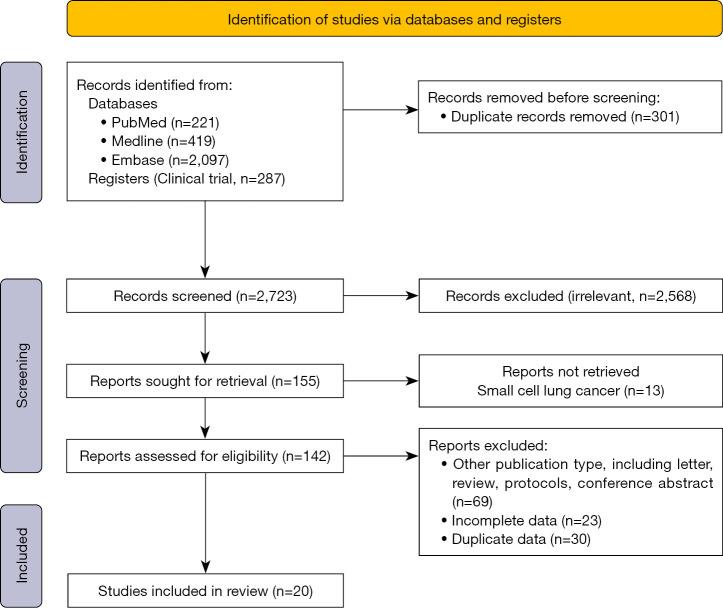
Twenty studies (10 prospective and 10 retrospective) were included from 155 retrieved articles. Nineteen studies were conducted in China, with programmed death receptor 1 (PD-1) antibodies and anlotinib as the most frequently used combination. The single-arm meta-analysis showed that the pooled median progression-free survival (mPFS) was 5.74 months [95% confidence interval (CI): 4.65-6.84], and the median overall survival was 15.41 months (95% CI: 13.40-17.41). The objective response rate was 26.35% (95% CI: 19.52-33.18%), and the disease control rate was about 80.73% (95% CI: 75.59-85.86%). For patients with EGFR/ALK/ROS1 mutations, the mPFS was 3.17 months (95% CI: 2.54-3.79). The most commonly reported severe adverse events across the included studies were hypertension, fatigue, hepatic dysfunction, urinary abnormalities, and hand-foot syndrome.
CONCLUSIONS
The combination of ICIs and multi-TKIs offers an alternative chemotherapy-free treatment option for patients with advanced NSCLC in the second- or later-line setting.
背景
晚期非小细胞肺癌(NSCLC)患者的二线或后续治疗具有高度个体化。将免疫检查点抑制剂(ICI)与多靶点酪氨酸激酶抑制剂(多TKI)联合使用已成为这些患者无需化疗的一种选择。我们旨在全面概述该治疗方法的疗效和安全性。
方法
我们系统检索了四个数据库,以查找评估ICI与多TKI联合用于NSCLC二线或后续治疗的研究。提取数据并使用加拿大卫生经济研究所的病例系列工具评估研究质量。对疗效结果进行了系统评价和荟萃分析。
结果
从155篇检索到的文章中纳入了20项研究(10项前瞻性研究和10项回顾性研究)。19项研究在中国进行,程序性死亡受体1(PD-1)抗体和安罗替尼是最常用的联合用药。单臂荟萃分析显示,汇总的中位无进展生存期(mPFS)为5.74个月[95%置信区间(CI):4.65-6.84],中位总生存期为15.41个月(95%CI:13.40-17.41)。客观缓解率为26.35%(95%CI:19.52-33.18%),疾病控制率约为80.73%(95%CI:75.59-85.86%)。对于表皮生长因子受体(EGFR)/间变性淋巴瘤激酶(ALK)/ROS1突变的患者,mPFS为3.17个月(95%CI:2.54-3.79)。纳入研究中最常报告的严重不良事件为高血压、疲劳、肝功能障碍、泌尿系统异常和手足综合征。
结论
ICI与多TKI联合为二线或后续治疗的晚期NSCLC患者提供了一种无需化疗的替代治疗选择。



 Zotero 插件