
基于呼出一氧化氮构建检查点抑制剂相关性肺炎诊断模型:一项前瞻性观察研究。
Construction of a checkpoint inhibitor-related pneumonia diagnostic model based on exhaled nitric oxide: a prospective observational study.
作者信息
Gao Yimei, Luo Tingyue, Huang Danhui, Fu Zeyu, Ma Shudong, Lin Li, Huang Haohua, Liu Tiantian, Zhang Jinming, Jiang Xiaoxiao, Ye Yanmei, Chen Junwei, Xi Junjie, Zhuo Jinzhong, Chen Kaijun, Ai Jingqi, Liu Laiyu, Cai Shaoxi, Dong Hangming
机构信息
Chronic Airways Diseases Laboratory, Department of Respiratory and Critical Care Medicine, Nanfang Hospital, Southern Medical University, Guangzhou, China.
Department of Oncology, Nanfang Hospital, Southern Medical University, Guangzhou, China.
出版信息
Transl Lung Cancer Res. 2025 May 30;14(5):1740-1755. doi: 10.21037/tlcr-2024-1085. Epub 2025 May 20.
BACKGROUND
Checkpoint inhibitor-related pneumonia (CIP) is a complication of immune checkpoint inhibitors (ICIs) with high mortality. There is still a lack of effective biomarkers to identify CIP. Exhaled nitric oxide (eNO), an airway inflammatory marker, can be obtained by non-invasive methods, but its value in CIP is unknown. The purpose of this study was to investigate the value of eNO in CIP.
METHODS
Lung cancer patients who received ICIs were included at Nanfang Hospital, Southern Medical University. Fractional eNO at expiratory flow rates of 50 and 200 mL/s (FeNO50 and FeNO200) were measured. The alveolar concentration of nitric oxide (CaNO) was calculated based on the two-compartment model of airway and alveoli. The optimal CaNO cut-off value was determined by the receiver operating characteristic (ROC) curve. eNO, clinical characteristics, and laboratory tests were analyzed to find out the risk factors for CIP by logistic regression analysis. A multi-indicator model based on best risk factors for CIP was developed and internally validated.
RESULTS
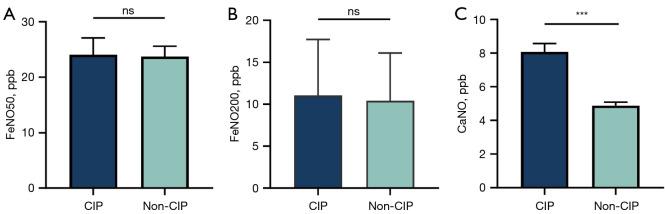
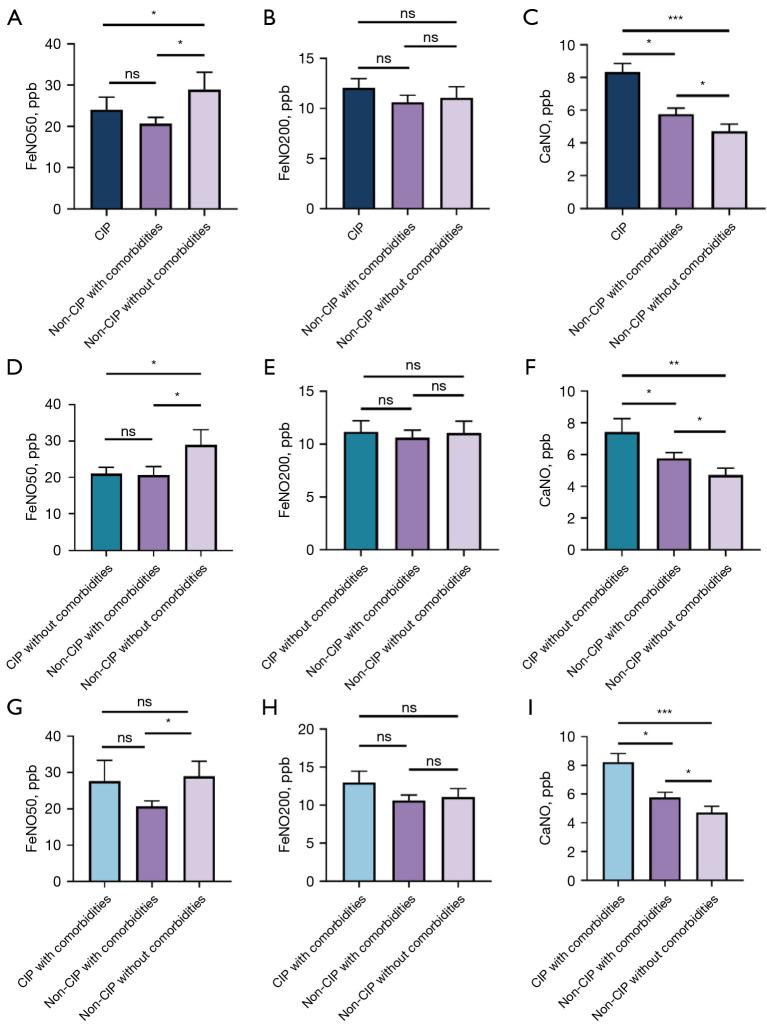
CaNO was significantly elevated in the CIP group [8.1±5.0 . 4.9±3.1 parts per billion (ppb), P<0.001]. The area under the curve (AUC) of CaNO to differentiate CIP was 0.728 [95% confidence interval (CI): 0.670-0.786; P=0.001]. The best cut-off value of CaNO was 6.350 ppb. Increased CaNO [odds ratio (OR), 1.30; 95% CI: 1.19-1.43; P<0.001], emphysema reported on chest computed tomography (CT) (OR, 2.54; 95% CI: 1.41-4.60), a small amount of pleural effusion reported on chest CT (OR, 2.48; 95% CI: 1.37-4.50), pre-existing radiotherapy (OR, 3.89; 95% CI: 1.96-7.73) and the lower counts of lymphocyte cell in peripheral blood (OR, 0.69; 95% CI: 0.44-1.10) were independently associated with CIP. The five factors were incorporated into a multi-indicator model with a good predictive accuracy of 0.821.
CONCLUSIONS
CaNO may be a new marker for identifying CIP. Increased CaNO, pre-existing radiotherapy and emphysema reported on chest CT, a small amount of pleural effusion reported on chest CT, and lower count of lymphocyte cell in peripheral blood are independently associated with CIP.
背景
检查点抑制剂相关肺炎(CIP)是免疫检查点抑制剂(ICI)的一种并发症,死亡率很高。目前仍缺乏有效的生物标志物来识别CIP。呼出一氧化氮(eNO)作为一种气道炎症标志物,可通过非侵入性方法获得,但其在CIP中的价值尚不清楚。本研究旨在探讨eNO在CIP中的价值。
方法
南方医科大学南方医院纳入接受ICI治疗的肺癌患者。测量呼气流量为50和200 mL/s时的eNO分数(FeNO50和FeNO200)。根据气道和肺泡的双室模型计算一氧化氮的肺泡浓度(CaNO)。通过受试者工作特征(ROC)曲线确定最佳CaNO临界值。通过逻辑回归分析对eNO、临床特征和实验室检查进行分析,以找出CIP的危险因素。建立并内部验证了基于CIP最佳危险因素的多指标模型。
结果
CIP组的CaNO显著升高[8.1±5.0. 4.9±3.1十亿分之一(ppb),P<0.001]。CaNO鉴别CIP的曲线下面积(AUC)为0.728[95%置信区间(CI):0.670-0.786;P=0.001]。CaNO的最佳临界值为6.350 ppb。CaNO升高[比值比(OR),1.30;95%CI:1.19-1.43;P<0.001]、胸部计算机断层扫描(CT)报告的肺气肿(OR,2.54;95%CI:1.41-4.60)、胸部CT报告的少量胸腔积液(OR,2.48;95%CI:1.37-4.50)、既往放疗史(OR,3.89;95%CI:1.96-7.73)和外周血淋巴细胞计数较低(OR,0.69;95%CI:0.44-1.10)与CIP独立相关。将这五个因素纳入一个多指标模型,预测准确率良好,为0.821。
结论
CaNO可能是识别CIP的一个新标志物。CaNO升高、既往放疗史、胸部CT报告的肺气肿、胸部CT报告的少量胸腔积液以及外周血淋巴细胞计数较低与CIP独立相关。


 Zotero 插件