
内皮角膜移植术的当前概念与近期趋势
Current concepts and recent trends in endothelial keratoplasty.
作者信息
Nishant Prateek, Gurnani Bharat, Singh Prabhakar, Sinha Sony, Kaur Kirandeep, Kumar Ashish, Sinha Ranjeet Kumar
机构信息
Department of Ophthalmology-Refractive Surgery, Uvea and Neuro-Ophthalmology, Akhand Jyoti Eye Hospital, Mastichak, Saran 841219, Bihar, India.
Department of Cataract, Cornea, External Diseases, Trauma, Ocular Surface, Refractive Surgery and Contact Lens, Gomabai Netralaya and Research Center, Neemuch 458441, Madhya Pradesh, India.
出版信息
World J Transplant. 2025 Jun 18;15(2):102507. doi: 10.5500/wjt.v15.i2.102507.
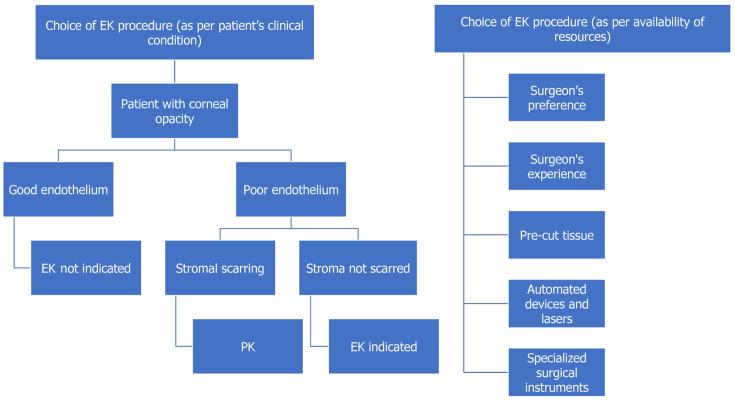
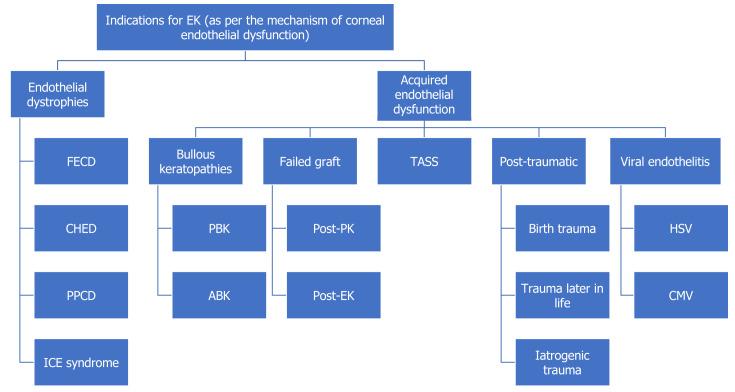
Endothelial keratoplasty (EK) is defined as an umbrella term comprising methods for selective surgical replacement of corneal endothelium and adjacent corneal tissue, which retains healthy portions of a patient's cornea while replacing diseased innermost corneal layer(s) with healthy donor tissue, to achieve corneal dehydration and transparency before the onset of irreversible stromal edema and permanent loss of corneal clarity. Recently, the pathophysiology of corneal decompensation is increasingly being researched upon. Consequent improvement in pharmacotherapy is progressively leading to reduction in the indications of EK. In addition, EK techniques have progressed towards using thinner tissue, optimizing visual outcomes. Improvements have enabled better donor tissue formulation, usage, and attachment, and surgical modifications have enhanced the tissue utilization in difficult clinical scenarios lowering failure and rejection. However, challenges are encountered in various complex clinical scenarios including eyes with prior intraocular surgery, complex anterior chamber anatomy, glaucoma, ocular surface disease These complexities demand tailored surgical strategies, including modifications in graft handling, instrumentation, and postoperative management to ensure success. Attention to these details and addressing patient-specific factors can help improve outcomes in these difficult cases. The choice of procedure depends on multiple factors, including the surgeon's experience, patient's ocular anatomy, and the specific clinical scenario. This review article encompasses the recent developments in this field presenting a comprehensive picture of our modern understanding of the indications, contraindications, surgical techniques, clinical situations, community aspects and future directions pertaining to EK.
内皮角膜移植术(EK)被定义为一个涵盖选择性手术替换角膜内皮及相邻角膜组织方法的统称,该手术保留患者角膜的健康部分,同时用健康的供体组织替换患病的最内层角膜层,以在不可逆的基质水肿和角膜透明度永久丧失之前实现角膜脱水和透明。最近,角膜失代偿的病理生理学研究越来越多。药物治疗的相应改善正逐渐导致EK适应症的减少。此外,EK技术已朝着使用更薄的组织发展,以优化视觉效果。这些改进使得供体组织的制备、使用和附着更好,手术改良提高了在困难临床情况下的组织利用率,降低了失败率和排斥反应。然而,在各种复杂的临床情况下会遇到挑战,包括有过眼内手术史的眼睛、复杂的前房解剖结构、青光眼、眼表疾病等。这些复杂性需要量身定制的手术策略,包括在移植物处理、器械使用和术后管理方面的改良,以确保手术成功。关注这些细节并考虑患者的具体因素有助于改善这些困难病例的治疗效果。手术方式的选择取决于多个因素,包括外科医生的经验、患者的眼部解剖结构以及具体的临床情况。这篇综述文章涵盖了该领域的最新进展,并全面呈现了我们对EK的适应症、禁忌症、手术技术、临床情况、社会层面及未来方向的现代理解。
 Zotero 插件