
间充质基质细胞分泌组及其关键生物活性代谢产物可诱导小鼠创伤性脑损伤后的长期神经保护作用。
Mesenchymal Stromal Cell Secretome and Its Key Bioactive Metabolites Induce Long-Term Neuroprotection After Traumatic Brain Injury in Mice.
作者信息
Pischiutta Francesca, Tribuzio Francesca, Magatti Marta, De Simone Giulia, Moro Federico, Nattino Giovanni, Signorini Fabiola, Loose Luther, Caruso Enrico, Bertani Costanza, Mazzone Edoardo, Pascente Rosaria, Micotti Edoardo, Silini Antonietta Rosa, Ortolano Fabrizio, Trolese Maria Chiara, Bolis Marco, Guarrera Luca, Violatto Martina Bruna, Bigini Paolo, Banfi Cristina, Pastorelli Roberta, Parolini Ornella, Brunelli Laura, Zanier Elisa R
机构信息
Laboratory of Traumatic Brain Injury and Neuroprotection, Department of Acute Brain and Cardiovascular Injury, Istituto di Ricerche Farmacologiche Mario Negri IRCCS, Milan, Italy.
Centro di Ricerca E. Menni, Fondazione Poliambulanza - Istituto Ospedaliero, Brescia, Italy.
出版信息
Adv Sci (Weinh). 2025 Aug;12(29):e15508. doi: 10.1002/advs.202415508. Epub 2025 Jun 19.
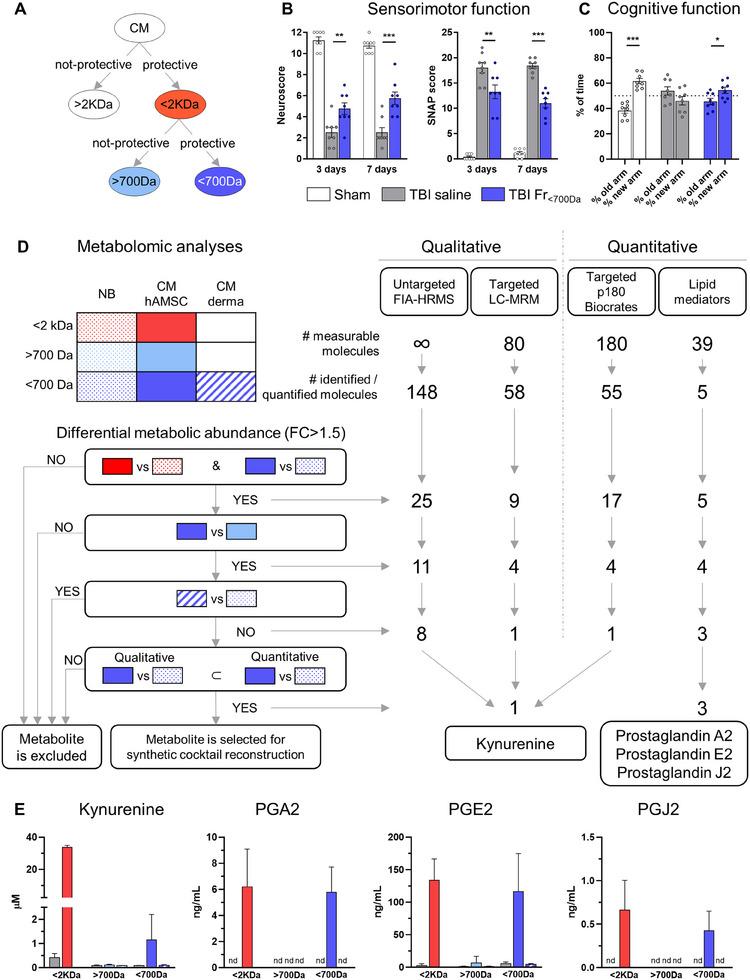
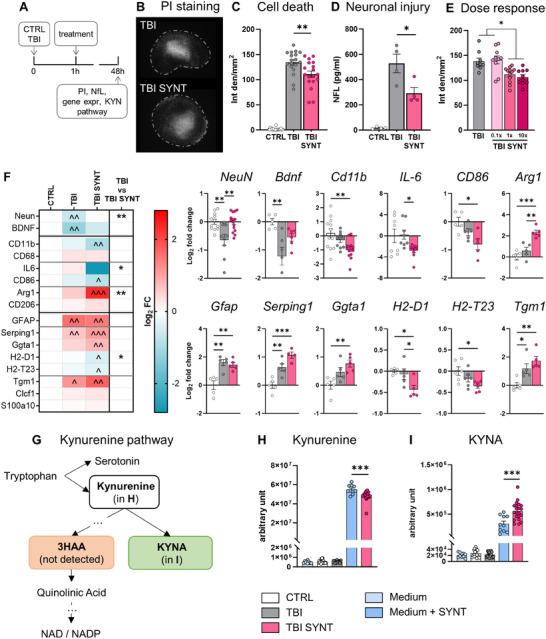
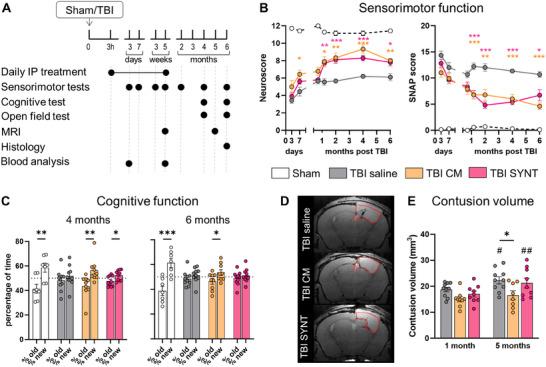
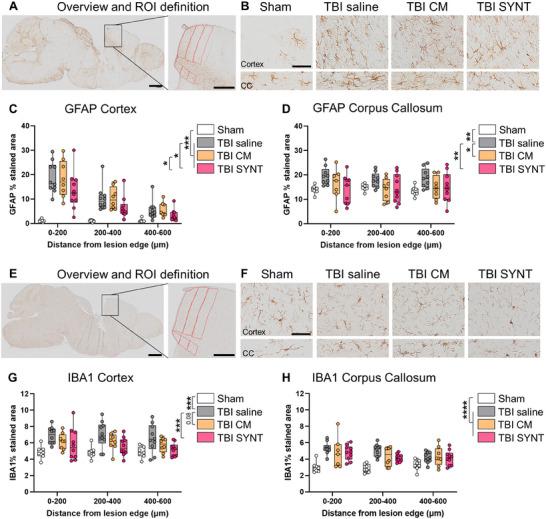
The severe and long-term consequences of traumatic brain injury (TBI) highlight the urgent need for effective neuroprotective therapies. Mesenchymal stromal cells (MSCs) show promise in TBI treatment through their secretome (conditioned media, CM). A low-molecular-weight (<700 Da) CM fraction with neuroprotective effects comparable to total CM after acute brain injury in vitro is previously identified. Here, it is aimed at identifying key bioactive factors, reconstituting them into a synthetic cocktail (SYNT), and evaluating its efficacy in TBI models. Metabolomic profiling identified three prostaglandins and kynurenine, which are used to create SYNT. The SYNT formulation reduced cell death, neuronal damage, and induced protective gene expression changes associated with neuronal protection and microglia modulation toward beneficial phenotype after TBI in vitro. In vivo, SYNT conferred similar long-term functional benefits as CM, improving sensorimotor function up to 6 months and memory preservation at 4 months compared to saline-treated animals, though only CM reduced contusion volume at 5 months. Both treatments modulated neuroinflammation, evidenced by reduced microglial activation and astrogliosis in the pericontusional tissue at 6 months. These findings demonstrate the neuroprotective effects of MSC-secretome treatment in TBI and highlight prostaglandins and kynurenine as key mediators of this response. The findings lay the groundwork for developing a standardized, cell-free therapeutic strategy for TBI based on MSC derivatives.
创伤性脑损伤(TBI)的严重和长期后果凸显了对有效神经保护疗法的迫切需求。间充质基质细胞(MSCs)通过其分泌组(条件培养基,CM)在TBI治疗中显示出前景。先前已鉴定出一种低分子量(<700 Da)的CM组分,其在体外急性脑损伤后具有与总CM相当的神经保护作用。在此,旨在鉴定关键生物活性因子,将它们重组为合成鸡尾酒(SYNT),并评估其在TBI模型中的疗效。代谢组学分析鉴定出三种前列腺素和犬尿氨酸,用于制备SYNT。SYNT制剂在体外TBI后减少了细胞死亡、神经元损伤,并诱导了与神经元保护和小胶质细胞向有益表型调节相关的保护性基因表达变化。在体内,SYNT与CM具有相似的长期功能益处,与盐水处理的动物相比,在长达6个月的时间内改善了感觉运动功能,在4个月时保留了记忆,尽管只有CM在5个月时减少了挫伤体积。两种治疗均调节了神经炎症,6个月时在挫伤周围组织中,小胶质细胞活化和星形胶质细胞增生减少证明了这一点。这些发现证明了MSC分泌组治疗在TBI中的神经保护作用,并突出了前列腺素和犬尿氨酸作为这种反应的关键介质。这些发现为基于MSC衍生物开发标准化的、无细胞的TBI治疗策略奠定了基础。


 Zotero 插件