
肺泡骨间充质干细胞表现出成骨潜力且巨噬细胞较少。
Alveolar Bone Mesenchymal Stem Cells Exhibit Osteogenic Potential with Fewer Macrophages.
作者信息
Wang Zhao, Joun Jaemin, Song Ju Han, Koh Jeong-Tae
机构信息
Department of Pharmacology and Dental Therapeutics, School of Dentistry, Chonnam National University, Gwangju, Korea.
Hard-Tissue Biointerface Research Center, School of Dentistry, Chonnam National University, Gwangju, Korea.
出版信息
J Bone Metab. 2025 May;32(2):83-92. doi: 10.11005/jbm.25.847. Epub 2025 May 31.
BACKGROUND
Mesenchymal stem cells (MSCs) derived from various tissues demonstrate regenerative potential in bone tissue engineering. However, bone marrow-derived MSCs (BMSCs) often contain macrophage contamination, necessitating additional purification steps such as liposomal clodronate treatment. In contrast, alveolar bone MSCs alveolar bone-derived MSCs (aBMSCs) may offer a distinct advantage due to their lower macrophage contamination.
METHODS
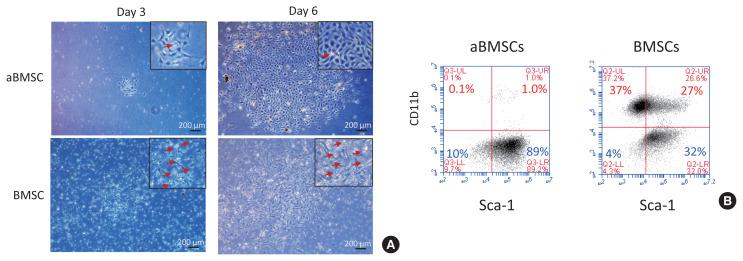
The aBMSCs were isolated from alveolar bone fragments through enzymatic digestion, and their macrophage contamination was compared to BMSCs using flow cytometry for MSC surface markers (CD44, CD105, CD90.2, CD140a) and macrophage markers (CD11b).
RESULTS
The aBMSCs exhibited significantly lower macrophage contamination compared to BMSCs and maintained osteogenic potential. Under inflammatory conditions in the presence of interleukin-1β (IL-1β), aBMSCs maintained their osteogenic capacity-unlike BMSCs, whose differentiation was impaired-accompanied by further activation of Protocadherin FAT4 (FAT4), which is known to initiate the osteogenic differentiation trajectory of aBMSCs.
CONCLUSIONS
These results highlight aBMSCs as a promising cell source for bone regeneration, offering low macrophage contamination and sustained osteogenic potential under inflammatory conditions such as IL-1β exposure.
背景
源自各种组织的间充质干细胞(MSC)在骨组织工程中显示出再生潜力。然而,骨髓来源的间充质干细胞(BMSC)通常含有巨噬细胞污染,这就需要额外的纯化步骤,如脂质体氯膦酸盐处理。相比之下,牙槽骨来源的间充质干细胞(aBMSC)由于其较低的巨噬细胞污染可能具有明显优势。
方法
通过酶消化从牙槽骨碎片中分离出aBMSC,并使用流式细胞术检测MSC表面标志物(CD44、CD105、CD90.2、CD140a)和巨噬细胞标志物(CD11b),将其巨噬细胞污染情况与BMSC进行比较。
结果
与BMSC相比,aBMSC的巨噬细胞污染显著降低,并保持了成骨潜力。在白细胞介素-1β(IL-1β)存在的炎症条件下,aBMSC保持其成骨能力,而BMSC的分化则受损,同时原钙黏蛋白FAT4(FAT4)进一步激活,已知FAT4可启动aBMSC的成骨分化轨迹。
结论
这些结果突出了aBMSC作为骨再生的一种有前景的细胞来源,在诸如暴露于IL-1β等炎症条件下具有低巨噬细胞污染和持续的成骨潜力。




 Zotero 插件