
香料精油对鸡皮刺螨(Dermanyssus gallinae)的体外杀螨活性。
In vitro acaricidal activity of spice essential oils against the poultry red mite (Dermanyssus gallinae).
作者信息
Ran Chongru, Zhang Ziyue, Zhang Siyu, Fan Jinghui, Guo Yicun, Wang Chuanwen, Zuo Yuzhu
机构信息
College of Veterinary Medicine, Hebei Agricultural University, Baoding 071001 Hebei, PR China.
Shijiazhuang Rongchuan feed Co., LTD, Shijiazhuang 051430 Hebei, PR China.
出版信息
Poult Sci. 2025 Jun 1;104(9):105387. doi: 10.1016/j.psj.2025.105387.
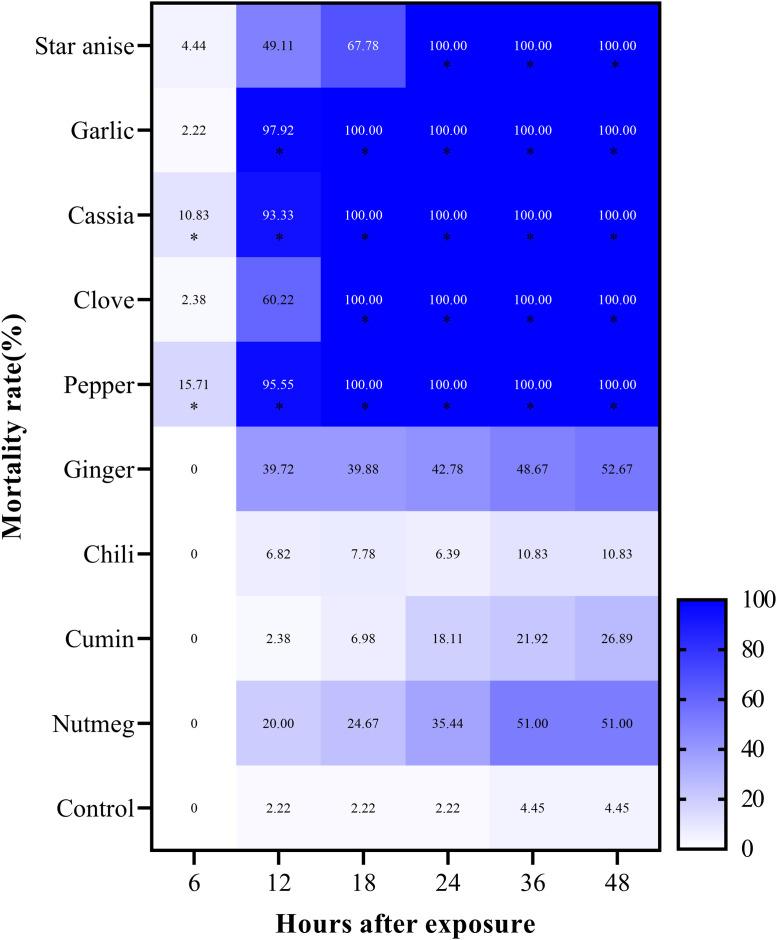
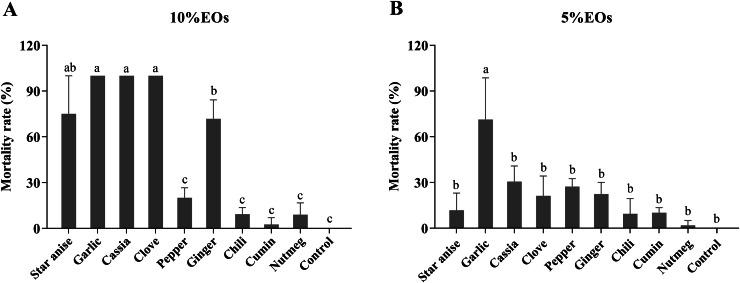
Dermanyssus gallinae is the primary ectoparasite associated with laying poultry, and is usually controlled with chemical acaricides, which lead to the development of drug resistance. Thus, there is an urgent need to identify alternative strategies for controlling D. gallinae. Spices are popular commodities with highly edible and medicinal values, and spice essential oils (EOs) have been demonstrated to function as insecticides, repellents, or feeding deterrence. In this present study, nine spice EOs (star anise, garlic, cassia, clove, pepper, ginger, chili, cumin and nutmeg) were evaluated for their contact, fumigation, residual and ovicidal toxicity against D. gallinae. Contact efficacy results demonstrated that garlic, cassia and clove EOs exhibited the best acaricidal effect on D. gallinae, with 100 % mortality after 24 h at 10 % concentration, also star anise (75.0 %) and ginger (71.9 %) exhibited high lethal activity. In the fumigation assay, star anise, garlic, cassia, clove and pepper EOs had a significantly higher vapour efficacy than others after 24-48 h (P < 0.05), with mite mortality of 100.0 %. Notably, cassia, clove, and garlic EOs had the best residual toxic effects, lasting up to 6 d with mortality rates of more than 50 %, followed by star anise and ginger, which could be maintained for 4 and 2 d, respectively. Furthermore, garlic, cassia and clove exhibited effective ovicidal activity, with egg hatchability of 22.2 %, 13.3 %, and 28.9 %, respectively, indicating that the egg hatching inhibition reached more than 70 %. This study has demonstrated the potential of spice EOs as natural acaricides against D. gallinae, which may be considered cheap and ready-to-use products as valid, eco-friendly alternatives to acaricides currently used in poultry farm.
鸡皮刺螨是与蛋鸡相关的主要体外寄生虫,通常使用化学杀螨剂进行控制,但这会导致抗药性的产生。因此,迫切需要确定控制鸡皮刺螨的替代策略。香料是具有高食用和药用价值的热门商品,香料精油已被证明具有杀虫剂、驱避剂或取食威慑剂的作用。在本研究中,评估了九种香料精油(八角茴香、大蒜、桂皮、丁香、胡椒、生姜、辣椒、小茴香和肉豆蔻)对鸡皮刺螨的触杀、熏蒸、残留和杀卵毒性。触杀效果结果表明,大蒜、桂皮和丁香精油对鸡皮刺螨表现出最佳的杀螨效果,在10%浓度下24小时后死亡率达100%,八角茴香(75.0%)和生姜(71.9%)也表现出高致死活性。在熏蒸试验中,24 - 48小时后,八角茴香、大蒜、桂皮、丁香和胡椒精油的蒸汽效果显著高于其他精油(P < 0.05),螨虫死亡率达100.0%。值得注意的是,桂皮、丁香和大蒜精油具有最佳的残留毒性作用,长达6天死亡率超过50%,其次是八角茴香和生姜,分别可维持4天和2天。此外,大蒜、桂皮和丁香表现出有效的杀卵活性,卵孵化率分别为22.2%、13.3%和28.9%,表明卵孵化抑制率超过70%。本研究证明了香料精油作为天然杀螨剂防治鸡皮刺螨的潜力,它们可能被认为是廉价且即用型的产品,可作为家禽养殖场目前使用的杀螨剂的有效、环保替代品。
 Zotero 插件