
化疗对育龄期乳腺癌幸存者卵巢储备的高影响:一项系统评价和荟萃分析。
High impact of chemotherapy on ovarian reserve in breast cancer survivors of reproductive age: A systematic review and meta-analysis.
作者信息
Weidlinger Susanna, Weidlinger Magdalena, Schramm Rose-Maria, Vidal Angela, Pape Janna, Karrer Tanya, Rabaglio Manuela, von Wolff Michael
机构信息
Division of Gynecological Endocrinology and Reproductive Medicine, University Women's Hospital, Inselspital Bern, University of Bern, 3010, Bern, Switzerland.
Medical Library, University Library Bern, University of Bern, 3010, Bern, Switzerland.
出版信息
Breast. 2025 Aug;82:104514. doi: 10.1016/j.breast.2025.104514. Epub 2025 Jun 13.
INTRODUCTION
The risk of infertility following breast cancer (BC) treatment is critical for women of reproductive age. Accurate risk assessment is essential for fertility counseling and preservation. Amenorrhoea as an infertility marker is unreliable due to endocrine therapies. Anti-Mullerian hormone (AMH) is a reliable fertility marker, but its role in assessing chemotherapy-induced loss of ovarian reserve in BC survivors remains underexplored.
OBJECTIVE
This systematic review and meta-analysis evaluates AMH decline and the prevalence of low (AMH <1 ng/mL) and very low (<0.5 ng/mL) ovarian reserve in BC survivors <40 years old, 12-24 months post-chemotherapy, to quantify the gonadotoxic impact of BC treatments.
METHODS
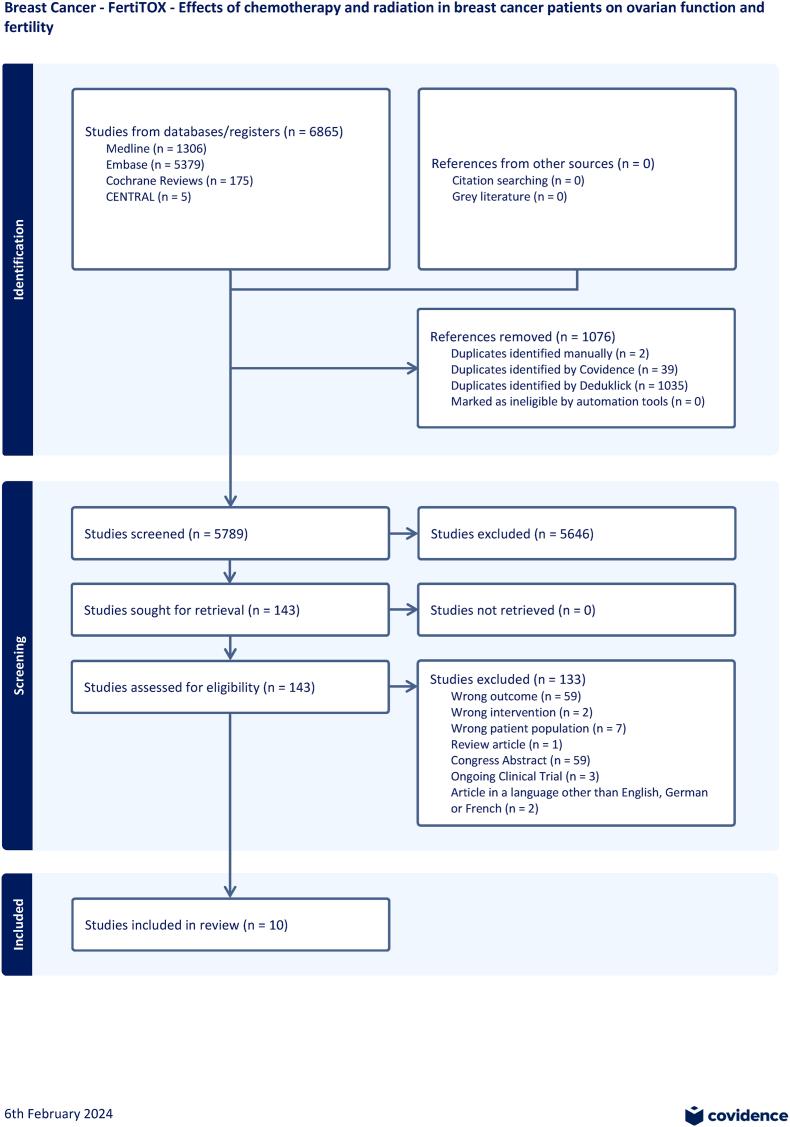
A systematic literature search of PubMed, Embase, and the Cochrane Library identified studies with AMH levels before and 12-24 months after chemotherapy in BC patients <40 years of age. Data on AMH levels were pooled using random-effects meta-analysis. Study quality was assessed using the Joanna Briggs Institute Critical Appraisal Checklist. This study is part of the FertiTOX project (www.fertitox.com).
RESULTS
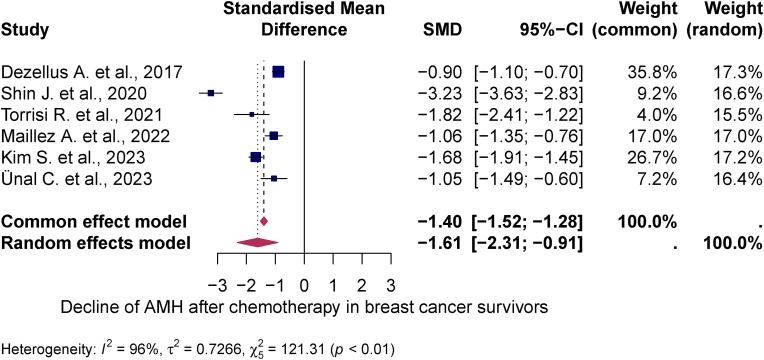
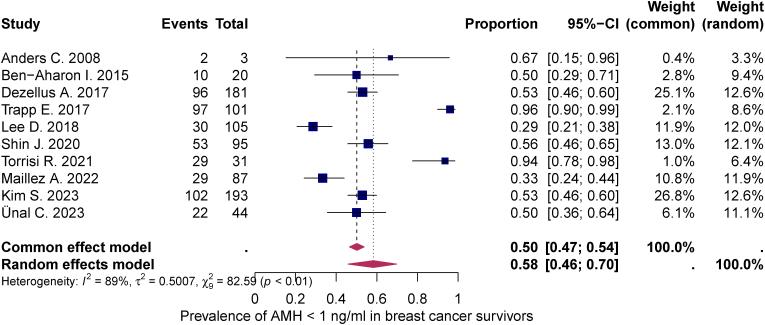
Ten studies (860 BC survivors) were included. Mean AMH decline was -1.61 (95 % CI: -2.31; -0.91) post-chemotherapy. The pooled prevalence of AMH <1 ng/mL and <0.5 ng/mL was 58 % (46-70 %) and 53 % (41-64 %), respectively. High heterogeneity was observed (I >80 %).
CONCLUSIONS
More than half of BC survivors have severely reduced ovarian reserve after chemotherapy, which is associated with a shortened fertile window and an increased risk of premature ovarian insufficiency. These findings highlight the need for pre-treatment fertility counseling and post-treatment ovarian insufficiency surveillance in routine oncology care.
引言
乳腺癌(BC)治疗后不孕的风险对育龄女性至关重要。准确的风险评估对于生育咨询和生育力保存至关重要。由于内分泌治疗,闭经作为不孕标志物并不可靠。抗苗勒管激素(AMH)是一种可靠的生育力标志物,但其在评估BC幸存者化疗引起的卵巢储备丧失中的作用仍未得到充分探索。
目的
本系统评价和荟萃分析评估了年龄小于40岁的BC幸存者在化疗后12 - 24个月时AMH的下降情况以及低(AMH<1 ng/mL)和极低(<0.5 ng/mL)卵巢储备的患病率,以量化BC治疗的性腺毒性影响。
方法
对PubMed、Embase和Cochrane图书馆进行系统文献检索,以确定年龄小于40岁的BC患者化疗前和化疗后12 - 24个月时AMH水平的研究。使用随机效应荟萃分析汇总AMH水平的数据。使用乔安娜·布里格斯研究所批判性评价清单评估研究质量。本研究是FertiTOX项目(www.fertitox.com)的一部分。
结果
纳入了10项研究(860名BC幸存者)。化疗后AMH平均下降-1.61(95%CI:-2.31;-0.91)。AMH<1 ng/mL和<0.5 ng/mL的合并患病率分别为58%(46 - 70%)和53%(41 - 64%)。观察到高度异质性(I>80%)。
结论
超过一半的BC幸存者化疗后卵巢储备严重降低,这与生育期缩短和卵巢功能早衰风险增加有关。这些发现凸显了在常规肿瘤护理中进行治疗前生育咨询和治疗后卵巢功能不全监测的必要性。

 Zotero 插件