
高渗高血糖状态和糖尿病酮症酸中毒(HHS-DKA)患者的临床特征及低钾血症风险预测:一项单中心回顾性观察研究
Clinical Characteristics and Hypokalemia Risk Prediction in Patients With Hyperosmolar Hyperglycemic State and Diabetic Ketoacidosis (HHS-DKA): A Single-Center, Retrospective Observational Study.
作者信息
Iwamoto Yuichiro, Kimura Tomohiko, Morimoto Yuichi, Harada Ayaka, Dan Kazunori, Iwamoto Hideyuki, Fushimi Yoshiro, Sanada Junpei, Shimoda Masashi, Nakanishi Shuhei, Mune Tomoatsu, Kaku Kohei, Kaneto HIdeaki
机构信息
Department of Diabetes, Endocrinology and Metabolism, Kawasaki Medical School, Kurashiki, JPN.
Department of Pediatrics, Kindai University, Osakasayama, JPN.
出版信息
Cureus. 2025 May 23;17(5):e84672. doi: 10.7759/cureus.84672. eCollection 2025 May.
BACKGROUND
People with combined diabetic ketoacidosis (DKA) and hyperosmolar hyperglycemic state (HHS) often present with more severe metabolic derangements than those with DKA or HHS alone. This study aimed to clarify the clinical characteristics of HHS-DKA and explore predictive models for complications, including hypokalemia.
METHODS
We retrospectively analyzed data from 99 patients admitted with hyperglycemic emergencies between April 1, 2010, and October 31, 2024, and classified them into DKA, HHS, and HHS-DKA groups. A decision tree model was also developed to predict the risk of post-continuous insulin infusion (CII) hypokalemia. The decision tree model was created using machine learning with the Python language (Python Software Foundation, Wilmington, Delaware).
RESULTS
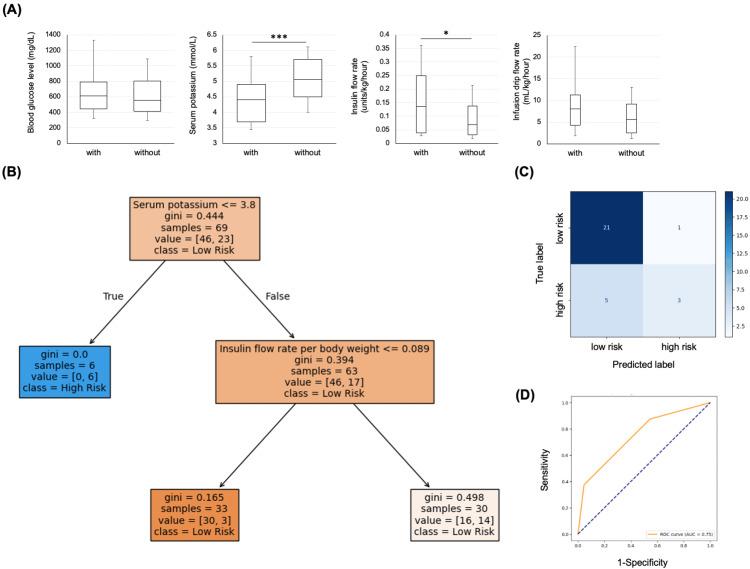
HHS-DKA patients had significantly higher rates of acute kidney injury (84%) and hyperkalemia (58%) compared to those with DKA or HHS alone. A decision tree model predicted post-CII hypokalemia with 80% accuracy, identifying key predictors such as initial blood glucose and insulin flow rates.
CONCLUSION
HHS-DKA represents a distinct and severe clinical entity with unique characteristics and complications. Predictive models developed in this study will likely assist in risk stratification and improve patient management during hyperglycemic crises in emergency settings. However, as this was a single-center retrospective study without external validation, further studies are warranted to confirm these findings.
背景
合并糖尿病酮症酸中毒(DKA)和高渗高血糖状态(HHS)的患者往往比单纯患有DKA或HHS的患者出现更严重的代谢紊乱。本研究旨在阐明HHS-DKA的临床特征,并探索包括低钾血症在内的并发症预测模型。
方法
我们回顾性分析了2010年4月1日至2024年10月31日期间因高血糖急症入院的99例患者的数据,并将他们分为DKA组、HHS组和HHS-DKA组。还开发了一种决策树模型来预测持续胰岛素输注(CII)后低钾血症的风险。该决策树模型使用Python语言(Python软件基金会,特拉华州威尔明顿)通过机器学习创建。
结果
与单纯患有DKA或HHS的患者相比,HHS-DKA患者的急性肾损伤发生率(84%)和高钾血症发生率(58%)显著更高。一种决策树模型预测CII后低钾血症的准确率为80%,识别出初始血糖和胰岛素流速等关键预测因素。
结论
HHS-DKA代表一种独特且严重的临床实体,具有独特的特征和并发症。本研究中开发的预测模型可能有助于进行风险分层,并改善急诊环境中高血糖危象期间的患者管理。然而,由于这是一项单中心回顾性研究且未进行外部验证,因此需要进一步研究来证实这些发现。

 Zotero 插件