
诊室血压目标对隐匿性未控制高血压和白大衣未控制高血压患病率及预测因素的影响
Impact of Clinic Blood Pressure Target on the Prevalence and Predictors of Masked Uncontrolled Hypertension and White-Coat Uncontrolled Hypertension.
作者信息
Kim Hyun-Jin, Lee Yonggu, Shin Jeong-Hun, Kim Ju Han, Hwang Sun Ho, Kim Woo Shik, Park Sungha, Rhee Sang Jae, Lee Eun Mi, Ihm Sang Hyun, Pyun Wook Bum, Shin Jinho
机构信息
Division of Cardiology, Department of Internal Medicine, Hanyang University College of Medicine, Seoul, Korea.
Division of Cardiology, Department of Internal Medicine, Chonnam National University Hospital, Gwangju, Korea.
出版信息
J Korean Med Sci. 2025 Jun 23;40(24):e117. doi: 10.3346/jkms.2025.40.e117.
BACKGROUND
Identifying masked uncontrolled hypertension (MUCH) and white-coat uncontrolled hypertension (WUCH) without ambulatory blood pressure (ABP) monitoring is challenging. Recent literature advocates intensive blood pressure (BP) control, but standard guidelines still suggest a clinic BP threshold of ≥ 149/90 mmHg to diagnose hypertension. This study explored the impact of different clinic BP targets on the prevalence and predictors of MUCH and WUCH.
METHODS
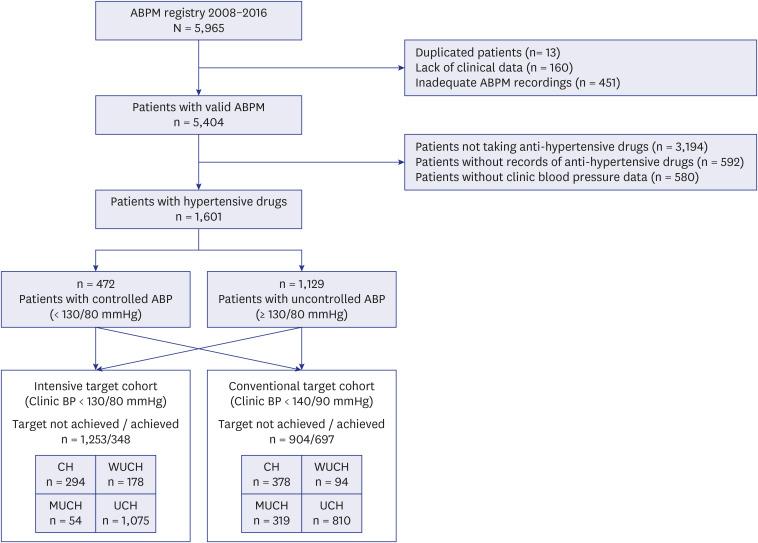
This multicenter prospective cohort study included 1,601 patients with hypertension from the Korean Ambulatory Blood Pressure registry, all with valid ABP records. Two clinic BP targets were evaluated: an intensive target (< 130/80 mmHg) and a conventional target (< 140/90 mmHg). Controlled hypertension was defined as a 24-hour mean ABP < 130/80 mmHg in patients treated with antihypertensive drugs who had a clinic BP below these targets.
RESULTS
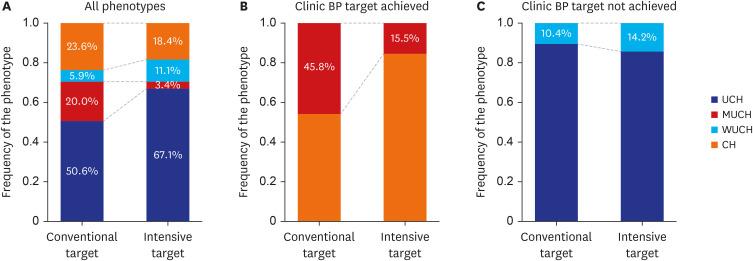
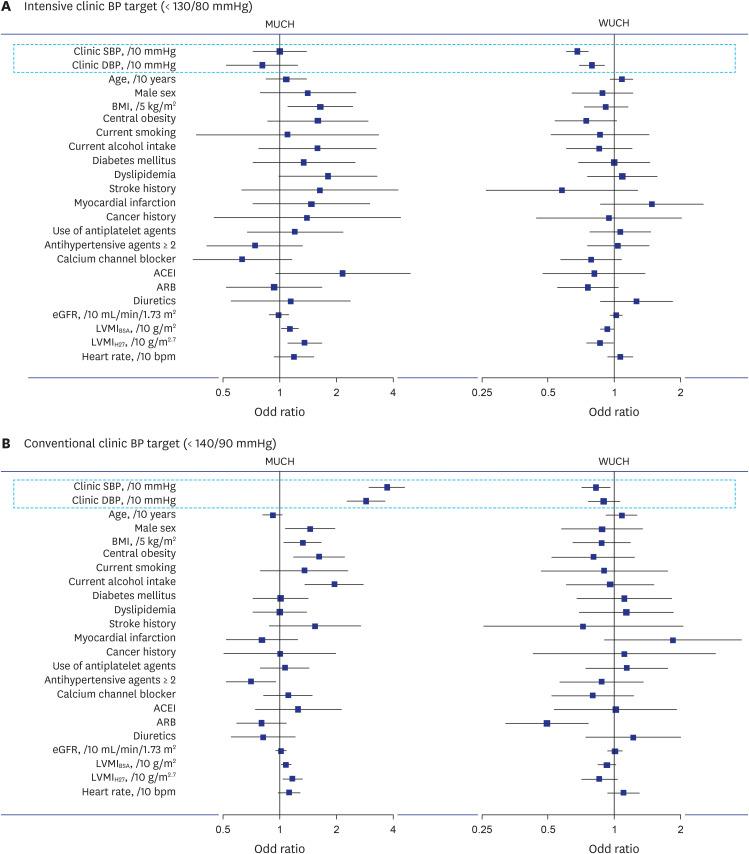
The prevalence of MUCH decreased significantly with the intensive target (15.5%) versus the conventional target (45.8%). In contrast, the prevalence of WUCH increased only marginally with the intensive targets. Most patients with MUCH (75.9%) had a clinic BP between 130/80 mmHg and 139/89 mmHg when MUCH was classified using the conventional target. For predicting MUCH, factors such as angiotensin-converting enzyme inhibitor use, body mass index, left ventricular mass index (LVMI), and use of ≥ 2 antihypertensive drugs were significant under the intensive target, whereas clinic BP, LVMI, alcohol intake, stroke history, and use of ≥ 2 antihypertensive drugs were relevant under the conventional target.
CONCLUSION
Adopting the intensive clinic BP target (< 130/80 mmHg) notably reduced the prevalence of MUCH, with a slight increase in WUCH, offering a more accurate assessment of BP control than the conventional target.
背景
在不进行动态血压(ABP)监测的情况下识别隐匿性未控制高血压(MUCH)和白大衣未控制高血压(WUCH)具有挑战性。近期文献提倡强化血压(BP)控制,但标准指南仍建议以诊所血压阈值≥149/90 mmHg来诊断高血压。本研究探讨了不同诊所血压目标对MUCH和WUCH患病率及预测因素的影响。
方法
这项多中心前瞻性队列研究纳入了来自韩国动态血压登记处的1601例高血压患者,所有患者均有有效的ABP记录。评估了两个诊所血压目标:强化目标(<130/80 mmHg)和传统目标(<140/90 mmHg)。在接受降压药物治疗且诊所血压低于这些目标的患者中,将控制良好的高血压定义为24小时平均ABP<130/80 mmHg。
结果
与传统目标(45.8%)相比,强化目标下MUCH的患病率显著降低(15.5%)。相比之下,强化目标下WUCH的患病率仅略有增加。当使用传统目标对MUCH进行分类时,大多数MUCH患者(75.9%)的诊所血压在130/80 mmHg至139/89 mmHg之间。对于预测MUCH,在强化目标下,使用血管紧张素转换酶抑制剂、体重指数、左心室质量指数(LVMI)以及使用≥2种降压药物等因素具有显著意义,而在传统目标下,诊所血压、LVMI、饮酒量、中风病史以及使用≥2种降压药物则与之相关。
结论
采用强化诊所血压目标(<130/80 mmHg)可显著降低MUCH的患病率,同时WUCH患病率略有增加,与传统目标相比,能更准确地评估血压控制情况。

 Zotero 插件