
耐多药结核病成人患者治疗期间及治疗后体重未增加及死亡率上升:2009 - 2020年格鲁吉亚的一项回顾性队列研究
Lack of weight gain and increased mortality during and after treatment among adults with drug-resistant tuberculosis: a retrospective cohort study in Georgia, 2009-2020.
作者信息
Chakhaia Tsira, Blumberg Henry M, Kempker Russell R, Luo Ruiyan, Dzidzikashvili Nino, Chincharauli Mamuka, Tukvadze Nestan, Avaliani Zaza, Stauber Christine, Magee Matthew J
机构信息
Georgia State University, Atlanta, GA, USA.
National Center for Tuberculosis and Lung Disease, Tbilisi, Georgia.
出版信息
ERJ Open Res. 2025 Jun 23;11(3). doi: 10.1183/23120541.00839-2024. eCollection 2025 May.
BACKGROUND
While low body mass index (BMI) is associated with poor tuberculosis (TB) treatment outcomes, the impact of weight gain during TB treatment is unclear. To address this knowledge gap, we assessed whether a lack of weight gain is associated with all-cause mortality during and after TB treatment.
METHODS
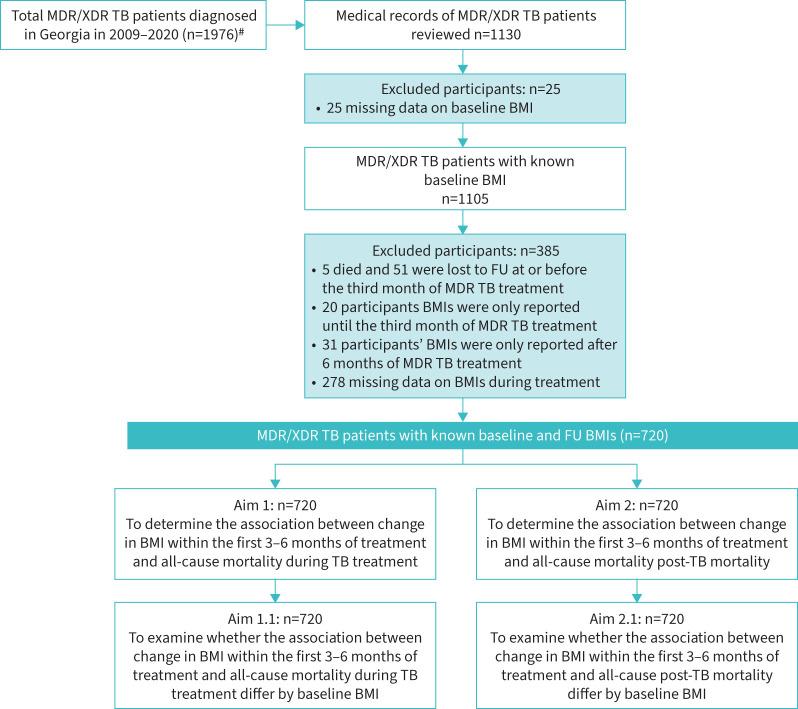
We conducted a retrospective cohort study among adults with newly diagnosed multidrug or extensively drug-resistant (MDR/XDR) pulmonary TB in Georgia between 2009-2020. The exposure was a change in BMI during the first 3-6 months of TB treatment. All-cause mortality during and after TB treatment was assessed using the National Death Registry. We used competing-risk Cox proportional hazard models to estimate adjusted hazard ratios (aHRs) between BMI change and all-cause mortality.
RESULTS
Among 720 adult participants, 21% had low BMI (<18.5 kg·m) at treatment initiation and 9% died either during (n=16) or after treatment (n=50). During the first 3-6 months of TB treatment, 17% lost weight and 14% had no weight change. Among 479 adults with normal baseline BMI (≥18.5-<25 kg·m), weight loss was associated with an increased risk of death during TB treatment (aHR 5.25, 95% CI 1.31-21.10). Among 149 adults with a low baseline BMI, no change in BMI was associated with increased post-TB treatment mortality (aHR 4.99, 95% CI 1.25-19.94).
CONCLUSIONS
Weight loss during TB treatment (among those with normal baseline BMI) or no weight gain (among those with low baseline BMI) was associated with increased rates of all-cause mortality. Our findings suggest that scaling up weight management interventions among those with M/XDR TB may be beneficial.
背景
虽然低体重指数(BMI)与结核病(TB)治疗效果不佳有关,但结核病治疗期间体重增加的影响尚不清楚。为了填补这一知识空白,我们评估了体重未增加是否与结核病治疗期间及之后的全因死亡率相关。
方法
我们对2009年至2020年期间在格鲁吉亚新诊断为多药耐药或广泛耐药(MDR/XDR)肺结核的成年人进行了一项回顾性队列研究。暴露因素是结核病治疗前3至6个月期间BMI的变化。使用国家死亡登记处评估结核病治疗期间及之后的全因死亡率。我们使用竞争风险Cox比例风险模型来估计BMI变化与全因死亡率之间的调整风险比(aHRs)。
结果
在720名成年参与者中,21%在治疗开始时BMI较低(<18.5kg·m),9%在治疗期间(n=16)或治疗后(n=50)死亡。在结核病治疗的前3至6个月期间,17%的人体重减轻,14%的人体重没有变化。在479名基线BMI正常(≥18.5-<25kg·m)的成年人中,体重减轻与结核病治疗期间死亡风险增加相关(aHR 5.25,95%CI 1.31-21.10)。在149名基线BMI较低的成年人中,BMI无变化与结核病治疗后死亡率增加相关(aHR 【此处原文有误,应为4.99】4.99,95%CI 1.25-19.94)。
结论
结核病治疗期间体重减轻(基线BMI正常者)或体重未增加(基线BMI较低者)与全因死亡率增加相关。我们的研究结果表明,在M/XDR结核病患者中扩大体重管理干预措施可能有益。
 Zotero 插件