
原发性纤毛运动障碍常规血液检测国际共识声明
International consensus statement on routine blood testing in primary ciliary dyskinesia.
作者信息
Altaraihi Sarah, Marthin June K, Anagnostopoulou Pinelopi, Boon Mieke, Carr Siobhan B, Castillo-Corullón Silvia, Dehlink Eleonora, Destouches Damien M S, Duckers Jamie, Haarman Eric G, Karadag Bülent, Kavouridou Christina, Loebinger Michael R, Maitre Bernard, Mazurek Henryk, Morgan Lucy, Omran Heymut, Ozcelik Ugur, Peckam Daniel, Pifferi Massimo, Pohunek Petr, Qvist Tavs, Raidt Johanna, Reix Phillipe, Ringshausen Felix C, Robinson Phil, Robson Evie, Röhmel Jobst, Santamaria Francesca, Schlegtendal Anne, Ullmann Nicola, Walker Woolf, Yiallouros Panayiotis, Thouvenin Guillaume, Crowley Suzanne, Nielsen Kim G
机构信息
Danish PCD Centre Copenhagen, Paediatric Pulmonary Service, Department of Paediatrics and Adolescent Medicine, Copenhagen University Hospital, Rigshospitalet, Copenhagen, Denmark.
Medical School, University of Cyprus, Nicosia, Cyprus.
出版信息
ERJ Open Res. 2025 Jun 23;11(3). doi: 10.1183/23120541.01071-2024. eCollection 2025 May.
BACKGROUND
Primary ciliary dyskinesia (PCD) is a rare genetic disorder characterised by dysfunction of motile cilia. Symptoms include recurrent and chronic airway infections which can lead to deteriorating lung function and inflammatory destructive lung disease in the form of persistent atelectasis and bronchiectasis. Routine blood testing may be used as a tool for disease monitoring and management. However, currently there are no consensus-based guidelines within the field of PCD. BEAT-PCD together with the ERN-LUNG PCD-Clinical Trial Network aimed to develop an international expert consensus statement on which routine blood tests should be conducted in patients with PCD.
METHODS
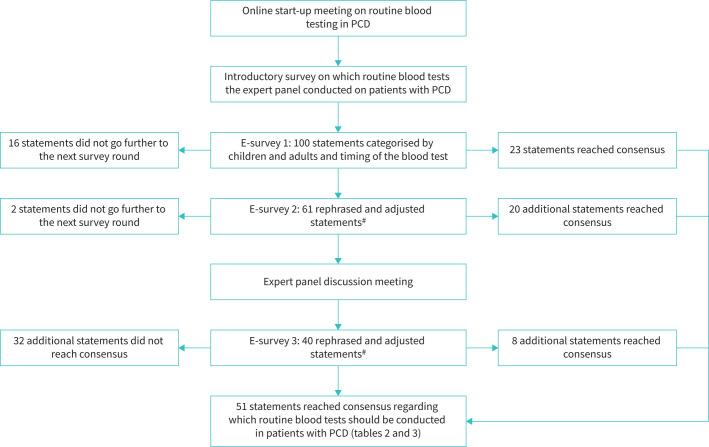
An international panel of 33 PCD experts from 17 countries was established to generate consensus on routine blood testing in PCD. A modified Delphi technique with three e-survey rounds was used to reach consensus, which was defined as ≥80% agreement for each statement. Two patient representatives were included in the consensus process.
RESULTS
The expert panel reached consensus on 51 out of 101 statements (50%) on routine blood testing in children and adults with PCD to be performed at diagnosis, annually and on exacerbation. The statements include biomarkers for inflammation, haemoglobin, iron status, vitamin D, immune function, inhalant allergies, liver and kidney function, and allergic bronchopulmonary aspergillosis.
CONCLUSIONS
This is the first international consensus on routine blood testing in PCD. It highlights blood tests that may be relevant to perform at diagnosis, annually and on exacerbation in people with PCD. Further research on the clinical usefulness of routine blood testing in PCD is needed.
背景
原发性纤毛运动障碍(PCD)是一种罕见的遗传性疾病,其特征为运动性纤毛功能障碍。症状包括反复慢性气道感染,可导致肺功能恶化以及以持续性肺不张和支气管扩张形式出现的炎症性破坏性肺病。常规血液检测可用作疾病监测和管理的工具。然而,目前在PCD领域尚无基于共识的指南。“战胜PCD”组织与ERN-LUNG PCD临床试验网络旨在就PCD患者应进行哪些常规血液检测制定一份国际专家共识声明。
方法
成立了一个由来自17个国家的33名PCD专家组成的国际小组,以就PCD的常规血液检测达成共识。采用经过改进的三轮电子调查德尔菲技术来达成共识,共识定义为每条声明的同意率≥80%。两名患者代表参与了共识达成过程。
结果
专家小组就101条关于PCD儿童和成人在诊断时、每年以及病情加重时进行常规血液检测的声明中的51条(50%)达成了共识。这些声明包括炎症生物标志物、血红蛋白、铁状态、维生素D、免疫功能、吸入性过敏、肝肾功能以及变应性支气管肺曲霉病。
结论
这是关于PCD常规血液检测的首个国际共识。它强调了在PCD患者诊断时、每年以及病情加重时可能需要进行的血液检测。需要对PCD常规血液检测的临床实用性进行进一步研究。
 Zotero 插件