
SNAP25在小鼠味蕾中的双重功能。
Dual functions of SNAP25 in mouse taste buds.
作者信息
Horie Kengo, Wang Kuanyu, Huang Hai, Yasumatsu Keiko, Ninomiya Yuzo, Mitoh Yoshihiro, Yoshida Ryusuke
机构信息
Department of Oral Physiology, Graduate School of Medicine, Dentistry and Pharmaceutical Sciences, Okayama University, Okayama, Japan.
Faculty of Medicine, Dentistry and Pharmaceutical Sciences, Okayama University, Okayama, Japan.
出版信息
J Physiol. 2025 Aug;603(16):4555-4571. doi: 10.1113/JP288683. Epub 2025 Jun 24.
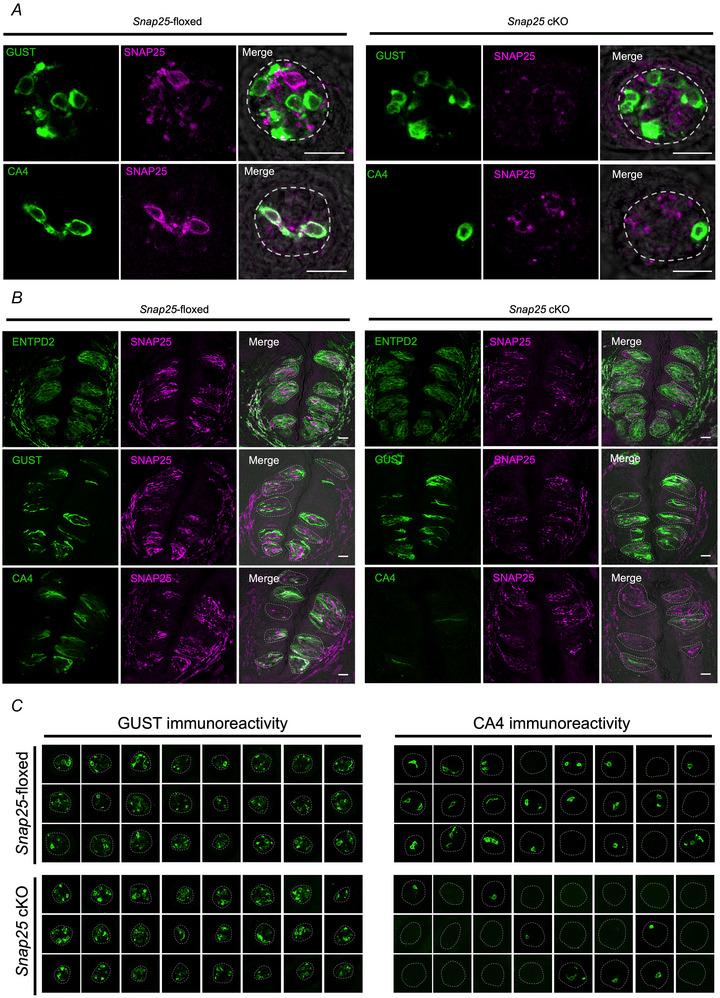
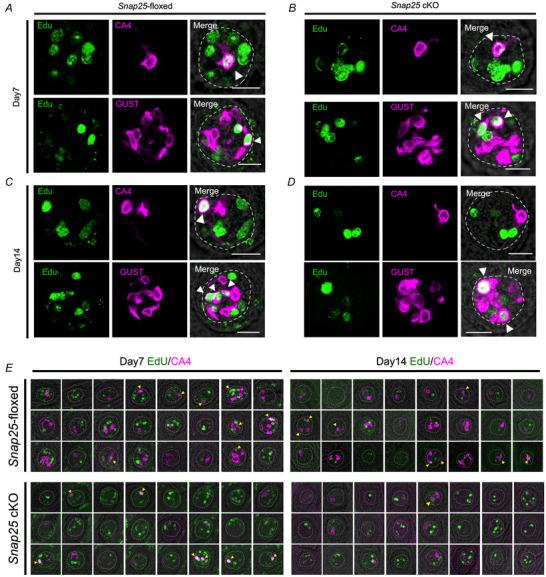
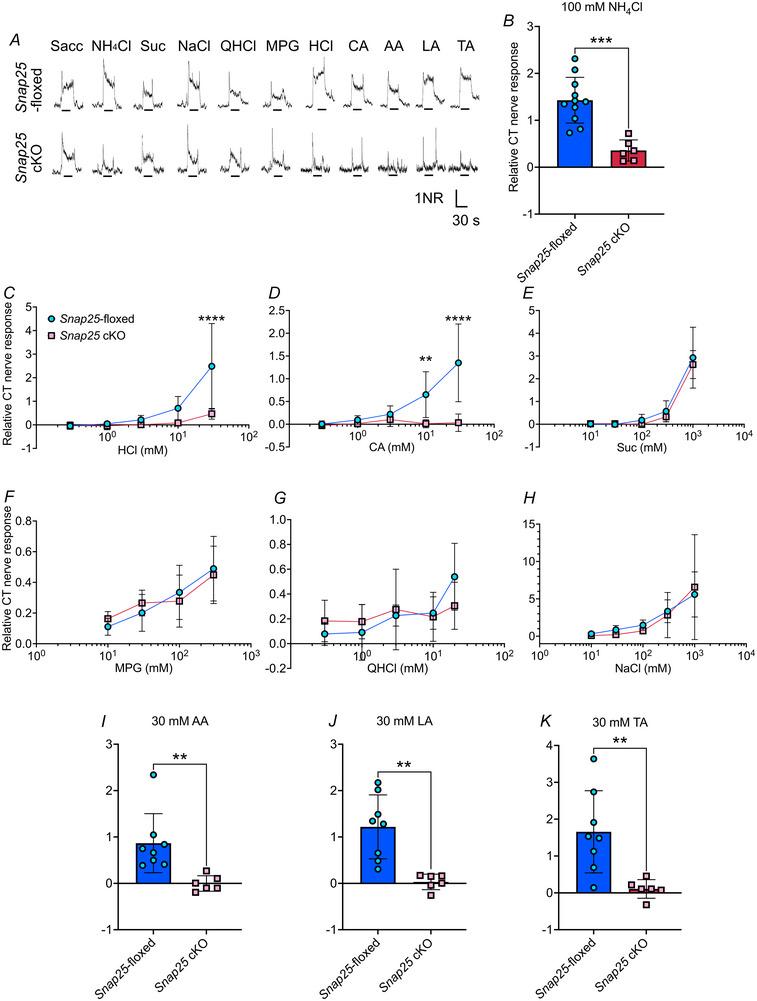
Type III cells in mouse taste buds are considered to transmit aversive stimuli, such as sourness, to the gustatory nerve through vesicular synapses. Synaptosome-associated protein 25 (SNAP25) might contribute to synaptic vesicular release in sour sensation, although direct evidence has been lacking. Here, we demonstrated that epithelia-specific Snap25 conditional knockout (cKO) mice exhibited a significant reduction in the number of type III cells. Notably, the proportion of 5-ethynyl 2'-deoxyuridine-positive post-mitotic type III cells in Snap25 cKO mice was significantly lower on tracing day 14, but not at day 7, which suggests that SNAP25 contributes to the maintenance of type III cells. In a short-term lick test, Snap25 cKO (sour taste absent) and Snap25/ transient receptor potential vanilloid 1 double KO (sour taste and somatosensory absent) mice exhibit a significantly higher lick response to sour tastants, confirming the role of SNAP25 for sour sensation. Electrophysiological recordings of the chorda tympani nerve reveal nearly abolished ammonium and sour taste responses in Snap25 cKO mice, which concludes sour-dependent synapse transmission in type III cells. Overall, these data suggest that vesicular synapses in taste buds are indispensable for transmission of information from, and the replenishment of, sour-sensitive type III taste cells. KEY POINTS: The lack of SNAP25 in sour taste cells (Snap25 conditional knockout) significantly reduces the number of sour taste cells in the fungiform and circumvallate papillae of mice. Snap25/Trpv1 double knockout mice exhibit increased lick responses to sour tastants in the short-term lick test. The chorda tympani nerve of Snap25 conditional knockout mice shows reduced electrophysiological responses to sour tastants. These findings demonstrate that SNAP25 contributes not only to sour taste signal transduction, but also to the maintenance of sour taste cells, underscoring the dual functions of SNAP25 in taste cells.
小鼠味蕾中的III型细胞被认为通过囊泡突触将厌恶刺激(如酸味)传递给味觉神经。尽管一直缺乏直接证据,但突触体相关蛋白25(SNAP25)可能在酸味感觉中有助于突触小泡释放。在这里,我们证明上皮细胞特异性Snap25条件性敲除(cKO)小鼠的III型细胞数量显著减少。值得注意的是,在追踪第14天,Snap25 cKO小鼠中5-乙炔基2'-脱氧尿苷阳性的有丝分裂后III型细胞比例显著降低,但在第7天没有,这表明SNAP25有助于III型细胞的维持。在短期舔舐试验中,Snap25 cKO(无酸味)和Snap25/瞬时受体电位香草酸受体1双敲除(无酸味和躯体感觉)小鼠对酸味剂的舔舐反应显著更高,证实了SNAP25在酸味感觉中的作用。鼓索神经的电生理记录显示,Snap25 cKO小鼠中铵和酸味反应几乎完全消失,这证明了III型细胞中酸味依赖的突触传递。总体而言,这些数据表明味蕾中的囊泡突触对于酸味敏感的III型味觉细胞的信息传递和补充是不可或缺的。要点:酸味细胞中缺乏SNAP25(Snap25条件性敲除)会显著减少小鼠菌状乳头和轮廓乳头中酸味细胞的数量。Snap25/Trpv1双敲除小鼠在短期舔舐试验中对酸味剂的舔舐反应增加。Snap25条件性敲除小鼠的鼓索神经对酸味剂的电生理反应降低。这些发现表明,SNAP25不仅有助于酸味信号转导,还有助于酸味细胞的维持,突出了SNAP25在味觉细胞中的双重功能。



 Zotero 插件